
GRB 221009A offered a unique chance to study black hole formation and X-ray polarization, marking a rare astrophysical milestone.
NASA’s Fermi Gamma-ray Space Telescope and Neil Gehrels Swift Observatory detected a high-energy blast of light from deep space on October 9, 2022. The light came from a powerful explosion called a gamma-ray burst dubbed GRB 221009A which ranks among the most luminous known. Around the world, astronomers quickly trained their telescopes on the aftermath.
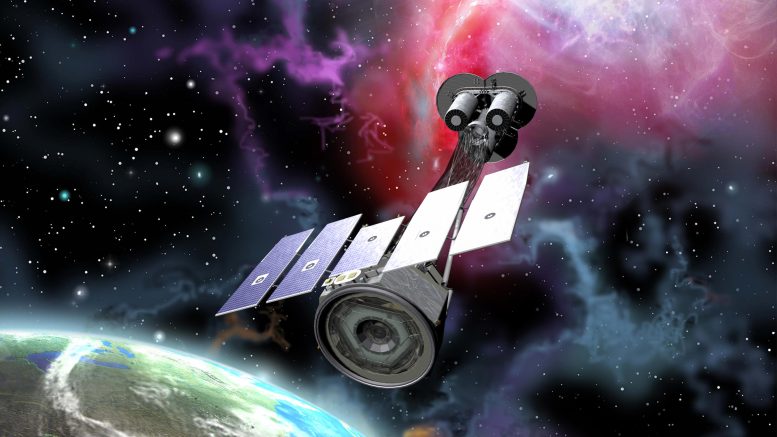
Michela Negro, a postdoctoral research assistant at the University of Maryland Baltimore County and NASA’s Goddard Space Flight Center in Greenbelt, Maryland, could not have been in a better place. She was attending the 10th Fermi Symposium, a gathering of gamma-ray astronomers, in Johannesburg, South Africa. She grabbed two colleagues and started doing the math to see if it might be possible to catch polarized X-rays with the Imaging X-ray Polarimetry Explorer (IXPE).
An Unexpected Opportunity for IXPE
Gamma-ray bursts (GRBs) are unpredictable and fleeting. The IXPE science team had not planned to observe one, but this burst created a unique opportunity. And a quick turnaround was essential.
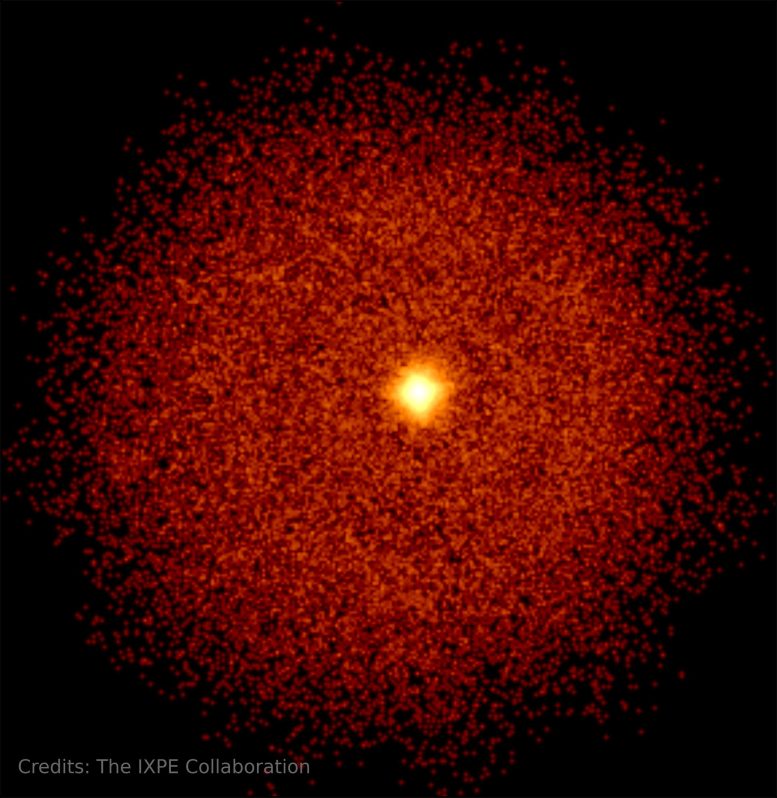
“We got some promising numbers, so we submitted a target of opportunity request,” said Negro, who led IXPE observation of the burst. This process allows the team to interrupt its long-term plan to retarget for high-interest, time-critical sources.
“In the request, you have to justify why you want to point the telescope that way and why so quickly,” Negro continued, “so we just said, ‘This is now or never.’”
For space-based telescopes like IXPE, observing an unplanned target is not as simple as it might sound. It takes a lot of coordination between the IXPE science operations team at NASA’s Marshall Space Flight Center in Alabama, the mission operations manager at Ball Aerospace in Colorado, and the mission operations team at the University of Colorado Boulder’s Laboratory for Atmospheric and Space Physics.
“From the time we got the request until we were observing the target was roughly 36 hours,” said Amy Walden, IXPE’s project manager at Marshall. “The team really did an amazing job. They recognized the incredible opportunity this was, so everyone was working as quickly as they could.”
Stephen Lesage also dropped everything when he learned about the event. Lesage is a graduate research assistant at the University of Alabama in Huntsville and Fermi Gamma-ray Burst Monitor (GBM) team member.
“I was in Atlanta for a Major League Soccer game, but my phone was constantly vibrating with notifications, so I knew it was something big,” Lesage said. “I went back to my hotel room and sat at the desk in the corner until 3 a.m. working on it. But even when the work was done, I couldn’t sleep, I was too excited.”
Unveiling the Origins of GRB 221009A
The signal, originating from the direction of the constellation Sagitta, had traveled an estimated 1.9 billion light years to reach Earth. Astronomers think it could be the birth cry of a new black hole, one that formed in the heart of a massive star collapsing under its own gravity. In these circumstances, a nascent black hole drives powerful jets of particles traveling near the speed of light. The jets pierce through the star, emitting X-rays and gamma rays as they stream into space.
The light from this ancient explosion brings with it new insights into stellar collapse, the birth of a black hole, the behavior and interaction of matter near the speed of light, the conditions in a distant galaxy, and much more. Another GRB this bright may not appear for decades.
“I believe that an event like this won’t happen again in my lifetime,” Negro said.
“It was at least 10 times brighter than the previous record-holder, GRB 130427A,” said GBM Principal Investigator Colleen Wilson-Hodge at Marshall. She also noted that scientists observed an unusually bright and long-lasting afterglow from the burst.
Scientists are still analyzing this data and forming conclusions about what the observations mean. For Walden, it was exciting to see IXPE play a role.
“That’s what IXPE is for: we’re uniquely qualified to search for X-ray polarization,” she said. “GRB 221009A was likely the only chance in our mission lifetime to view one.”
IXPE is a partnership between NASA and the Italian Space Agency.
Never miss a breakthrough: Join the SciTechDaily newsletter.
Follow us on Google and Google News.