
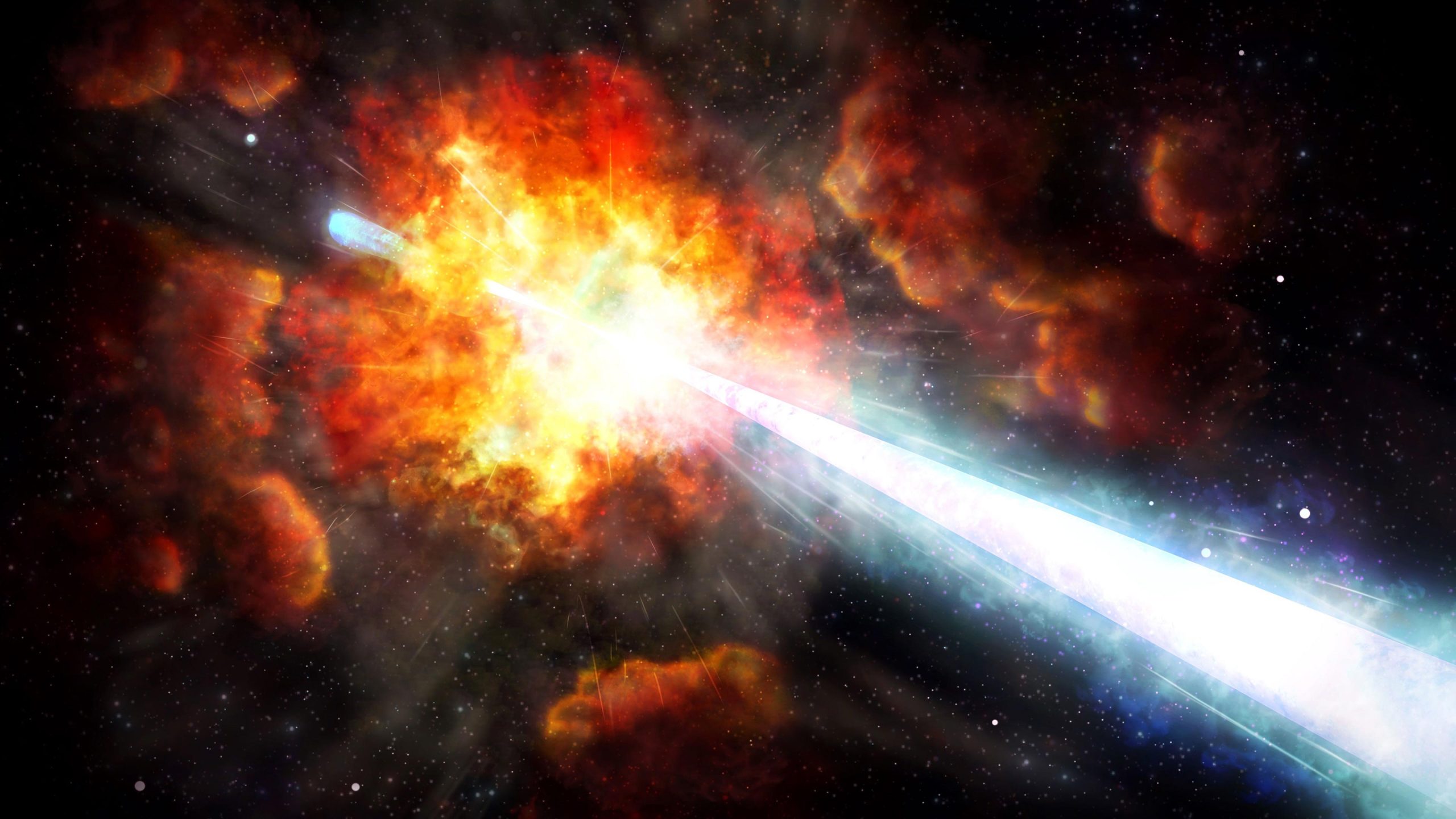
Gamma-ray bursts are the most energetic explosions in the Universe, marking the end of a star’s life. A particularly bright burst, GRB 221009, was recently detected by several space telescopes. A team of scientists led by astronomers at the Cosmic Dawn Center measured the exact distance to the burst, allowing them to calculate the total energy released: During its duration of just five minutes, it released 1,000 times more energy than our Sun has emitted throughout its 4.5 billion year life, making the burst the single most energetic ever detected.
Gamma-ray bursts are the most energetic and luminous events known to occur in the Universe. Short-lived flashes of gamma-rays that typically last from a tenth of a second to less than an hour, gamma-ray bursts may for a brief period of time outshine entire galaxies. The explosions are believed to be caused by the collapse of massive stars, the collision of neutron stars, or the merging of a neutron star and a black hole.
Although we have known about their existence for 60 years, there is still much to learn about these fascinating events. Not only are they transient and occur at random locations in the sky; gamma rays are also mostly absorbed by our atmosphere impeding their detection from Earth.
To detect them, scientists, therefore, use space-based gamma-ray telescopes that, when triggered, send automatic instant messages to Earth. This allows astronomers to follow up the detections with Earth-based telescopes, to look for a less energetic “afterglow” that often follows the gamma rays.
Outshining an Entire Galaxy
On 9 October 2022, ESA’s INTEGRAL, NASA’s Swift and Fermi satellites, and other space observatories detected the gamma-ray burst which was, accordingly, named GRB 221009A. This led Daniele Bjørn Malesani, astronomer at Radboud University in the Netherlands and affiliated scientist at the Cosmic Dawn Center, to point the Very Large Telescope (VLT) in Chile toward the direction of GRB 221009A.
Using the X-shooter spectrograph mounted at the VLT, the resulting spectrum allowed Malesani and his team to measure the exact distance to GRB 221009A. Although the host galaxy of the burst turned out to lie more than two billion lightyears away, this actually makes it one of the most nearby bursts. Moreover, with a secure distance the team was also able to calculate the total amount of energy released from the burst.
The enigmatic gamma-ray bursts
Gamma-ray bursts were first discovered in 1967 by the Vela satellite, built to monitor the sky for possible tests of nuclear weapons, which would be a violation of the 1963 Nuclear Test Ban Treaty. First thought to originate from nearby sources within our own galaxy, more sensitive space observatories revealed, in the 1990’s, that they must come from far outside the Milky Way, distributed over the whole Universe.
The transient nature of the bursts made them difficult to study, but since the late 1990’s astronomers have been able to detect also their less energetic afterglow, from X-rays to optical light, to the infrared, helping to establish a theory of their origin.
“Gamma-ray bursts are always energetic, but this one was absolutely astonishing: During the 290 seconds that it lasted, GRB 221009A released roughly 1,000 times as much energy as our Sun has emitted during all of its lifetime of 4.5 billion years,” says Malesani.
Another way to put it is that the burst for a brief period of time was more luminous that the combined light of all the hundreds of billions of stars in the Milky Way.
As is normal, this calculation assumes that GRB 221009A has emitted the same amount of energy in all directions. More likely though, the energy in “concentrated” in a narrow beam, in the direction of which we happen to lie. The total energy is therefore somewhat smaller, although still extremely high.
And in any rate, it is the most energetic gamma-ray burst ever detected, 70 times brighter than ever seen before. It was even reported to affect the Earth’s ionosphere.
“Theoretically, we would expect such a powerful event to happen only once in 10,000 years,” explains Malesani. “This makes us wonder if our detection is just sheer luck, of if there’s something we’re misunderstanding about the nature of gamma-ray bursts.”
Followed up with James Webb
GRB 221009A was also followed up at longer wavelengths with the James Webb Space Telescope. These observations were led by Andrew Levan, also at Radboud University, although Malesani and other DAWNers also were a part of the team.
These observations allowed the astronomers to further characterize the gamma-ray burst. The James Webb telescope was particularly useful because the burst happens to lie, by an unlucky chance, behind a thick layer of cosmic dust inside the Milky Way galaxy. This has nothing to do with the burst itself, but makes it harder to interpret the results, as it dims the light from the burst. Webb looked at the afterglow in the mid infrared, which is much less affected by dust, offering a better view of the event.
But Even Webb Has Shortcomings
Kasper Heintz, assistant professor at the Cosmic Dawn Center, participated in both studies. He explains: “Gamma-ray bursts like GRB 221009A are expected to explode together with a supernova whose light should ‘add’ to the burst itself. But for this burst, despite Webb’s huge mirror it couldn’t find convincing evidence for a bright supernova.”
So, was the supernova just fainter than normal, or was it missing altogether? The jury is still out, and there are more surprises to come from this once-in-a-lifetime mysterious event.
The articles have just been accepted for publication in, respectively, Astronomy & Astrophysics and Astrophysical Journal Letters.
For more on these discoveries:
- Incredible 1-in-10,000-Year Gamma-Ray Burst
- Solar System Hit by Pulse of Intense Radiation – 1-in-10,000-Year Gamma-Ray Burst
- Unprecedented Gamma-Ray Burst Illuminates the Universe
References:
“The brightest GRB ever detected: GRB 221009A as a highly luminous event at z = 0.151” by D. B. Malesani, A. J. Levan, L. Izzo, A. de Ugarte Postigo, G. Ghirlanda, K. E. Heintz, D. A. Kann, G. P. Lamb, J. Palmerio, O. S. Salafia, R. Salvaterra, N. R. Tanvir, J. F. Agüí Fernández, S. Campana, A. A. Chrimes, P. D’Avanzo, V. D’Elia, M. Della Valle, M. De Pasquale, J. P. U. Fynbo, N. Gaspari, B. P. Gompertz, D. H. Hartmann, J. Hjorth, P. Jakobsson, E. Palazzi, E. Pian, G. Pugliese, M. E. Ravasio, A. Rossi, A. Saccardi, P. Schady, B. Schneider, J. Sollerman, R. L. C. Starling, C. C. Thöne, A. J. van der Horst, S. D. Vergani, D. Watson, K. Wiersema, D. Xu and T. Zafar, Accepted, Astronomy & Astrophysics.
DOI: 10.48550/arXiv.2302.07891
“The First JWST Spectrum of a GRB Afterglow: No Bright Supernova in Observations of the Brightest GRB of all Time, GRB 221009A” by A. J. Levan, G. P. Lamb, B. Schneider, J. Hjorth, T. Zafar, A. de Ugarte Postigo, B. Sargent, S. E. Mullally, L. Izzo, P. D’Avanzo, E. Burns, J. F. Agüí Fernández, T. Barclay, M. G. Bernardini, K. Bhirombhakdi, M. Bremer, R. Brivio, S. Campana, A. A. Chrimes, V. D’Elia, M. Della Valle, M. De Pasquale, M. Ferro, W. Fong, A. S. Fruchter, J. P. U. Fynbo, N. Gaspari, B. P. Gompertz, D. H. Hartmann, C. L. Hedges, K. E. Heintz, K. Hotokezaka, P. Jakobsson, D. A. Kann, J. A. Kennea, T. Laskar, E. Le Floc’h, D. B. Malesani, A. Melandri, B. D. Metzger, S. R. Oates, E. Pian, S. Piranomonte, G. Pugliese, J. L. Racusin, J. C. Rastinejad, M. E. Ravasio, A. Rossi, A. Saccardi, R. Salvaterra, B. Sbarufatti, R. L. C. Starling, N. R. Tanvir, C. C. Thöne, A. J. van der Horst, S. D. Vergani, D. Watson, K. Wiersema, R. A. M. J. Wijers and Dong Xu, 28 March 2023, The Astrophysical Journal Letters.
DOI: 10.3847/2041-8213/acc2c1
Never miss a breakthrough: Join the SciTechDaily newsletter.
Follow us on Google and Google News.
5 Comments
There is a theory about two or more universes (bubbles as it were) occasionally bumping into each other and creating a mass explosion and depending on how strong the collision is, perhaps even being a plausible alternate explanation to the Big Bang theory itself as “parts” of the Universe experience a massive energy release, eventually creating new galaxies and renewing the Universe piece-meal instead of an entire collapse/release as the Big Bang theory might imply (or happening once and going on forever until everything burns out, which doesn’t sound very cyclical for “eternity” (a cause but an end anyway?).
The problem is that most cosmologists are unwilling to even consider other theories because they’re so certain the Big Bang is correct. So when events like this (or the Webb telescope revealing massive “early” galaxies) contradicts what is expected, they are then forced to do the Dark Energy/Matter “math” thing and INVENT some even more fantastical or ridiculous explanation rather than simply consider a mistake (e.g. Red Shift assumptions about space being “empty”) was made in the past.
So it’s always amusing to see these articles about incredible things they can’t explain until someone invents something to explain it and that takes off (Dark ‘Explosions’ anyone?)
Sure, let’s throw s*** at a wall and see which ones stick. Your woo-woo magic bubbles don’t explain anything. Only thing I get from your post is that you are desperately grabbing at anything to rescue you from big bang theory. Are you really that afraid of your mortality?
Thanks for the observation of this new type of unique phenomena like GRB 221009 matching to milky way.
The galaxy that originates GRB 221009A has established a unique relationship with the milky way with this phenomena.
Does stupidity hurt? I guess not. Otherwise you will be screaming in agony.