

Researchers found that mutant mtDNA buildup in eggs leads to mitochondrial disease transmission, suggesting new prevention strategies
A research article published in the journal Science Advances describes a mechanism that helps explain how certain kinds of genetic disorders known as mitochondrial diseases are transmitted from mother to child. The study it reports could serve as the basis for novel strategies to ensure that future generations are not affected by such diseases. Existing treatments are palliative, aimed at improving quality of life for the patient or delaying progression of the disease.
The Role of Mitochondria and mtDNA Mutations
Mitochondria are organelles that generate most of the chemical energy needed by cells. Mitochondrial DNA (mtDNA) contains 16,569 nucleotides subject to mutation. Some of these mutations can lead to the development of mitochondrial diseases.
Whereas nuclear DNA (the famous double helix, which encodes most of the genome) is inherited from both parents, mtDNA is inherited solely from the mother.
At birth, a female infant’s ovaries already contain all the eggs she will ever have. During the reproductive cycles that begin at puberty, some of these immature eggs develop under the influence of hormones, leading to ovulation and potentially to fertilization.
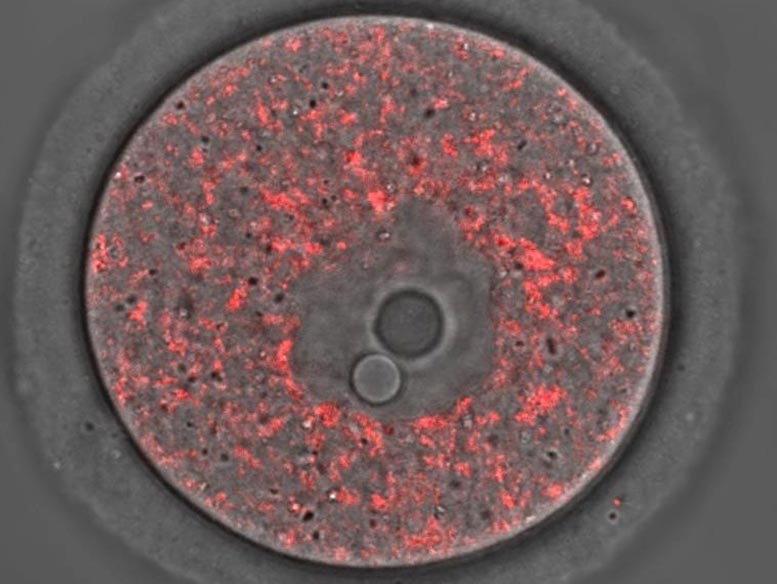
The study shows for the first time that mutant mtDNA builds up in the final stages of egg formation. The researchers conducted experiments in mice, reporting that the proportion of mutant molecules increased as the eggs matured, that these mutants can impair the functioning of mitochondria, and that they are responsible for the development of disease.
At most 90% of the mtDNA was subject to mutation, the researchers discovered. The existence of an upper limit is important to an understanding of how mutant mtDNA is transmitted and can cause disease.
Mechanisms of Mutant mtDNA Transmission
When mutant and wild-type mtDNA coexist in a cell (heteroplasmy), the effects of mutant mtDNA may be masked, facilitating transmission to offspring. “Until now, no one knew if this buildup occurred, but our study proved it does. Now that we understand where and how it occurs, it’s possible to work out ways of avoiding it,” said Marcos Roberto Chiaratti, a professor in the Department of Genetics and Evolution at the Federal University of São Carlos (UFSCar) in the state of São Paulo, Brazil.
Chiaratti and graduate student Carolina Habermann Macabelli are among the authors of the article. The study was supported by FAPESP via two projects (17/04372-0 and 16/07868-4).
Chiaratti also received a Newton Advanced Fellowship from the UK’s Academy of Medical Sciences. He collaborates with the group led by Patrick Francis Chinnery, last author of the article. Chinnery is Professor of Neurology at the University of Cambridge, and Wellcome Trust Principal Research Fellow for its MRC Mitochondrial Biology Unit.
“The most effective treatment entails identifying the mutation in the mother in order to prevent inheritance by the children. This is the context for our research, which aims to verify which mutations are transmitted and analyze the mechanism involved. The study of mitochondrial disease in Brazil is still very incipient,” Chiaratti said.
Symptoms and Prevalence of Mitochondrial Disease
The symptoms of mitochondrial disease vary according to the mutation, the number of damaged cells, and the tissue affected. The most common include weak muscles, loss of motor coordination, cognitive impairment, brain degeneration, and kidney or heart failure.
Such hereditary metabolic diseases can appear at any age, but the earlier the mutation manifests itself, the more likely it is to lead to severe symptoms and even death. Diagnosis is difficult, typically requiring genetic and molecular testing, and statistics on prevalence are therefore deficient.
According to estimates, diseases caused by mtDNA mutations affect at least one in every 5,000 people worldwide. However, the frequency of pathogenic mtDNA mutations is about one in 200. The mutation m.3243A>G, which causes MELAS syndrome (Mitochondrial Encephalopathy, Lactic Acidosis, and Stroke-like episodes), occurs in some 80% of adults with pathogenic heteroplasmic mutations.
The researchers studied genetically modified mice with two types of mitochondrial genome: the wild type, which does not cause disease, and the pathogenic mutation m.5024C>T, similar to m.5650G>A, a pathogenic mutation present in humans.
Analysis of 1,167 mother-pup pairs detected a strong tendency for females with low levels of m.5024C>T to transmit higher levels of the mutation to their offspring. In females with high levels of the mutation, however, the opposite tendency was detected, pointing to purifying selection against high levels of the mutation (over 90%).
Analysis of Heteroplasmy and Positive Selection
Analysis of mouse oocytes (immature eggs) at different stages of development showed rising levels of m.5024C>T over wild-type mtDNA. This suggests mutant mtDNA is preferentially replicated during oocyte maturation, regardless of the cellular cycle, as eggs do not undergo cell division until ovulation.
The researchers tested several mathematical models, and the one that best explained the phenomenon pointed to a replicative advantage favoring mutant mtDNA and purifying selection that prevents the mutation from reaching high levels.
They first measured heteroplasmy in 42 females and 1,167 descendants. Next, they measured levels of mutant mtDNA in eggs at different stages of development and compared them with levels of mutation in different organs at different ages.
They found evidence that the results applied to mice bearing another pathogenic mutation (m.3875delC tRNA) and to humans, as indicated by analysis of 236 mother-child pairs. This pointed to positive selection when the mutation was transmitted from mothers with low heteroplasmy levels and purifying selection against high heteroplasmy levels (over 90%). They concluded that positive selection resulted from a preference for replication of the mutant over the wild-type molecule.
“This preferential replication enabled the level of mutation to reach the 90% ceiling, above which the negative effect of mutations is too great and other mechanisms appear to act on the egg to prevent them from reaching 100%,” Chiaratti said.
He plans to travel to the UK soon to conduct new experiments. A possible next step would be to proceed to the pharmacological treatment stage with the aim of combating levels of mtDNA mutation so as to prevent transmission of disease. “Once we understand how the buildup in mutations leading to mitochondrial disease occurs during the final stage of egg formation, we’re in a position to produce eggs in vitro and manipulate them, pharmacologically as well as genetically, in order to reduce mutation levels, lowering the probability that a child will develop the disease,” he said.
Reference: “Mitochondrial DNA heteroplasmy is modulated during oocyte development propagating mutation transmission” by Haixin Zhang, Marco Esposito, Mikael G. Pezet, Juvid Aryaman, Wei Wei, Florian Klimm, Claudia Calabrese, Stephen P. Burr, Carolina H. Macabelli, Carlo Viscomi, Mitinori Saitou, Marcos R. Chiaratti, James B. Stewart, Nick Jones and Patrick F. Chinnery, 8 December 2021, Science Advances.
DOI: 10.1126/sciadv.abi5657
Never miss a breakthrough: Join the SciTechDaily newsletter.
Follow us on Google and Google News.