
Researchers discovered rapid ice loss in the West Antarctic Ice Sheet 8,000 years ago, signaling potential future risks under global warming.
Researchers from the University of Cambridge and the British Antarctic Survey have uncovered the first direct evidence that the West Antarctic Ice Sheet shrunk suddenly and dramatically at the end of the Last Ice Age, around eight thousand years ago.
The evidence, contained within an ice core, shows that in one location the ice sheet thinned by 450 meters — that’s more than the height of the Empire State Building — in just under 200 years.
Implications for Future Climate Change
This is the first evidence anywhere in Antarctica for such a fast loss of ice. Scientists are worried that today’s rising temperatures might destabilize parts of the West Antarctic Ice Sheet in the future, potentially passing a tipping point and inducing a runaway collapse. The new study, published today (February 8) in Nature Geoscience, sheds light on how quickly Antarctic ice could melt if temperatures continue to soar.
“We now have direct evidence that this ice sheet suffered rapid ice loss in the past,” said Professor Eric Wolff, senior author of the new study from Cambridge’s Department of Earth Sciences. “This scenario isn’t something that exists only in our model predictions and it could happen again if parts of this ice sheet become unstable.”
The Antarctic ice sheets, from west to east, contain enough freshwater to raise global sea levels by around 57 meters. The West Antarctic Ice Sheet is considered particularly vulnerable because much of it sits on bedrock that lies below sea level.
Model predictions suggest that a large part of the West Antarctic Ice Sheet could disappear in the next few centuries, causing sea levels to rise. Exactly when and how quickly the ice could be lost is, however, uncertain.
Historical Context and Modern Relevance
One way to train ice sheet models to make better predictions is to feed them with data on ice loss from periods of warming in Earth’s history. At the peak of Last Ice Age 20,000 years ago, Antarctic ice covered a larger area than today. As our planet thawed and temperatures slowly climbed, the West Antarctic Ice Sheet contracted to more or less its current extent.
“We wanted to know what happened to the West Antarctic Ice Sheet at the end of the Last Ice Age, when temperatures on Earth were rising, albeit at a slower rate than current anthropogenic warming,” said Dr. Isobel Rowell, study co-author from the British Antarctic Survey. “Using ice cores we can go back to that time and estimate the ice sheet’s thickness and extent.”
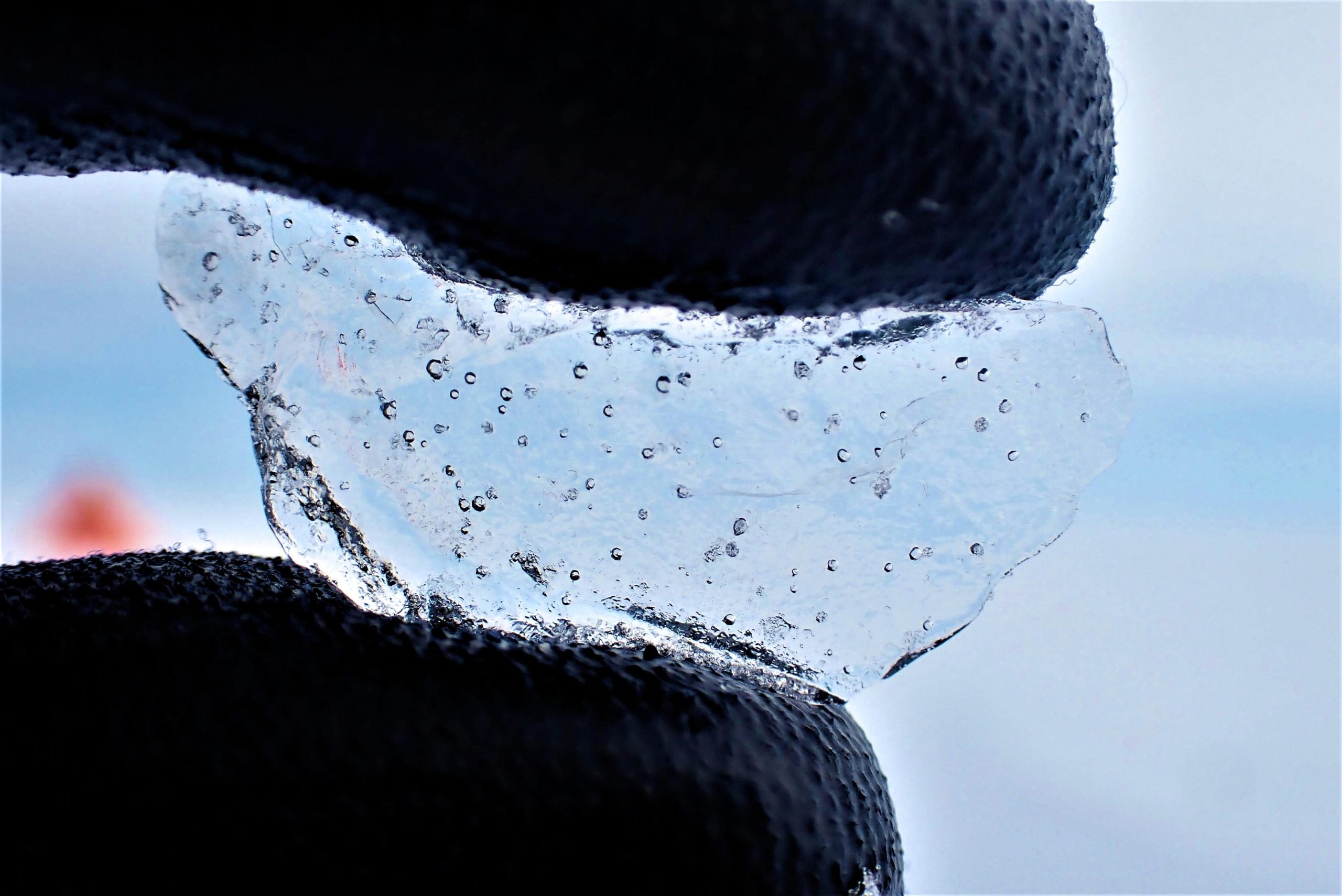
Ice cores are made up of layers of ice that formed as snow fell and was then buried and compacted into ice crystals over thousands of years. Trapped within each ice layer are bubbles of ancient air and contaminants that mixed with each year’s snowfall — providing clues as to the changing climate and ice extent.
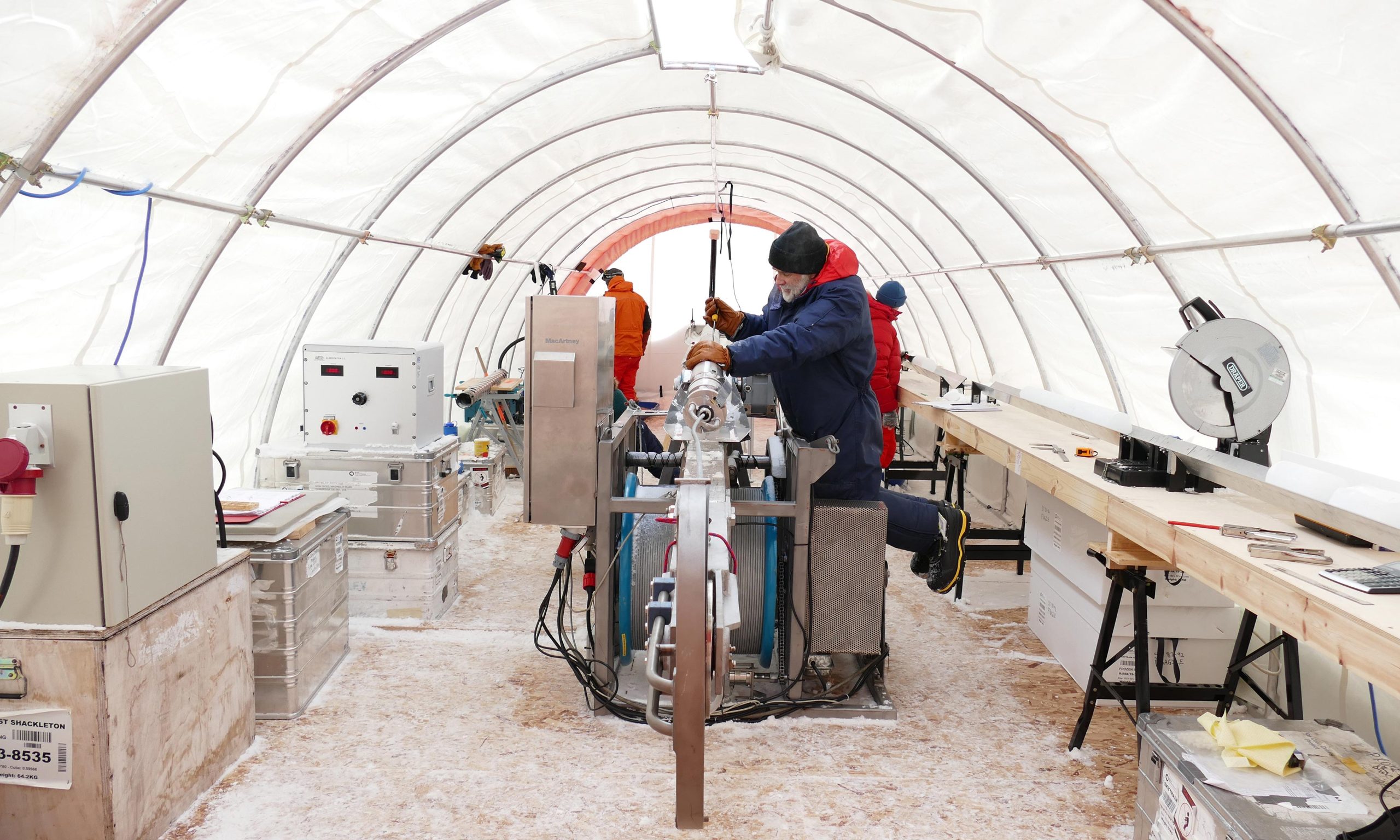
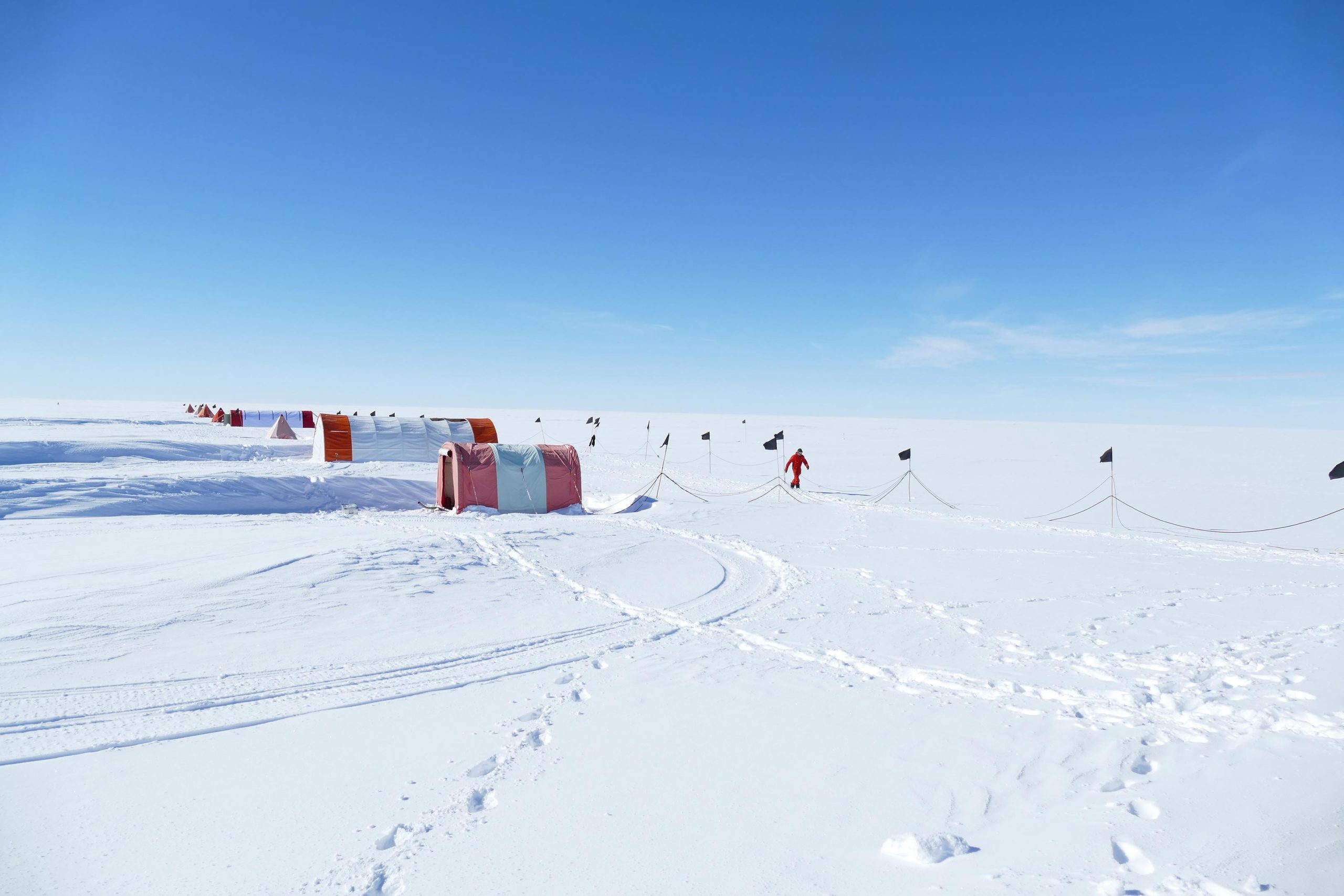
The researchers drilled a 651-metre-long ice core from Skytrain Ice Rise in 2019. This mound of ice sits at the edge of the ice sheet, near the point where grounded ice flows into the floating Ronne Ice Shelf.
After transporting the ice cores back to Cambridge at -20oC, the researchers analyzed them to reconstruct the ice thickness. First, they measured stable water isotopes, which indicate the temperature at the time the snow fell. Temperature decreases at higher altitudes (think of cold mountain air), so they were able to equate warmer temperatures with lower-lying, thinner ice.
They also measured the pressure of air bubbles trapped in the ice. Like temperature, air pressure also varies systematically with elevation. Lower-lying, thinner ice contains higher-pressure air bubbles.
These measurements told them that ice thinned rapidly 8,000 years ago. “Once the ice thinned, it shrunk really fast,” said Wolff, “this was clearly a tipping point — a runaway process.”
They think this thinning was probably triggered by warm water getting underneath the edge of the West Antarctic Ice Sheet, which normally sits on bedrock. This likely untethered a section of the ice from bedrock, allowing it to float suddenly and forming what is now the Ronne Ice Shelf. This then allowed neighboring Skytrain Ice Rise, no longer restrained by grounded ice, to thin rapidly.
The researchers also found that the sodium content of the ice (originating from salt in sea spray) increased about 300 years after the ice thinned. This told them that, after the ice thinned, the ice shelf shrunk back so that the sea was hundreds of kilometers nearer to their site.
“We already knew from models that the ice thinned at around this time, but the date of this was uncertain,” said Rowell. Ice sheet models placed the retreat anywhere between 12,000 and 5,000 years ago and couldn’t say how quickly it happened. “We now have a very precisely dated observation of that retreat which can be built into improved models,” said Rowell.
Although the West Antarctic Ice Sheet retreated quickly 8,000 years ago, it stabilized when it reached roughly its current extent. “It’s now crucial to find out whether extra warmth could destabilize the ice and cause it to start retreating again,” said Wolff.
Reference: “Abrupt Holocene ice loss due to thinning and ungrounding in the Weddell Sea Embayment” by Mackenzie M. Grieman, Christoph Nehrbass-Ahles, Helene M. Hoffmann, Thomas K. Bauska, Amy C. F. King, Robert Mulvaney, Rachael H. Rhodes, Isobel F. Rowell, Elizabeth R. Thomas and Eric W. Wolff, 8 February 2024, Nature Geoscience.
DOI: 10.1038/s41561-024-01375-8
Never miss a breakthrough: Join the SciTechDaily newsletter.
Follow us on Google and Google News.
3 Comments
“The West Antarctic Ice Sheet is considered particularly vulnerable because much of it sits on bedrock that lies below sea level.”
It is also a region known for having a higher geothermal gradient, and possible vulcanism, than East Antarctica.
“They think this thinning was probably triggered by warm water getting underneath the edge of the West Antarctic Ice Sheet, which normally sits on bedrock.”
Or, the warm water was meltwater generated in-place by a pulse of heat from the mantle. They need to expand their vision and consider alternative working hypotheses before settling on one that supports the current paradigm of “CO2 Bad!”
Salt content from sea spray is one of their measurements. This would be accurate if air current velocities remained constant throughout the ice age growth and receding processes. Weather patterns are clearly subject to many geological factors and change accordingly. How accurate can the salt content measurements be?
Drake’s Passage is renowned for the ferocious storms and giant waves. So, even today, the “air current velocities” are not constant. The real question is, “What do the salt content measurements mean?”