

Researchers say the isolated white dwarfs Gandalf and Moon-Sized define a new class of stellar remnant because they share five traits, including X-ray emission.
Across the immense scale of the Universe, a single unusual object can prompt astronomers to look for others like it, sometimes leading to the recognition of an entirely new class of stars.
In a paper published in Astronomy & Astrophysics and an arXiv preprint, researchers at the Institute of Science and Technology Austria (ISTA) describe two stellar remnants that share five traits, including X-ray emission, even though both appear to be isolated. The team argues that these two objects are enough to establish a new class of stellar remnants.
Our Sun is expected to become a white dwarf in about five to eight billion years. A white dwarf is an extremely dense stellar remnant, roughly the size of Earth, left behind after a star has used up its fuel and shed its outer layers.
Although the Sun is alone, research over the last 15 years has shown that binary and multiple-star systems are much more common than astronomers previously realized. When a compact, dense remnant such as a white dwarf is part of a binary system, it can often pull material away from its companion star. This process, called accretion, typically produces X-rays that are treated as a signature signal.

Scientists in the group of Ilaria Caiazzo, assistant professor at the Institute of Science and Technology Austria (ISTA), have now confirmed X-ray signals from two isolated objects known as Gandalf and Moon-Sized. Both are highly magnetic, spin rapidly, and are classified as “merger remnants” because each formed after a violent cosmic collision. Since they emit X-rays without a companion star, the two objects now appear to define a class of their own.
Gandalf—the Lord of the Half Rings?
Gandalf is not a completely new object. Caiazzo first observed it during her postdoctoral research and flagged it as unusual because some of its signals suggested material might be present around it.
“We initially thought it was a binary system,” says Andrei Cristea, a PhD student in the Caiazzo group and first author of the paper published in Astronomy & Astrophysics, about Gandalf. “At the remnant’s extremely high level of magnetism, its spin should be synchronized with its companion’s orbit, similarly to Earth’s rotation with the Moon’s orbit,” he adds. However, the fastest orbit period observed to date is 80 minutes. Gandalf, on the other hand, rotates on its axis every six minutes. According to Cristea, this is but one of its puzzling features.
“If Gandalf were involved in a binary system, it would have been highly unsynchronized, which might have made it even more puzzling than it already is. But we never found a companion. So, where does the circumstellar material come from?”
To investigate that puzzle, the team turned to optical emission spectra, a commonly used observational method in astronomy.
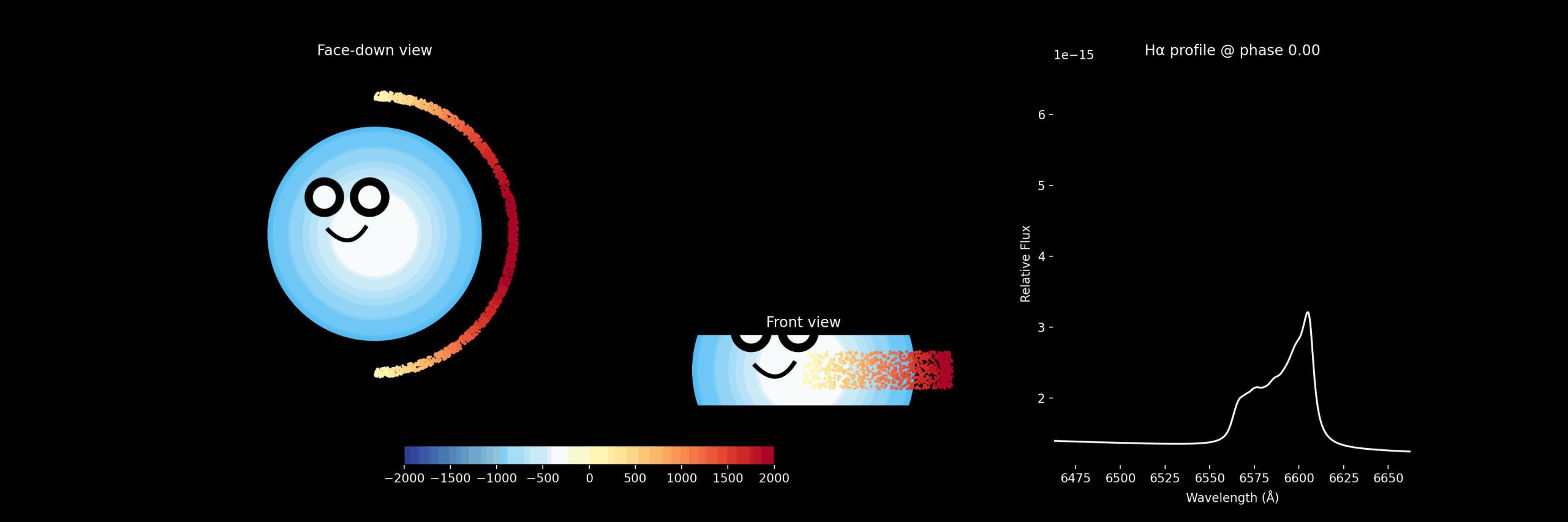
For the surrounding material to be trapped in a half-ring configuration, the object must have a strong and asymmetric magnetic field, the ISTA scientists argue. Credit: Russell C. J. Kightley
“We saw hydrogen emission spectra that exhibited a double-peaked signature, similar to cat ears,” says Cristea. “Usually, this signature indicates the presence of a disk of material surrounding a merger remnant. However, by examining the signal more closely, we realized that it was alternating between the two peaks over the remnant’s six-minute spin period.” This curious observation matched the existence of a half-ring of material circling the star. “We have never seen anything like that before in any white dwarf,” he adds.
The researchers concluded that if material around the merger remnant is being held in an uneven half ring, the object must have a strong magnetic field that is also asymmetric.
“To note, white dwarfs of similar age and evolutionary stage are typically nonmagnetic,” says Cristea. “While highly magnetic white dwarf remnants are already an exception, Gandalf is now one of only two known merger remnants to feature asymmetric magnetization.” These unusual traits led Cristea to name the object after the riddle-loving character from J.R.R. Tolkien’s novels.
Moon-Sized—Gandalf’s more evolved twin?
Although the researchers did not find a companion for Gandalf, they may have found something like a twin elsewhere in the Universe.
Caiazzo published the discovery of a white dwarf called “Moon-Sized” in 2021, and the object already stood out for several unusual reasons. It is extremely magnetic and spins quickly, and it compresses about the mass of the Sun into an object comparable in size to the Moon, or slightly larger, according to new evidence in an arXiv preprint led by Aayush Desai, another PhD student in the Caiazzo group.
The ISTA team found that Moon-Sized and Gandalf have five major traits in common. Both are ultra-massive, highly magnetic, rapidly rotating, companionless, and sources of X-rays. Because of those shared properties, the scientists propose that Gandalf and Moon-Sized are two examples of a new class of remnants.
Still, the objects are not identical. Gandalf shows evidence of surrounding material, while Moon-Sized does not. Gandalf formed in a collision around 60 to 70 million years ago, while Moon-Sized is much older, with its merger event dating to about 500 million years ago. Gandalf also emits X-rays about 100 times more brightly, which may mean that Moon-Sized is an older and more evolved version that is gradually losing whatever powers its X-ray emission.
What are the criteria for defining a new class of stars or remnants?
Astronomers generally agree that nearby objects are more likely to represent a broader population than a rare one off object. Even so, any object with unfamiliar features can motivate a wider search.
Caiazzo explains: “If we find one new object in the vastness of the Universe, what are the chances of it being the only one? Usually, one stellar object with new characteristics is more than enough for us to start looking for similar ones. But here, we actually found two objects with five overlapping features. This is plenty for a new class of star remnants!”
X-rays and the mysteries of stellar evolution
The team has suggested several possible explanations for the observations, especially the origin of the X-rays.
In one possibility, a strongly magnetized star spins fast enough to create a force that pulls material out of the star remnant itself. “This is my favorite scenario because it only accounts for the white dwarf itself rather than material originating from outside the star remnant,” says Desai. The team notes that this outflow process is known from highly magnetized neutron stars called pulsars, but it has not yet been modeled in a white dwarf remnant.
A second possibility involves material flowing inward. In this scenario, a leftover stream from the original merger may not have fully fallen onto the remnant after the collision. If that material travels on a highly eccentric orbit, moving far from the star before returning close to it, it could fall back onto the remnant over hundreds of millions of years.
In a third scenario, the researchers consider another possible source of external inflowing material.
“We know that a third of white dwarfs are ‘polluted,’” says Desai. “They are so dense that we would expect external material, such as asteroids or even disrupted planetary bodies, to collapse onto them.” While Gandalf shows some signs of pollution, possibly through carbon- or silicon-rich materials, the team did not detect such signals from the considerably older Moon-Sized. “This scenario seems less likely, as it does not fully explain why we see the X-rays in both objects right now,” Desai explains.
The team has learned important details about Moon-Sized and Gandalf, but more research will be needed to determine how objects like these may affect their planetary systems.
“The two objects we identified so far have lots of similarities, but also differences,” explains Desai. “Finding more such remnants will help us exclude scenarios and perhaps find other explanations altogether.”
For now, researchers still need to determine whether any one of the five shared traits is essential for membership in this proposed new class.
References:
“A half ring of ionized circumstellar material trapped in the magnetosphere of a white dwarf merger remnant – A new class of white dwarf merger remnants with X-ray emission” by Andrei A. Cristea, Ilaria Caiazzo, Tim Cunningham, John C. Raymond, Stephane Vennes, Adela Kawka, Aayush Desai, David R. Miller, J. J. Hermes, Jim Fuller, Jeremy Heyl, Jan van Roestel, Kevin B. Burdge, Antonio C. Rodriguez, Ingrid Pelisoli, Boris T. Gänsicke, Paula Szkody, Scott J. Kenyon, Zach Vanderbosch, Andrew Drake, Lilia Ferrario, Dayal Wickramasinghe, Viraj R. Karambelkar, Stephen Justham, Ruediger Pakmor, Kareem El-Badry, Thomas Prince, S. R. Kulkarni, Matthew J. Graham, Frank J. Masci, Steven L. Groom, Josiah Purdum, Richard Dekany and Eric C. Bellm, 10 February 2026, Astronomy & Astrophysics.
DOI: 10.1051/0004-6361/202556432
“Magnetic Atmospheres and Circumstellar Interaction in J1901+1458: Revisiting the Most Compact White Dwarf Merger Remnant in the light of new UV and X-ray data” by Aayush Desai, Ilaria Caiazzo, Stephane Vennes, Adela Kawka, Tim Cunningham, Gauri Kotiwale, Andrei A. Cristea, John C. Raymond, Maria Camisassa, Leandro G. Althaus, J. J. Hermes, Iris Traulsen, James Fuller, Jeremy Heyl, Jan van Roestel, Kevin B. Burdge, Antonio C. Rodriguez, Ingrid Pelisoli, Boris T. Gänsicke, Paula Szkody, Sumit K. Maheshwari, Zachary P. Vanderbosch, Andrew Drake, Lilia Ferrario, Dayal Wickramasinghe, Stephen Justham, Ruediger Pakmor, Kareem El-Badry, Thomas Prince, S. R. Kulkarni, Matthew J. Graham, Ben Rusholme, Russ R. Laher, and Josiah Purdum, 3 September 2025, arXiv.
DOI: 10.48550/arXiv.2509.03216
Never miss a breakthrough: Join the SciTechDaily newsletter.
Follow us on Google and Google News.