
Close Menu
    Facebook X (Twitter) Instagram
    SciTechDaily
    • Biology
    • Chemistry
    • Earth
    • Health
    • Physics
    • Science
    • Space
    • Technology
    Facebook X (Twitter) Pinterest YouTube RSS
    SciTechDaily
    Home»Space»Cosmic Geode: Hubble Captures the Birth of a Sun-like Star
    Space

    Cosmic Geode: Hubble Captures the Birth of a Sun-like Star

    By NASA's Goddard Space Flight CenterMay 19, 2024No Comments3 Mins Read
    Facebook Twitter Pinterest Telegram LinkedIn WhatsApp Email Reddit
    Share
    Facebook Twitter LinkedIn Pinterest Telegram Email Reddit
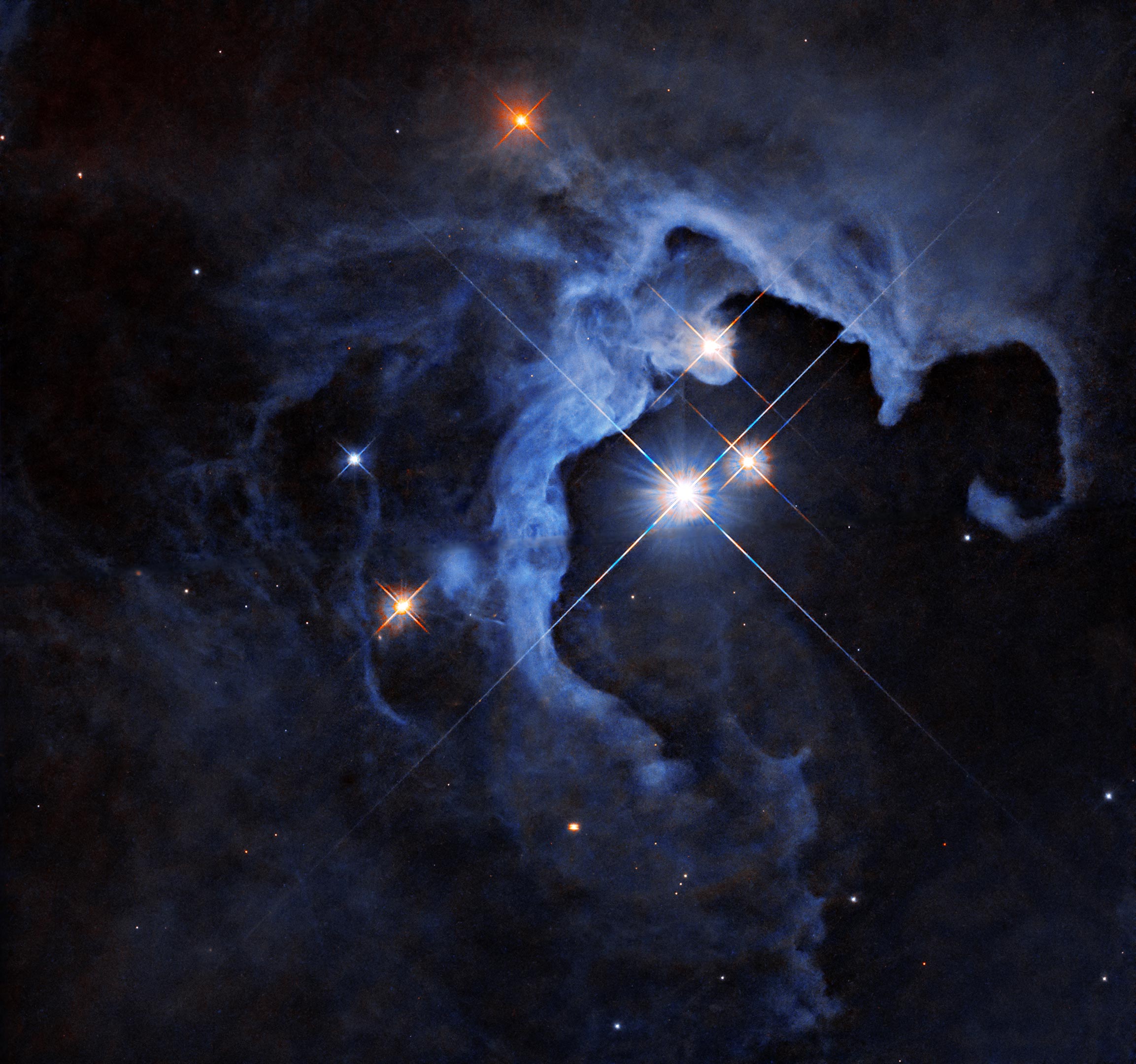
    HP Tau Dawn of a Sun-Like Star
    This NASA Hubble Space Telescope image captures a triple-star star system. Credit: NASA, ESA, G. Duchene (Universite de Grenoble I); Image Processing: Gladys Kober (NASA/Catholic University of America)

    NASA’s Hubble Space Telescope captured a striking image of a trio of stars, including the variable star HP Tau, in a reflection nebula. These young T Tauri stars, not yet undergoing nuclear fusion, are still shrouded in the remnants of the dust and gas clouds from which they formed, highlighting the early stages of star formation and planetary disk development.

    Resembling a glittering cosmic geode, a stunning trio of stars blaze from the hollowed-out cavity of a reflection nebula in this new image captured by NASA’s Hubble Space Telescope. This triple-star system is composed of the variable star HP Tau, HP Tau G2, and HP Tau G3. HP Tau is known as a T Tauri star, a type of young variable star that hasn’t yet started nuclear fusion but is beginning to evolve into a hydrogen-fueled star similar to our Sun.

    T Tauri stars are typically younger than 10 million years old. In comparison, our Sun is around 4.6 billion years old. They are often found still enveloped in the clouds of dust and gas from which they formed.
    HP Tau Hubble Space Telescope
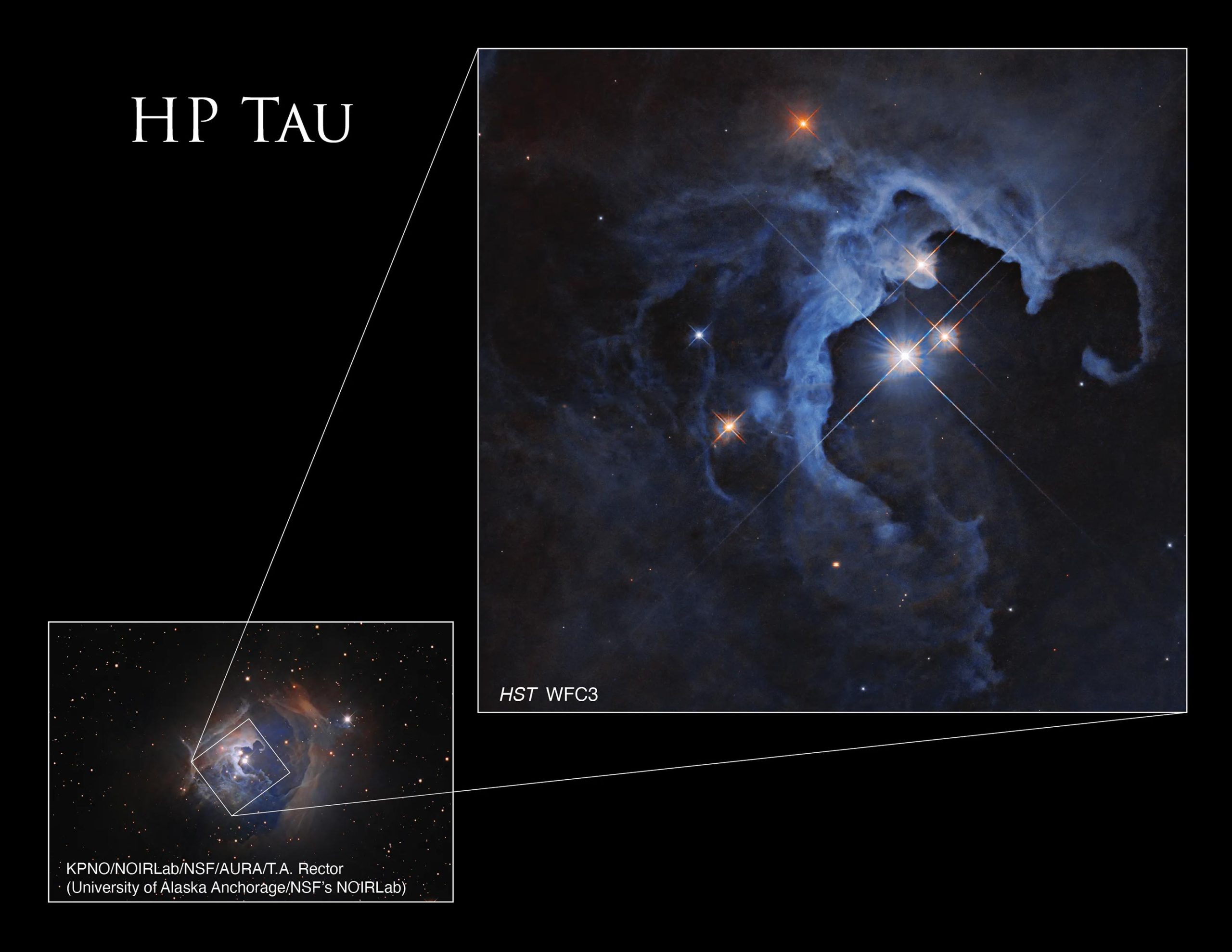
    The box in the ground-based image reveals the location of Hubble’s view within the wider context of this triple-star system. Credit: NASA, ESA, G. Duchene (Universite de Grenoble I); Image Processing: Gladys Kober (NASA/Catholic University of America); Inset: KPNO/NOIRLab/NSF/AURA/T.A. Rector (University of Alaska Anchorage/NSF’s NOIRLab)

    As with all variable stars, HP Tau’s brightness changes over time. T Tauri stars are known to have both periodic and random fluctuations in brightness. The random variations may be due to the chaotic nature of a developing young star, such as instabilities in the accretion disk of dust and gas around the star, material from that disk falling onto the star and being consumed, and flares on the star’s surface. The periodic changes may be due to giant sunspots rotating in and out of view.

    Curving around the stars, a cloud of gas and dust shines with their reflected light. Reflection nebulae do not emit visible light of their own, but shine as the light from nearby stars bounces off the gas and dust, like fog illuminated by the glow of a car’s headlights.

    HP Tau is located approximately 550 light-years away in the constellation Taurus. Hubble studied HP Tau as part of an investigation into protoplanetary disks, the disks of material around stars that coalesce into planets over millions of years.

    Never miss a breakthrough: Join the SciTechDaily newsletter.
    Follow us on Google and Google News.

    Astronomy Hubble Space Telescope NASA NASA Goddard Space Flight Center Popular
    Share. Facebook Twitter Pinterest LinkedIn Email Reddit

    Related Articles

    3.7 Billion Miles Away: Hubble Uncovers a Hidden Trio That Could Rewrite Kuiper Belt History

    Historic Discovery: Twin Titans Clash As NASA Unveils Closest Supermassive Black Hole Duo

    The Great Escape: NASA’s Hubble and MAVEN Help Solve Mystery of Mars’ Vanishing Water

    Webb and Hubble Unite: A Breathtaking 3D Journey Through the Pillars of Creation

    Stellar Sleuths: Citizen Scientists and AI Uncover Hidden Asteroids With Hubble

    Stellar Fireworks: Hubble Revisits a Strange Star’s 40-Year Nova Mystery

    Jupiter Unveiled: Hubble Captures the Giant’s Roaring Storms and Volcanic Moon Io

    Cyclones in Space? See How Hubble Uncovered Extreme Weather on a Distant Planet

    Saturn’s Seasonal Spectacle: Hubble’s Ultra-Sharp Vision Unveils Ring Spoke Phenomenon

    Leave A Reply Cancel Reply

    • Facebook
    • Twitter
    • Pinterest
    • YouTube

    Don't Miss a Discovery

    Subscribe for the Latest in Science & Tech!

    Trending News

    Millions of People Have Osteopenia Without Realizing It – Here’s What You Need To Know

    Researchers Discover Boosting a Single Protein Helps the Brain Fight Alzheimer’s

    World-First Study Reveals Human Hearts Can Regenerate After a Heart Attack

    Why Your Dreams Feel So Real Sometimes and So Strange Other Times

    This Simple Home Device May Boost Brain Power in Adults Over 40

    Enormous Prehistoric Insects Puzzle Scientists

    Scientists Develop Bioengineered Chewing Gum That Could Help Fight Oral Cancer

    After 37 Years, the World’s Longest-Running Soil Warming Experiment Uncovers a Startling Climate Secret

    Follow SciTechDaily
    • Facebook
    • Twitter
    • YouTube
    • Pinterest
    • Newsletter
    • RSS
    SciTech News
    • Biology News
    • Chemistry News
    • Earth News
    • Health News
    • Physics News
    • Science News
    • Space News
    • Technology News
    Recent Posts
    • After 100 Years, Scientists Uncover Hidden Rule Governing Cosmic Rays
    • The Milky Way Has a Hidden Edge and Scientists Finally Mapped It
    • Scientists Stunned by New Organic Molecules Found on Mars
    • Scientists Discover Evolution’s 120-Million-Year-Old “Cheat Sheet”
    • This New “Sound Laser” Could Measure Gravity With Stunning Precision
    Copyright © 1998 - 2026 SciTechDaily. All Rights Reserved.
    • Science News
    • About
    • Contact
    • Editorial Board
    • Privacy Policy
    • Terms of Use

    Type above and press Enter to search. Press Esc to cancel.