
Close Menu
    Facebook X (Twitter) Instagram
    SciTechDaily
    • Biology
    • Chemistry
    • Earth
    • Health
    • Physics
    • Science
    • Space
    • Technology
    Facebook X (Twitter) Pinterest YouTube RSS
    SciTechDaily
    Home»Space»Deep Space Atomic Clock Activated by NASA
    Space

    Deep Space Atomic Clock Activated by NASA

    By Arielle Samuelson, Jet Propulsion LaboratoryAugust 27, 2019No Comments3 Mins Read
    Facebook Twitter Pinterest Telegram LinkedIn WhatsApp Email Reddit
    Share
    Facebook Twitter LinkedIn Pinterest Telegram Email Reddit
    NASA Deep Space Atomic Clock
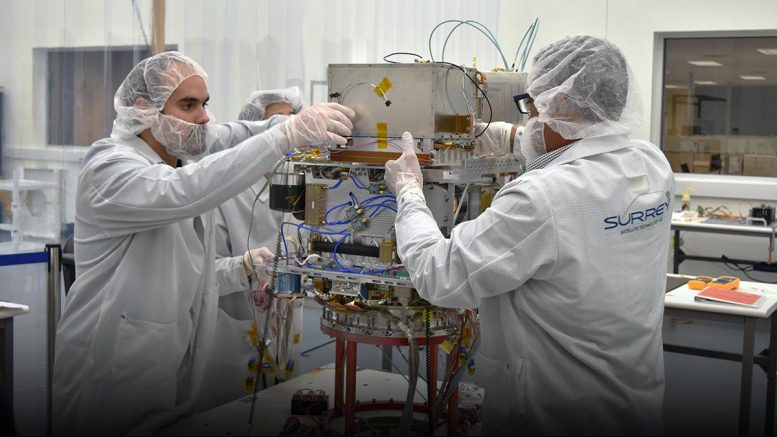
    NASA’s Deep Space Atomic Clock (DSAC), the first GPS-like technology for deep space, started its one-year space mission on Friday, August 23, 2019. If the technology demonstration proves successful, similar atomic clocks will be used to navigate the self-flying spacecraft. Credit: General Atomics Electromagnetic Systems

    An atomic clock that could pave the way for autonomous deep space travel was successfully activated last week and is ready to begin its year-long tech demo, the mission team confirmed on Friday, August 23, 2019. Launched in June, NASA’s Deep Space Atomic Clock is a critical step toward enabling spacecraft to safely navigate themselves in deep space rather than rely on the time-consuming process of receiving directions from Earth.

    Developed at NASA’s Jet Propulsion Laboratory in Pasadena, California, the clock is the first timekeeper stable enough to map a spacecraft’s trajectory in deep space while being small enough to fly onboard the spacecraft. A more stable clock can operate farther from Earth, where it needs to work well for longer periods than satellites closer to home.

    Atomic clocks, like those used in GPS satellites, are used to measure the distance between objects by timing how long it takes a signal to travel from Point A to Point B. For space exploration, atomic clocks must be extremely precise: an error of even one second means the difference between landing on a planet like Mars or missing it by hundreds of thousands of miles. Up to 50 times more stable than the atomic clocks on GPS satellites, the mercury-ion Deep Space Atomic Clock loses one second every 10 million years, as proven in controlled tests on Earth. Now it will test that accuracy in space.

    Navigators currently use refrigerator-size atomic clocks on Earth to pinpoint a spacecraft’s location. Minutes to hours can go by as a signal is sent from Earth to the spacecraft before being returned to Earth, where it is used to create instructions that are then sent back to the spacecraft. A clock aboard a spacecraft would allow the spacecraft to calculate its own trajectory, instead of waiting for navigators on Earth to send that information. This advancement would free missions to travel farther and, eventually, carry humans safely to other planets.

    “The goal of the space experiment is to put the Deep Space Atomic Clock in the context of an operating spacecraft – complete with the things that affect the stability and accuracy of a clock – and see if it performs at the level we think it will: with orders of magnitude more stable than existing space clocks,” said navigator Todd Ely, principal investigator of the project at JPL.

    In the coming months, the team will measure how well the clock keeps time down to the nanosecond. The results begin the countdown to a day when technology can safely help astronauts navigate themselves to other worlds.

    The Deep Space Atomic Clock is hosted on a spacecraft provided by General Atomics Electromagnetic Systems of Englewood, Colorado. It is sponsored by the Technology Demonstration Missions program within NASA’s Space Technology Mission Directorate and the Space Communications and Navigations program within NASA’s Human Exploration and Operations Mission Directorate. JPL manages the project.

    Never miss a breakthrough: Join the SciTechDaily newsletter.
    Follow us on Google and Google News.

    Atomic Clock DSAC GPS JPL NASA Popular
    Share. Facebook Twitter Pinterest LinkedIn Email Reddit

    Related Articles

    Deep Space Atomic Clock to Improve GPS, Increase Spacecraft Autonomy

    NASA Researchers Test Deep Space Atomic Clock (DSAC)

    The Mysterious Dusty Plasma Plumes of Saturn’s Moon Enceladus

    NEOWISE Data Reveals Potentially Hazardous Asteroids

    Black Hole Rips Apart a Helium Rich Star

    Robonaut 2: A Robotic Space Station Crew Member

    Saturn’s Moon Phoebe Has Planet-Like Qualities

    Dawn Images Shine New Light on Vesta

    Searching for “Bubbles” in the Milky Way

    Leave A Reply Cancel Reply

    • Facebook
    • Twitter
    • Pinterest
    • YouTube

    Don't Miss a Discovery

    Subscribe for the Latest in Science & Tech!

    Trending News

    Breakthrough Bowel Cancer Trial Leaves Patients Cancer-Free for Nearly 3 Years

    Natural Compound Shows Powerful Potential Against Rheumatoid Arthritis

    100,000-Year-Old Neanderthal Fossils in Poland Reveal Unexpected Genetic Connections

    Simple “Gut Reset” May Prevent Weight Gain After Ozempic or Wegovy

    2.8 Days to Disaster: Scientists Warn Low Earth Orbit Could Suddenly Collapse

    Common Food Compound Shows Surprising Power Against Superbugs

    5 Simple Ways To Remember More and Forget Less

    The Atomic Gap That Could Cost the Semiconductor Industry Billions

    Follow SciTechDaily
    • Facebook
    • Twitter
    • YouTube
    • Pinterest
    • Newsletter
    • RSS
    SciTech News
    • Biology News
    • Chemistry News
    • Earth News
    • Health News
    • Physics News
    • Science News
    • Space News
    • Technology News
    Recent Posts
    • After 37 Years, the World’s Longest-Running Soil Warming Experiment Uncovers a Startling Climate Secret
    • NASA Satellite Captures First-Ever High-Res View of Massive Pacific Tsunami
    • ADHD Isn’t Just a Deficit: Study Reveals Powerful Hidden Strengths
    • Scientists Uncover “Astonishing” Hidden Property of Light
    • Scientists Discover Stem Cells That Could Regrow Teeth and Bone
    Copyright © 1998 - 2026 SciTechDaily. All Rights Reserved.
    • Science News
    • About
    • Contact
    • Editorial Board
    • Privacy Policy
    • Terms of Use

    Type above and press Enter to search. Press Esc to cancel.