
New Findings Challenge Classical Views Held by Scientists
What happened to the water that once covered Mars? Scientists know that some went deep underground, but where is the rest? Evidence shows that some water molecules broke into atoms, which rise through the Martian atmosphere and escape into space. By combining data from Hubble and MAVEN, a team measured the number and current rate of escaping hydrogen atoms.
They discovered that the escape rates of hydrogen and “heavy hydrogen,” called deuterium, change rapidly when Mars is close to the Sun. This upended the classical picture that scientists previously had, where these atoms were thought to slowly diffuse upward through the atmosphere to a height where they could escape. Extrapolating the escape rate backward through time helped the team to understand the history of water on the Red Planet.
NASA’s Hubble, MAVEN Help Solve the Mystery of Mars’ Escaping Water
Mars was once a very wet planet as is evident in its surface geological features. Scientists know that over the last 3 billion years, at least some water went deep underground, but what happened to the rest? Now, NASA’s Hubble Space Telescope and MAVEN (Mars Atmosphere and Volatile Evolution) missions are helping unlock that mystery.
“There are only two places water can go. It can freeze into the ground, or the water molecule can break into atoms, and the atoms can escape from the top of the atmosphere into space,” explained study leader John Clarke of the Center for Space Physics at Boston University in Massachusetts. “To understand how much water there was and what happened to it, we need to understand how the atoms escape into space.”
Clarke and his team combined data from Hubble and MAVEN to measure the number and current escape rate of the hydrogen atoms escaping into space. This information allowed them to extrapolate the escape rate backward through time to understand the history of water on the Red Planet.

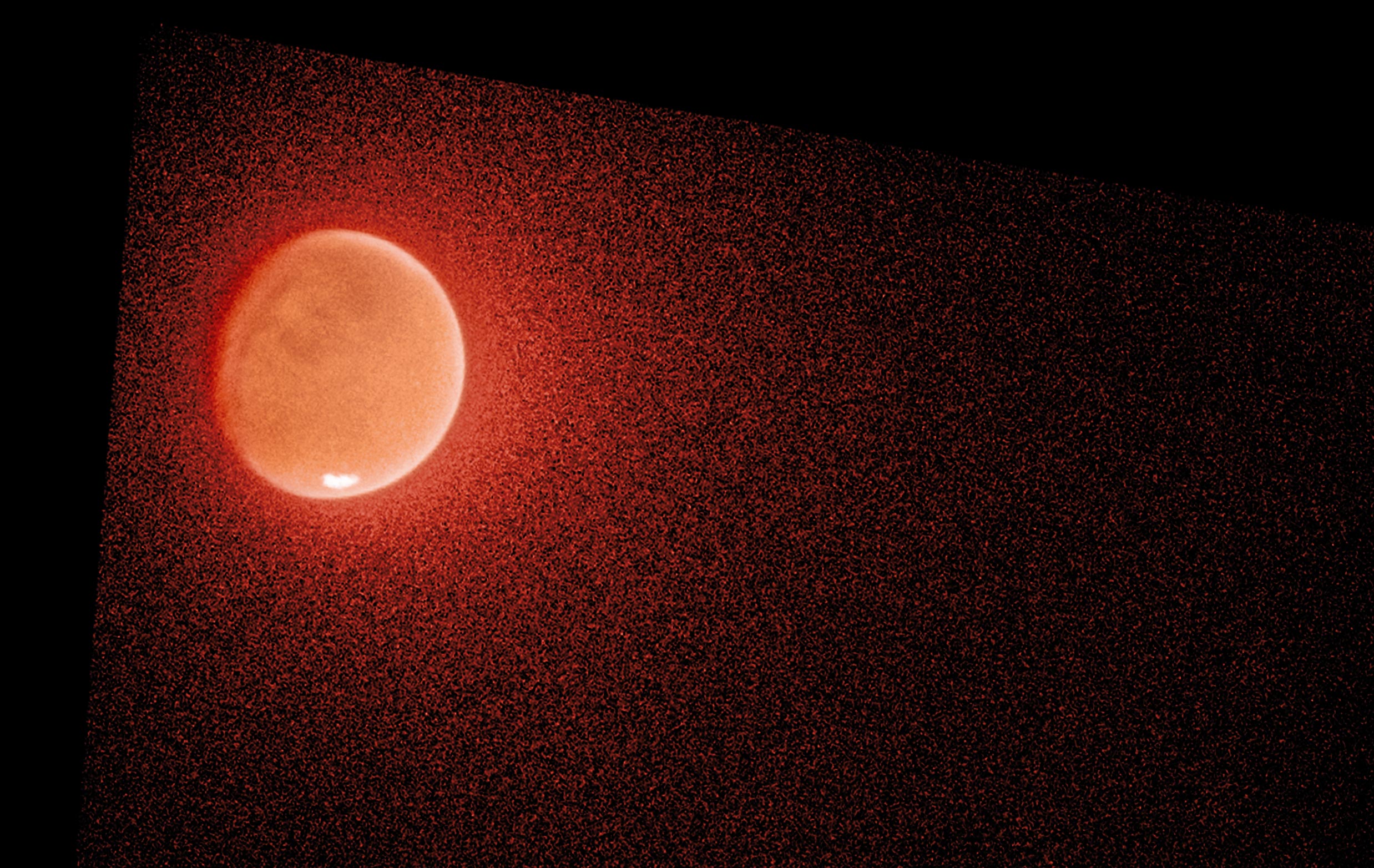
Reflected sunlight from Mars at these wavelengths shows scattering by atmospheric molecules and haze, while the polar ice caps and some surface features are also visible. Hubble and MAVEN showed that Martian atmospheric conditions change very quickly. When Mars is close to the Sun, water molecules rise very rapidly through the atmosphere, breaking apart and releasing atoms at high altitudes. Credit: NASA, ESA, STScI, John T. Clarke (Boston University), Joseph DePasquale (STScI)
Escaping Hydrogen and “Heavy Hydrogen”
Water molecules in the Martian atmosphere are broken apart by sunlight into hydrogen and oxygen atoms. Specifically, the team measured hydrogen and deuterium, which is a hydrogen atom with a neutron in its nucleus. This neutron gives deuterium twice the mass of hydrogen. Because its mass is higher, deuterium escapes into space much more slowly than regular hydrogen.
Over time, as more hydrogen was lost than deuterium, the ratio of deuterium to hydrogen built up in the atmosphere. Measuring the ratio today gives scientists a clue to how much water was present during the warm, wet period on Mars. By studying how these atoms currently escape, they can understand the processes that determined the escape rates over the last four billion years and thereby extrapolate back in time.
Interplanetary Comparisons and Extrapolations
Although most of the study’s data comes from the MAVEN spacecraft, MAVEN is not sensitive enough to see the deuterium emission at all times of the Martian year. Unlike the Earth, Mars swings far from the Sun in its elliptical orbit during the long Martian winter, and the deuterium emissions become faint. Clarke and his team needed the Hubble data to “fill in the blanks” and complete an annual cycle for three Martian years (each of which is 687 Earth days). Hubble also provided additional data going back to 1991 – prior to MAVEN’s arrival at Mars in 2014.
The combination of data between these missions provided the first holistic view of hydrogen atoms escaping Mars into space.
A Dynamic and Turbulent Martian Atmosphere
“In recent years scientists have found that Mars has an annual cycle that is much more dynamic than people expected 10 or 15 years ago,” explained Clarke. “The whole atmosphere is very turbulent, heating up and cooling down on short timescales, even down to hours. The atmosphere expands and contracts as the brightness of the Sun at Mars varies by 40 percent over the course of a Martian year.”
The team discovered that the escape rates of hydrogen and deuterium change rapidly when Mars is close to the Sun. In the classical picture that scientists previously had, these atoms were thought to slowly diffuse upward through the atmosphere to a height where they could escape.
But that picture no longer accurately reflects the whole story, because now scientists know that atmospheric conditions change very quickly. When Mars is close to the Sun, the water molecules, which are the source of the hydrogen and deuterium, rise through the atmosphere very rapidly releasing atoms at high altitudes.
The second finding is that the changes in hydrogen and deuterium are so rapid that the atomic escape needs added energy to explain them. At the temperature of the upper atmosphere only a small fraction of the atoms have enough speed to escape the gravity of Mars. Faster (super-thermal) atoms are produced when something gives the atom a kick of extra energy. These events include collisions from solar wind protons entering the atmosphere or sunlight that drives chemical reactions in the upper atmosphere.
Serving as a Proxy
Studying the history of water on Mars is fundamental not only to understanding planets in our own solar system but also the evolution of Earth-size planets around other stars. Astronomers are finding more and more of these planets, but they’re difficult to study in detail. Mars, Earth and Venus all sit in or near our solar system’s habitable zone, the region around a star where liquid water could pool on a rocky planet; yet all three planets have dramatically different present-day conditions. Along with its sister planets, Mars can help scientists grasp the nature of far-flung worlds across our galaxy.
These results appear in the July 26 edition of Science Advances, published by the American Association for the Advancement of Science.
Reference: “Martian atmospheric hydrogen and deuterium: Seasonal changes and paradigm for escape to space” by John T. Clarke, Majd Mayyasi, Dolon Bhattacharyya, Jean-Yves Chaufray, Nicolas Schneider, Bruce Jakosky, Roger Yelle, Franck Montmessin, Michael Chaffin, Shannon Curry, Justin Deighan, Sonal Jain, Jean-Loup Bertaux, Eryn Cangi, Matteo Crismani, Scott Evans, Sumedha Gupta, Franck Lefevre, Greg Holsclaw, Daniel Lo, William McClintock, Michael Stevens, Ian Stewart, Shane Stone, Paul Mahaffy, Mehdi Benna and Meredith Elrod, 26 July 2024, Science Advances.
DOI: 10.1126/sciadv.adm7499
About the Missions
Launched over thirty years ago, the Hubble Space Telescope remains an invaluable asset in space exploration, continually contributing to our understanding of the cosmos. Managed by NASA’s Goddard Space Flight Center and supported by Lockheed Martin Space, the telescope is a beacon of international collaboration, jointly operated with the European Space Agency. The Space Telescope Science Institute in Baltimore conducts the science operations, making Hubble a cornerstone in both astronomical research and international cooperation.
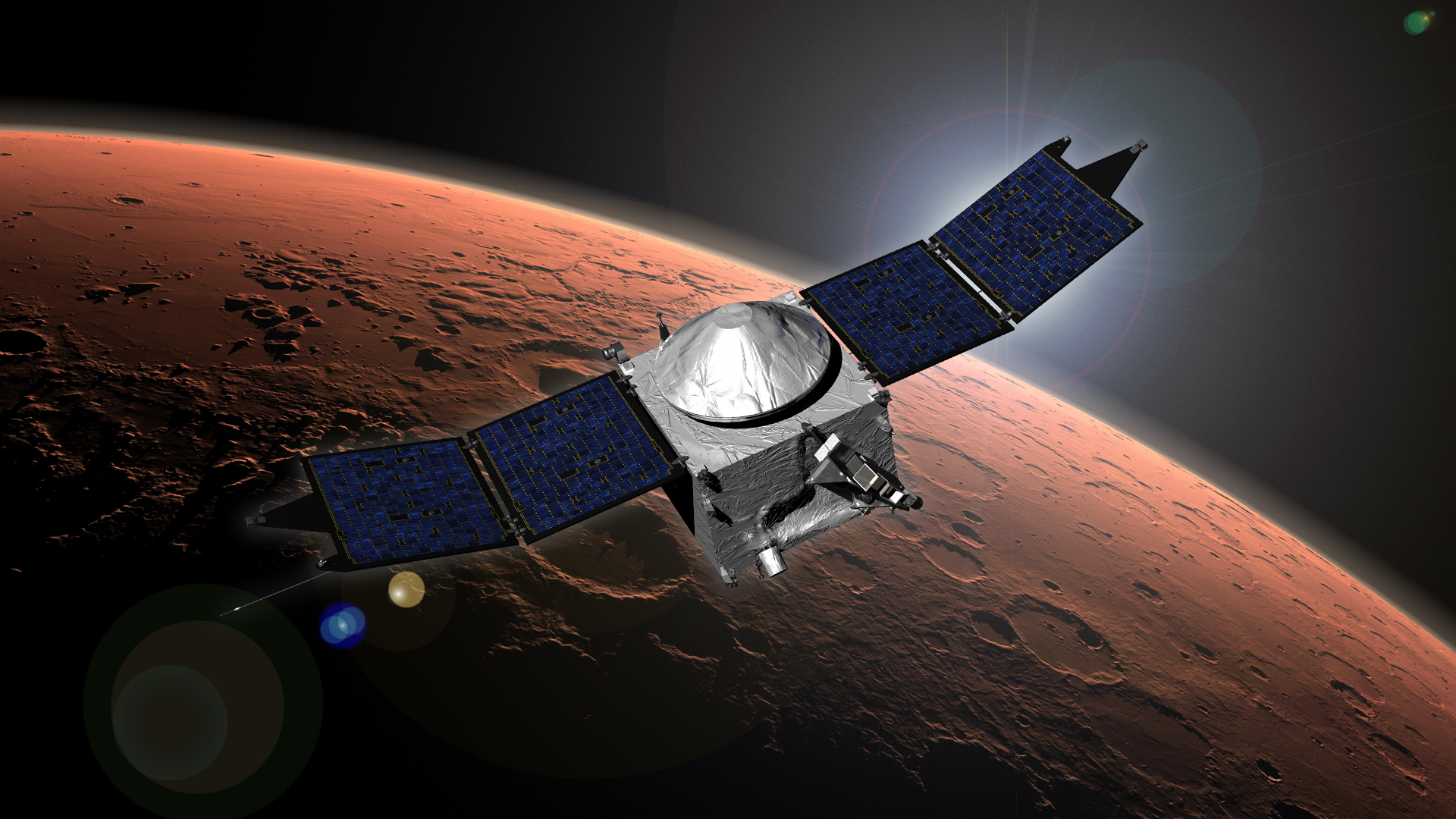
Managed by NASA’s Goddard Space Flight Center and constructed by Lockheed Martin Space, MAVEN has been orbiting Mars and studying its atmosphere since 2014. The mission’s principal investigator and the management of its science operations are housed at the University of Colorado Boulder’s Laboratory for Atmospheric and Space Physics. This setup supports MAVEN’s goals of understanding Mars’ atmospheric loss, with additional navigation and communication assistance provided by NASA’s Jet Propulsion Laboratory. As it nears its tenth year at Mars, MAVEN continues to contribute critical data to our understanding of the Red Planet.
Never miss a breakthrough: Join the SciTechDaily newsletter.
Follow us on Google and Google News.
2 Comments
Human have lived on Mars before, we did, we have used all the resource on Mars, includes water, So what left is Rock and some left over water, or lost water. Is going to be deficut to live there again. There are many places we can live that have Ice. Ice =water. That I have fund in the past. Is in working progress. Is going to take millions of years for those places to be ready for human habitable. For now we are here. Some of those places are under construction as we speak.
What mystery? Hydrogen escape is a known mechanism of water loss. Given enough time, water escapes. One should not consider loss of water on a small planet a “mystery”. One should consider it a mystery if the planet has NOT lost significant water over billions of years. These scientists are simply refining loss rate estimates, not changing the fundamental understanding that water is lost due to hydrogen escape.
The process of hydrogen escaping an atmosphere into space is a problem that exists for all atmospheres that contain hydrogen at their upper reaches. This hydrogen can come from water if the atmosphere has water. For planets orbiting a radiating body like our sun, the stellar radiation will sometimes cause atmospheric water molecules to break up into atomic hydrogen and O2. If and when that atomic hydrogen achieves enough velocity to escape the atmosphere (i.e, reach escape velocity), it will obviously be permanently unavailable to recombine with the O2 to reform into a water molecule. Unless the planet has enough hydrogen reserves to keep recombining with all of the newly freed oxygen, the amount of water on the planet will decrease. Thus, hydrogen escape is a mechanism for water loss. This has been known for longer than most readers may have been alive. It is not in itself a mystery. These scientists are simply refining loss rate estimates, not the fundamental fact that water is lost due to hydrogen escape.
Meanwhile, if the O2 manages to eventually get removed from the atmospherecertainly have some water molecules break up (for various reasons, but stellar rad