
Close Menu
    Facebook X (Twitter) Instagram
    SciTechDaily
    • Biology
    • Chemistry
    • Earth
    • Health
    • Physics
    • Science
    • Space
    • Technology
    Facebook X (Twitter) Pinterest YouTube RSS
    SciTechDaily
    Home»Space»Hubble Spots Giant Space “Pumpkin” [Video]
    Space

    Hubble Spots Giant Space “Pumpkin” [Video]

    By Space Telescope Science InstituteOctober 30, 20201 Comment4 Mins Read
    Facebook Twitter Pinterest Telegram LinkedIn WhatsApp Email Reddit
    Share
    Facebook Twitter LinkedIn Pinterest Telegram Email Reddit
    Greater Pumpkin Galaxy Pair
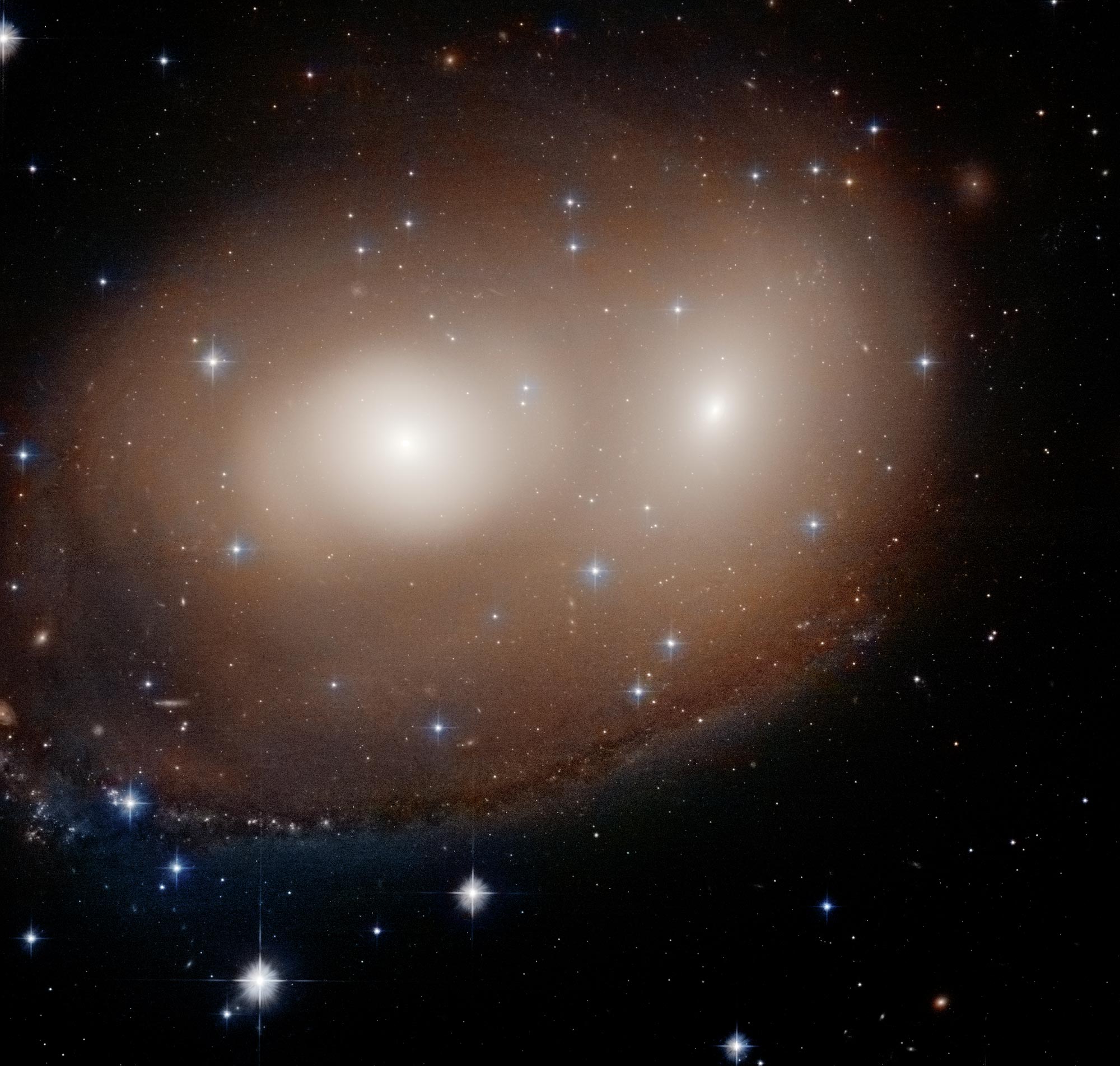
    This is a Hubble Space Telescope snapshot of the early stages of a collision between two galaxies that resembles a Halloween carved pumpkin. The “pumpkin’s” glowing “eyes” are the bright, star-filled cores of each galaxy that contain supermassive black holes. An arm of newly forming stars give the imaginary pumpkin a wry smirk. The two galaxies, cataloged as NGC  2292 and NGC  2293, are located about 120 million light-years away in the constellation Canis Major. Credit: NASA, ESA, and W. Keel (University of Alabama)

    Sorry Charlie Brown, NASA’s Hubble Space Telescope is taking a peek at what might best be described as the “Greater Pumpkin,” that looks like a Halloween decoration tucked away in a patch of sky cluttered with stars. What looks like two glowing eyes and a crooked carved smile is a snapshot of the early stages of a collision between two galaxies. The entire view is nearly 109,000 light-years across, approximately the diameter of our Milky Way.

    The overall pumpkin-ish color corresponds to the glow of aging red stars in two galaxies, cataloged as NGC  2292 and NGC  2293, which only have a hint of spiral structure. Yet the smile is bluish due to newborn star clusters, spread out like pearls on a necklace, along a newly forming dusty arm. The glowing eyes are concentrations of stars around a pair of supermassive black holes. The scattering of blue foreground stars makes the “pumpkin” look like it got all glittery for a Halloween party.

    What’s going on in this pumpkin-like pair?

    If you mix two fried eggs together, you get something resembling scrambled eggs. The same goes for galaxy collisions throughout the universe. They lose their flattened spiral disk and the stars are scrambled into a football-shaped volume of space, forming an elliptical galaxy. But this interacting pair is a very rare example of what may turn out to result in a bigger fried egg—the construction of a giant spiral galaxy. It may depend on the specific trajectory the colliding galaxy pair is following. The encounter scenario must be rare because there’s only a handful of other examples in the universe, say astronomers.


    Halloween is scarier with Hubble! What looks like two glowing eyes and a crooked carved smile is a snapshot of the early stages of a collision between two galaxies. This new image is just one of several spooky views Hubble has captured in the universe. Credit: NASA’s Goddard Space Flight Center

    The ghostly arm making the “smile” may be just the beginning of the process of rebuilding a spiral galaxy, say researchers. The arm embraces both galaxies. It most likely formed when interstellar gas was compressed as the two galaxies began to merge. The higher density precipitates new star formation.

    The dynamic duo hides out 120 million light-years away in the constellation Canis Major, so it is seen far behind the star-filled foreground plane of our Milky Way galaxy. Therefore, it’s a difficult area to pinpoint far-flung distant background galaxies from the plethora of stars seen in the field.

    The galaxy pair was similar to objects tagged by the citizen-science project Galaxy Zoo, where volunteers go hunting for oddball-looking galaxies. Astronomer William Keel, of the University of Alabama in Tuscaloosa, included several of these in the “Gems of the Galaxy Zoos” Hubble program, which is observing several kinds of rare galaxies during short gaps between other scheduled Hubble observations. The Hubble image brought out new details of the close encounter.

    Keel speculates that the ultimate destiny for this pair will be to merge into a giant luminous spiral galaxy like UGC 2885, Rubin’s Galaxy, which is over twice the diameter of our Milky Way. Hubble has caught a snapshot of the groundbreaking early stages of a galactic makeover.

    The Hubble Space Telescope is a project of international cooperation between NASA and ESA (European Space Agency). NASA’s Goddard Space Flight Center in Greenbelt, Maryland, manages the telescope. The Space Telescope Science Institute (STScI) in Baltimore, Maryland, conducts Hubble science operations. STScI is operated for NASA by the Association of Universities for Research in Astronomy in Washington, D.C.

    Never miss a breakthrough: Join the SciTechDaily newsletter.
    Follow us on Google and Google News.

    Astronomy Hubble Space Telescope NASA NASA Goddard Space Flight Center Popular Space Telescope Science Institute
    Share. Facebook Twitter Pinterest LinkedIn Email Reddit

    Related Articles

    3.7 Billion Miles Away: Hubble Uncovers a Hidden Trio That Could Rewrite Kuiper Belt History

    Historic Discovery: Twin Titans Clash As NASA Unveils Closest Supermassive Black Hole Duo

    The Great Escape: NASA’s Hubble and MAVEN Help Solve Mystery of Mars’ Vanishing Water

    Webb and Hubble Unite: A Breathtaking 3D Journey Through the Pillars of Creation

    Stellar Sleuths: Citizen Scientists and AI Uncover Hidden Asteroids With Hubble

    Jupiter Unveiled: Hubble Captures the Giant’s Roaring Storms and Volcanic Moon Io

    Cyclones in Space? See How Hubble Uncovered Extreme Weather on a Distant Planet

    Saturn’s Seasonal Spectacle: Hubble’s Ultra-Sharp Vision Unveils Ring Spoke Phenomenon

    Astronomers Puzzled After Hubble View of Torrential Outflows From Infant Stars Blows Hole in Current Theories

    1 Comment

    1. Cora Mabry on October 30, 2020 12:01 pm

      I love it all

      Reply
    Leave A Reply Cancel Reply

    • Facebook
    • Twitter
    • Pinterest
    • YouTube

    Don't Miss a Discovery

    Subscribe for the Latest in Science & Tech!

    Trending News

    New Pill Lowers Stubborn Blood Pressure and Protects the Kidneys

    Humans May Have Hidden Regenerative Powers, New Study Suggests

    Scientists Just Solved the Mystery of Why Crabs Walk Sideways

    Doctors Are Surprised by What This Vaccine Is Doing to the Heart

    This Popular Supplement May Boost Your Brain, Not Just Your Muscles

    Scientists Say This Simple Supplement May Actually Reverse Heart Disease

    Warming Oceans Could Trigger a Dangerous Methane Surge

    This Simple Movement Could Be Secretly Cleaning Your Brain

    Follow SciTechDaily
    • Facebook
    • Twitter
    • YouTube
    • Pinterest
    • Newsletter
    • RSS
    SciTech News
    • Biology News
    • Chemistry News
    • Earth News
    • Health News
    • Physics News
    • Science News
    • Space News
    • Technology News
    Recent Posts
    • This Magnetic Field Trick Creates Entirely New Forms of Matter
    • Astronomers Stunned by Ancient Galaxy With No Spin
    • Physicists May Be on the Verge of Discovering “New Physics” at CERN
    • AI Learns To Work Backward and Reveal Hidden Forces in Nature
    • Scientists Warn of Rising Male Childlessness As Global Fertility Changes
    Copyright © 1998 - 2026 SciTechDaily. All Rights Reserved.
    • Science News
    • About
    • Contact
    • Editorial Board
    • Privacy Policy
    • Terms of Use

    Type above and press Enter to search. Press Esc to cancel.