
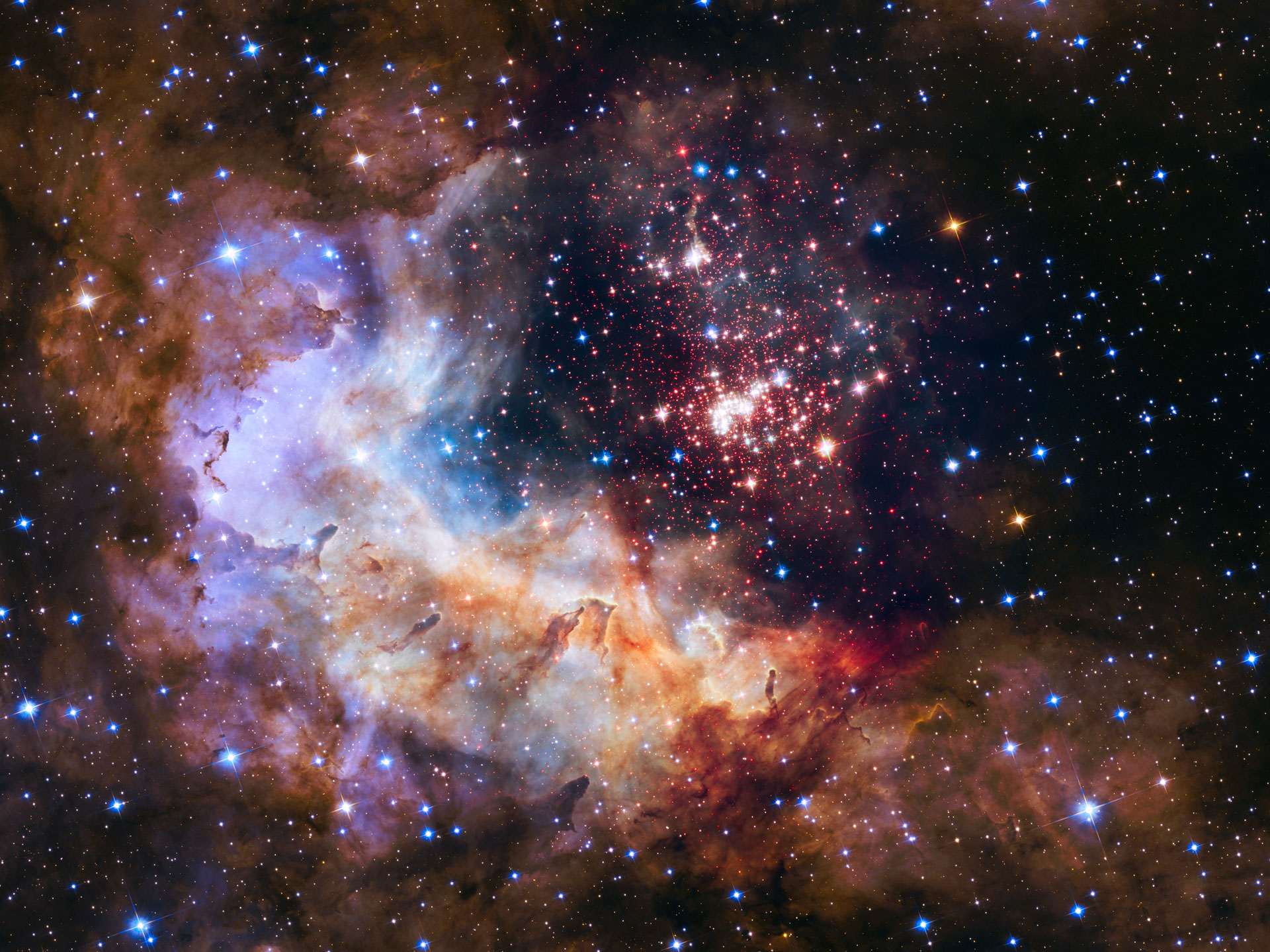
Number 1: Westerlund 2 — Hubble’s 25th Anniversary Image
This NASA/ESA Hubble Space Telescope image of the cluster Westerlund 2 and its surroundings has been released to celebrate Hubble’s 25th year in orbit and a quarter of a century of new discoveries, stunning images and outstanding science.
The image’s central region, containing the star cluster, blends visible-light data taken by the Advanced Camera for Surveys and near-infrared exposures taken by the Wide Field Camera 3. The surrounding region is composed of visible-light observations taken by the Advanced Camera for Surveys. Credit: NASA, ESA, the Hubble Heritage Team (STScI/AURA), A. Nota (ESA/STScI), and the Westerlund 2 Science Team
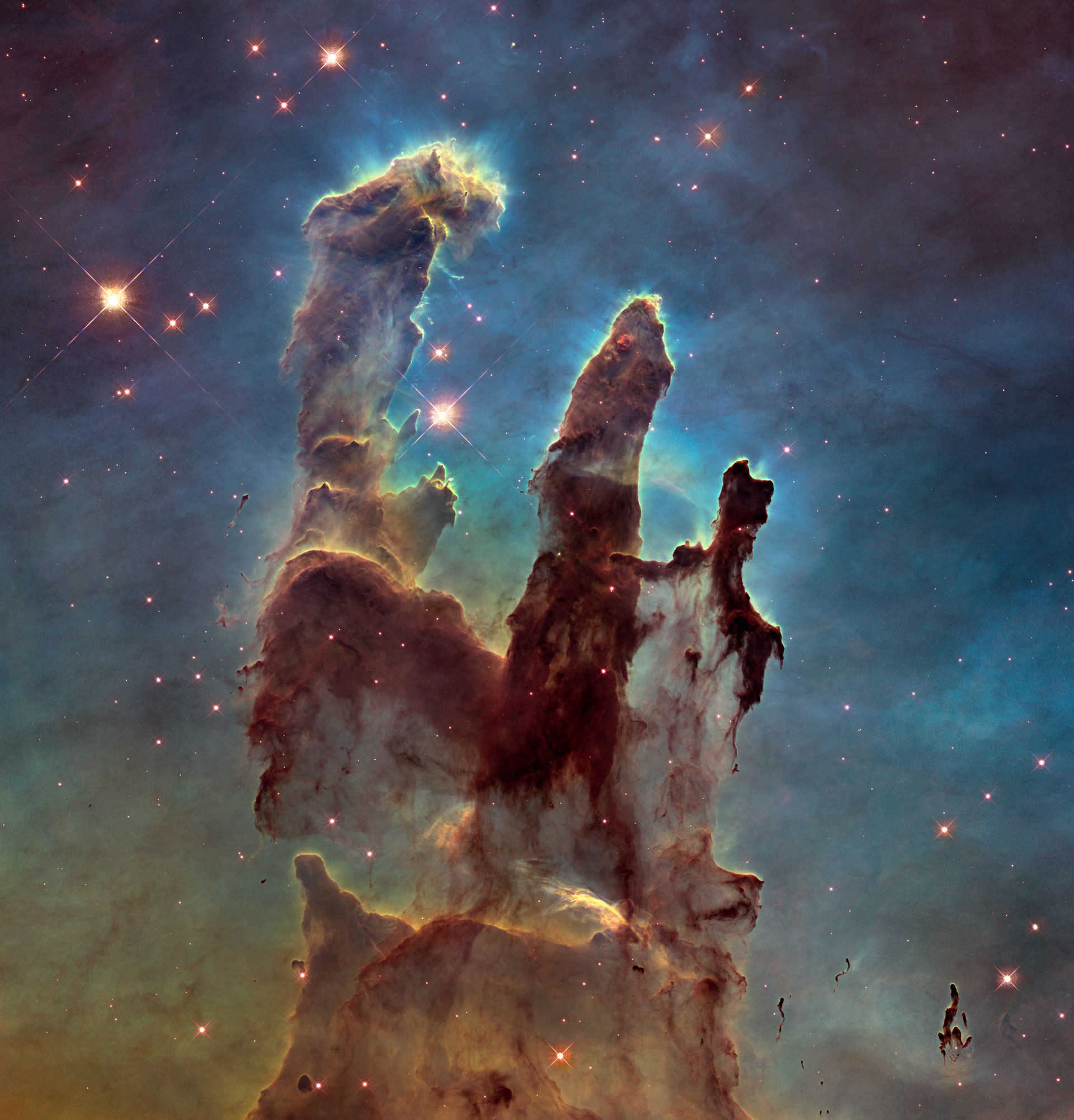
Number 2: New View of the Pillars of Creation — Visible Light
The NASA/ESA Hubble Space Telescope has revisited one of its most iconic and popular images: the Eagle Nebula’s Pillars of Creation. This image shows the pillars as seen in visible light, capturing the multi-colored glow of gas clouds, wispy tendrils of dark cosmic dust, and the rust-colored elephants’ trunks of the nebula’s famous pillars.
The dust and gas in the pillars are seared by the intense radiation from young stars and eroded by strong winds from massive nearby stars. With these new images comes better contrast and a clearer view for astronomers to study how the structure of the pillars is changing over time. Credit: NASA, ESA/Hubble and the Hubble Heritage Team
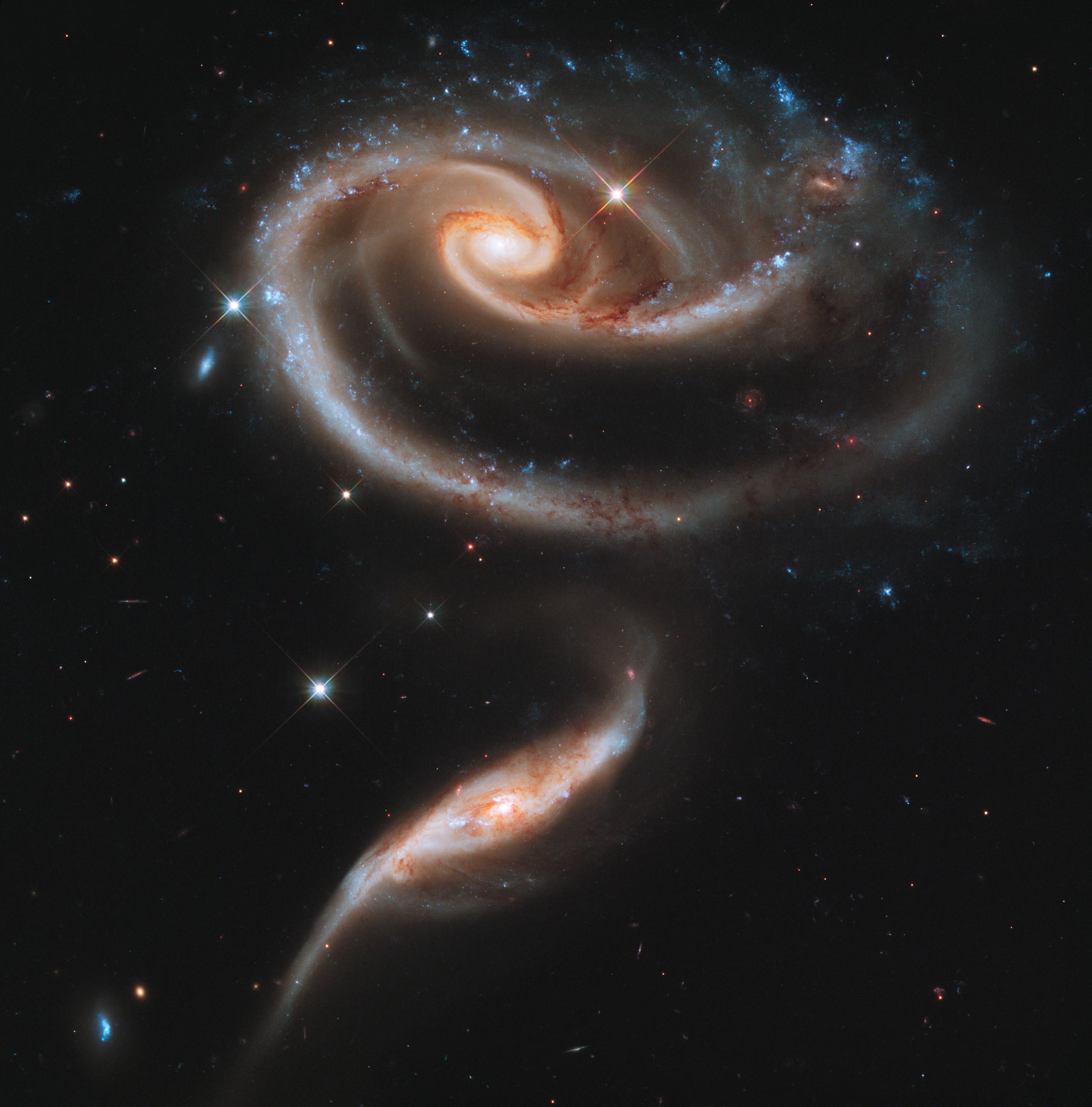
Number 3: A Rose Made of Galaxies
This image of a pair of interacting galaxies called Arp 273 was released to celebrate the 21st anniversary of the launch of the NASA/ESA Hubble Space Telescope.
The distorted shape of the larger of the two galaxies shows signs of tidal interactions with the smaller of the two. It is thought that the smaller galaxy has actually passed through the larger one. Credit: NASA, ESA and the Hubble Heritage Team (STScI/AURA)
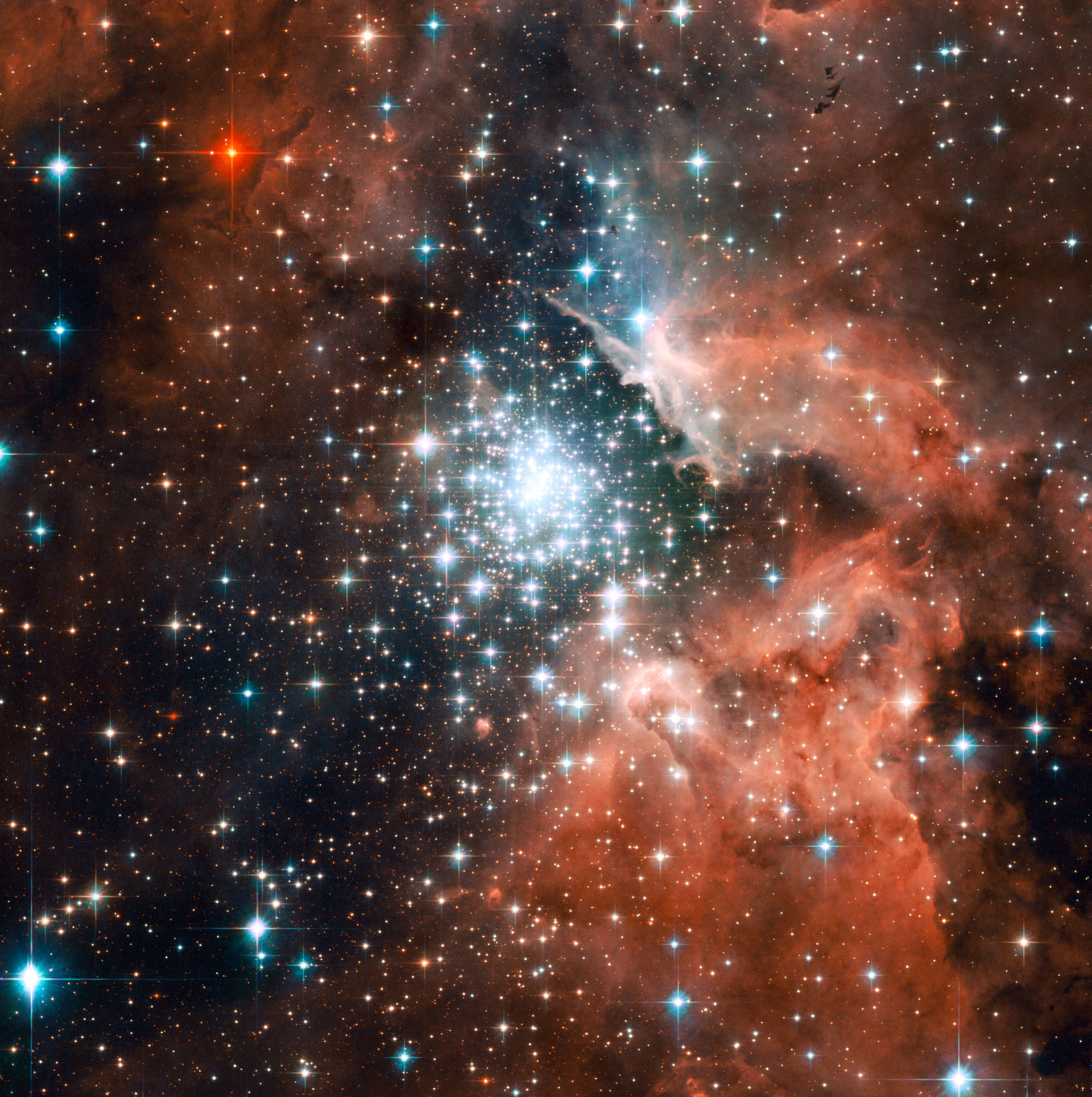
Number 4: Extreme Star Cluster Bursts Into Life in New Hubble Image
The star-forming region NGC 3603 — seen here in the latest Hubble Space Telescope image — contains one of the most impressive massive young star clusters in the Milky Way. Bathed in gas and dust the cluster formed in a huge rush of star formation thought to have occurred around a million years ago. The hot blue stars at the core are responsible for carving out a huge cavity in the gas seen to the right of the star cluster in NGC 3603’s center. Credit: NASA, ESA and the Hubble Heritage (STScI/AURA)-ESA/Hubble Collaboration

Number 5: The Bubble Nebula
The Bubble Nebula, also known as NGC 7635, is an emission nebula located 8,000 light-years away. This stunning new image was observed by the NASA/ESA Hubble Space Telescope to celebrate its 26th year in space. Credit: NASA, ESA, Hubble Heritage Team
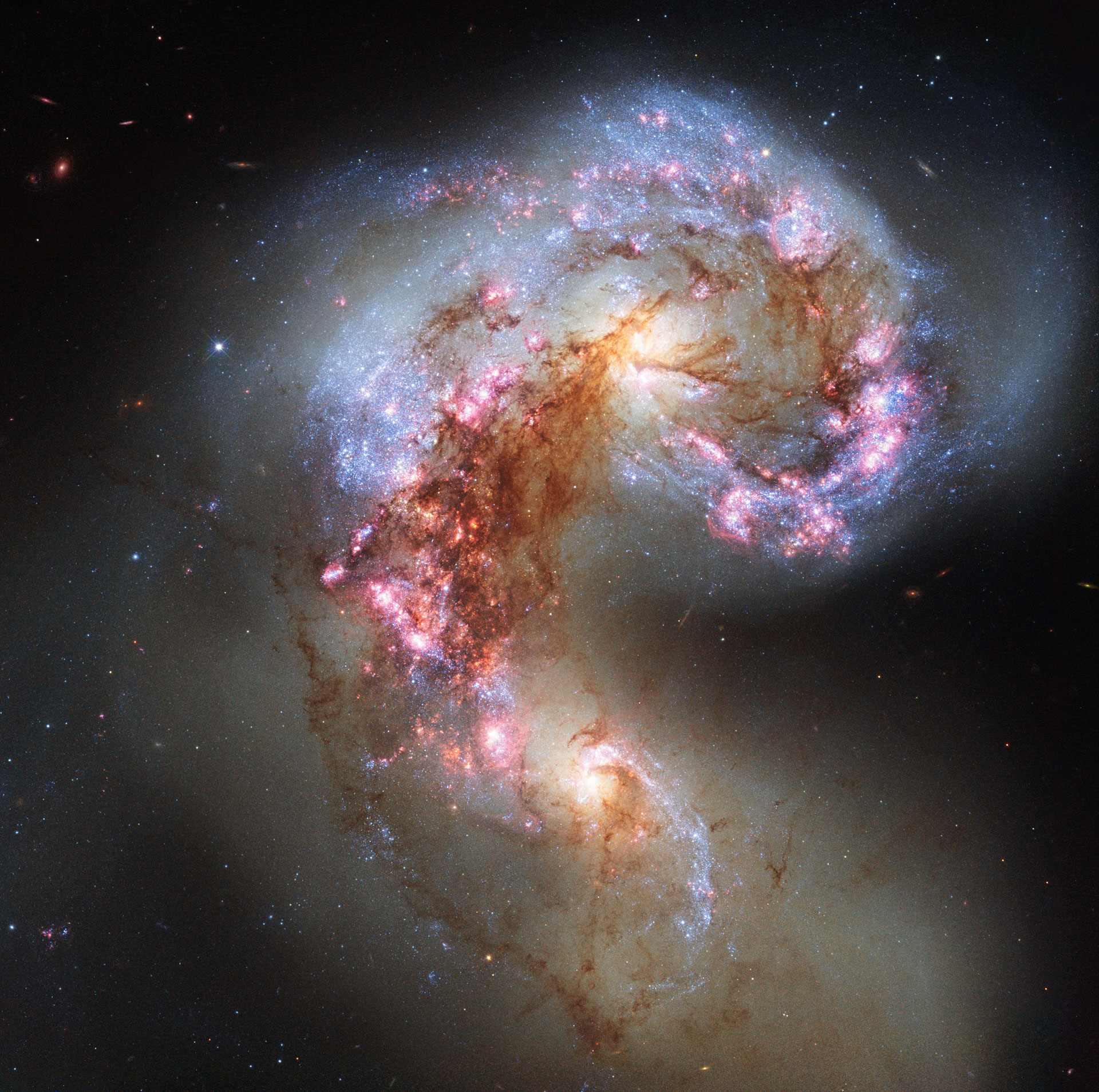
Number 6: Antennae Galaxies Reloaded
The NASA/ESA Hubble Space Telescope has snapped the best-ever image of the Antennae Galaxies. Hubble has released images of these stunning galaxies twice before, once using observations from its Wide Field and Planetary Camera 2 (WFPC2) in 1997, and again in 2006 from the Advanced Camera for Surveys (ACS). Each of Hubble’s images of the Antennae Galaxies has been better than the last, due to upgrades made during the famous servicing missions, the last of which took place in 2009.
The galaxies — also known as NGC 4038 and NGC 4039 — are locked in a deadly embrace. Once normal, sedate spiral galaxies like the Milky Way, the pair have spent the past few hundred million years sparring with one another. This clash is so violent that stars have been ripped from their host galaxies to form a streaming arc between the two. In wide-field images of the pair the reason for their name becomes clear — far-flung stars and streamers of gas stretch out into space, creating long tidal tails reminiscent of antennae.
This new image of the Antennae Galaxies shows obvious signs of chaos. Clouds of gas are seen in bright pink and red, surrounding the bright flashes of blue star-forming regions — some of which are partially obscured by dark patches of dust. The rate of star formation is so high that the Antennae Galaxies are said to be in a state of starburst, a period in which all of the gas within the galaxies is being used to form stars. This cannot last forever and neither can the separate galaxies; eventually the nuclei will coalesce, and the galaxies will begin their retirement together as one large elliptical galaxy.
This image uses visible and near-infrared observations from Hubble’s Wide Field Camera 3 (WFC3), along with some of the previously-released observations from Hubble’s Advanced Camera for Surveys (ACS). Credit: ESA/Hubble & NASA

Number 7: New Infrared View of the Horsehead Nebula — Hubble’s 23rd Anniversary Image
This new Hubble image, captured and released to celebrate the telescope’s 23rd year in orbit, shows part of the sky in the constellation of Orion (The Hunter). Rising like a giant seahorse from turbulent waves of dust and gas is the Horsehead Nebula, otherwise known as Barnard 33.
This image shows the region in infrared light, which has longer wavelengths than visible light and can pierce through the dusty material that usually obscures the nebula’s inner regions. The result is a rather ethereal and fragile-looking structure, made of delicate folds of gas — very different to the nebula’s appearance in visible light. Credit: NASA, ESA, and the Hubble Heritage Team (AURA/STScI)
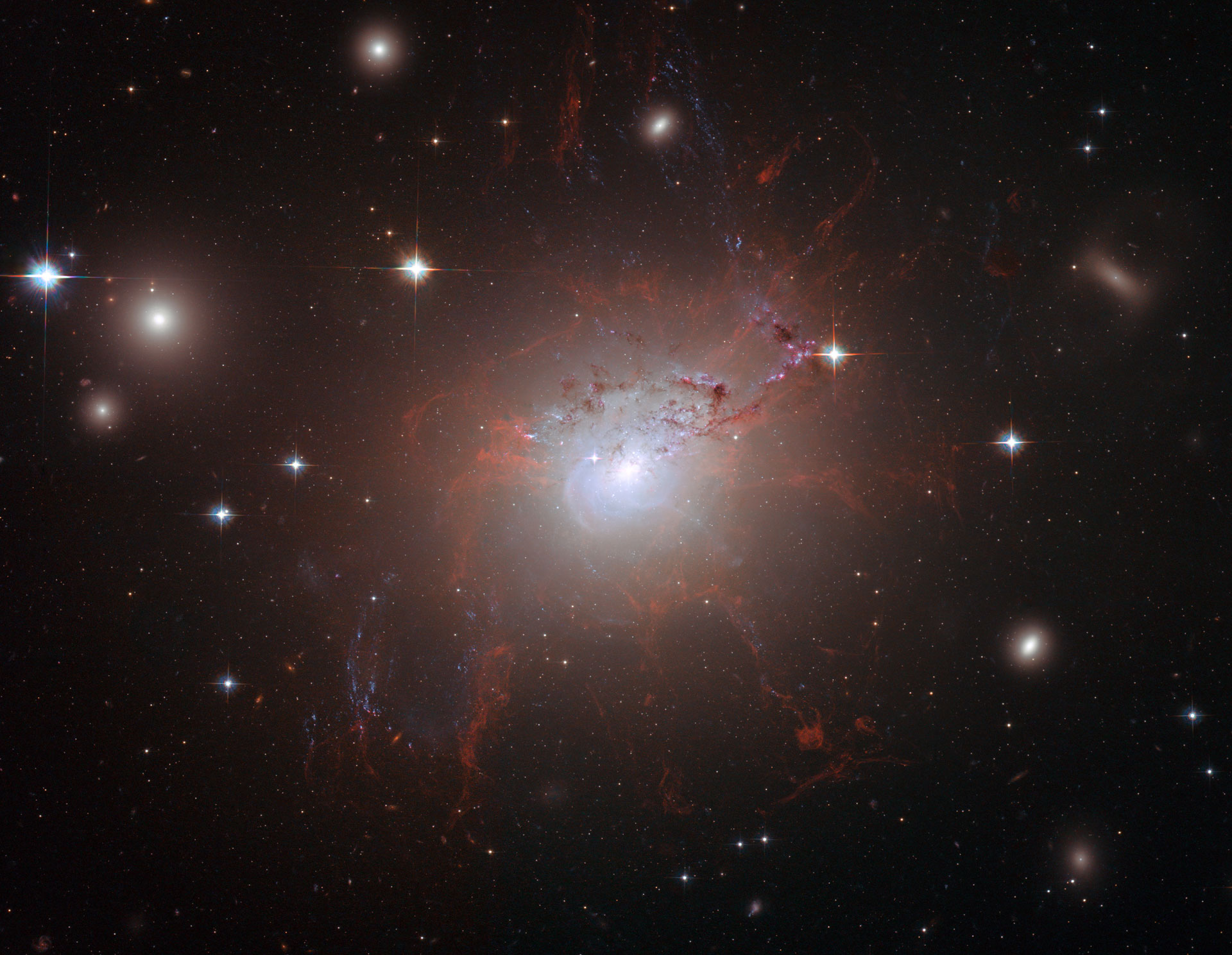
Number 8: Magnetic Monster NGC 1275
This stunning image of NGC 1275 was taken using the NASA/ESA Hubble Space Telescope’s Advanced Camera for Surveys in July and August 2006. It provides amazing detail and resolution of the fragile filamentary structures, which show up as a reddish lacy structure surrounding the central bright galaxy NGC 1275. These filaments are cool despite being surrounded by gas that is around 55 million degrees Celsius hot. They are suspended in a magnetic field which maintains their structure and demonstrates how energy from the central black hole is transferred to the surrounding gas.
By observing the filamentary structure, astronomers were, for the first time, able to estimate the magnetic field’s strength. Using this information they demonstrated how the extragalactic magnetic fields have maintained the structure of the filaments against collapse caused by either gravitational forces or the violence of the surrounding cluster during their 100-million-year lifetime.
This is the first time astronomers have been able to differentiate the individual threads making up such filaments to this degree. Astonishingly, they distinguished threads a mere 200 light-years across. By contrast, the filaments seen here can be a gaping 200 000 light-years long. The entire image is approximately 260 000 light-years across.
Also seen in the image are impressive lanes of dust from a separate spiral galaxy. It lies partly in front of the giant elliptical central cluster galaxy and has been completely disrupted by the tidal gravitational forces within the galaxy cluster. Several striking filaments of blue newborn stars are seen crossing the image. Credit: NASA, ESA and Andy Fabian (University of Cambridge, UK)
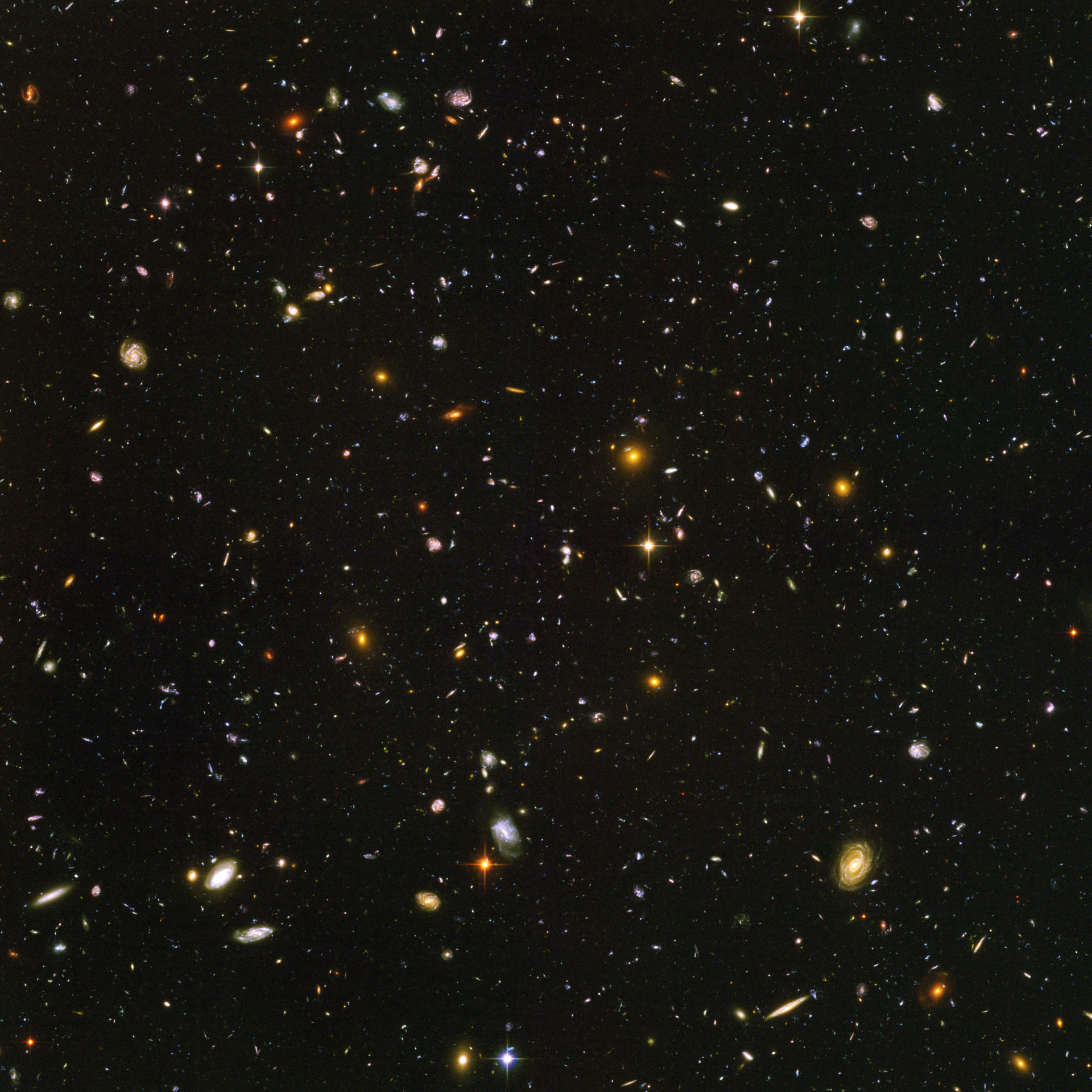
Number 9: Hubble Sees Galaxies Galore
Galaxies, galaxies everywhere – as far as the NASA/ESA Hubble Space Telescope can see. This view of nearly 10,000 galaxies is the deepest visible-light image of the cosmos. Called the Hubble Ultra Deep Field, this galaxy-studded view represents a “deep” core sample of the universe, cutting across billions of light-years.
The snapshot includes galaxies of various ages, sizes, shapes, and colors. The smallest, reddest galaxies, about 100, may be among the most distant known, existing when the universe was just 800 million years old. The nearest galaxies — the larger, brighter, well-defined spirals and ellipticals — thrived about 1 billion years ago, when the cosmos was 13 billion years old.
In vibrant contrast to the rich harvest of classic spiral and elliptical galaxies, there is a zoo of oddball galaxies littering the field. Some look like toothpicks; others like links on a bracelet. A few appear to be interacting. These oddball galaxies chronicle a period when the universe was younger and more chaotic. Order and structure were just beginning to emerge.
The Ultra Deep Field observations, taken by the Advanced Camera for Surveys, represent a narrow, deep view of the cosmos. Peering into the Ultra Deep Field is like looking through a 2.5-meter-long (8.2-foot long) soda straw.
In ground-based photographs, the patch of sky in which the galaxies reside (just one-tenth the diameter of the full Moon) is largely empty. Located in the constellation Fornax, the region is so empty that only a handful of stars within the Milky Way galaxy can be seen in the image.
In this image, blue and green correspond to colors that can be seen by the human eye, such as hot, young, blue stars and the glow of Sun-like stars in the disks of galaxies. Red represents near-infrared light, which is invisible to the human eye, such as the red glow of dust-enshrouded galaxies.
The image required 800 exposures taken over the course of 400 Hubble orbits around Earth. The total amount of exposure time was 11.3 days, taken between September 24, 2003 and January 16, 2004. Credit: NASA, ESA, and S. Beckwith (STScI) and the HUDF Team
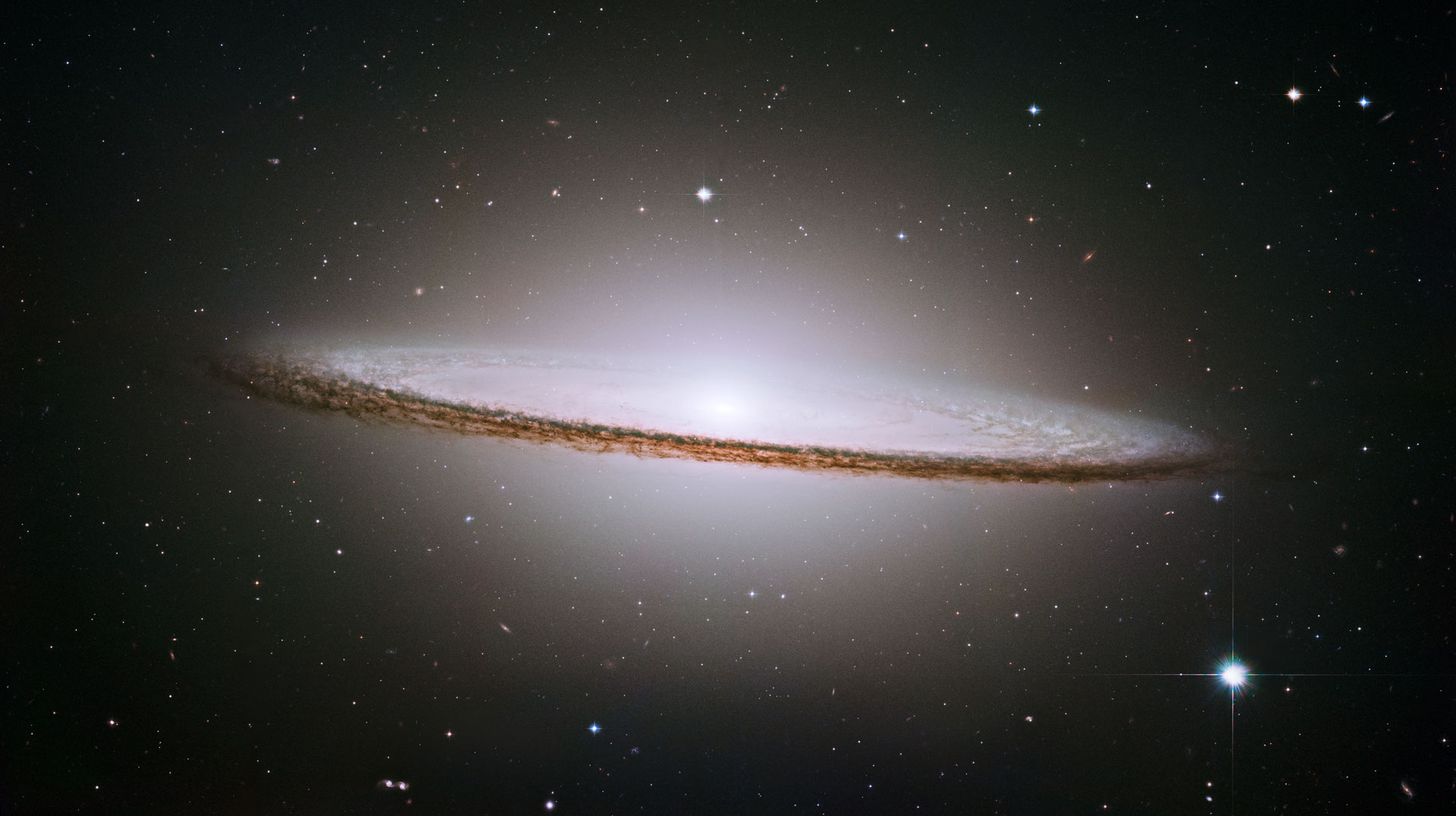
Number 10: Hubble Mosaic of the Majestic Sombrero Galaxy
NASA/ESA Hubble Space Telescope has trained its razor-sharp eye on one of the universe’s most stately and photogenic galaxies, the Sombrero galaxy, Messier 104 (M104). The galaxy’s hallmark is a brilliant white, bulbous core encircled by the thick dust lanes comprising the spiral structure of the galaxy. As seen from Earth, the galaxy is tilted nearly edge-on. We view it from just six degrees north of its equatorial plane. This brilliant galaxy was named the Sombrero because of its resemblance to the broad rim and high-topped Mexican hat.
At a relatively bright magnitude of +8, M104 is just beyond the limit of naked-eye visibility and is easily seen through small telescopes. The Sombrero lies at the southern edge of the rich Virgo cluster of galaxies and is one of the most massive objects in that group, equivalent to 800 billion suns. The galaxy is 50,000 light-years across and is located 30 million light-years from Earth. Credit: NASA/ESA and The Hubble Heritage Team (STScI/AURA)
Want to see more? View Hubble’s Top 100 Images
Never miss a breakthrough: Join the SciTechDaily newsletter.
Follow us on Google and Google News.
9 Comments
Beyond impressive. Hubble is so good and available that I rarely set up my own telescope…
Re: The Hubble Deep Field
I’d like to ask a question of somebody who works with the Hubble and the photographs it produces. Regarding the Hubble Deep Field photograph, in your opinion, if you were to place to Hubble in the farthest seeing galaxies in that picture, and take another photograph just like you did shooting the same way, do you believe that you would have chained the same results? That is, a picture somewhat like it with 10,000 more galaxies, just farther away? I’m very curious to hear your answer. Thanks, Bob Fisher
Re: my post regarding the Hubble Deep Field photograph. Sorry for the misspellings, I used voice to text and should have proof read it! I believe you’ll get the drift of my question though. In your opinion, if you place the Hubble at the farthest seen Galaxy in that picture, and took another picture into Infinite Space shooting the same direction, do you think the photo would have achieved the same results, or do you believe it would be something different? Thanks again.
That is a very interesting question.
If we looked far enough would we just eventually see ourselves from the other side as light bends around in a circle due to the the mass of gravity within the sphere of the universe…and if we were looking at ourself – how old is that light signal! Would we even know we are looking at our own galaxy from the other side?
Chandaryaan2 3D images. https://www.sarthtya.tech/2019/11/chandaryaan2-chandaryaan2-send-their.html?m=1
Amazing and beautifull photos,just makes me wonder what our galaxy really looks like. Do you think we’ll ever know ? Thankyou Hubble team for years of hard work and sharing.
Beautiful and fantastic thanks for sharing the wonders of the universe. Maybe people will learn something about the vastness of creation by these photos.
If we are looking at, for example, the Sombrero Galaxy, and it is 30 billion light years away, that means we are looking at what it was 30 billion years ago. What are the chances it’s even still there, or in a totally different form? That applies to everything we see in the night sky and beyond – we are only looking at something that used to be there, not what’s there now. It’s mind blowing to realize we are looking at ancient history.