
Insight-HXMT Breaks Own Measurement Record for Strongest Magnetic Field in Universe
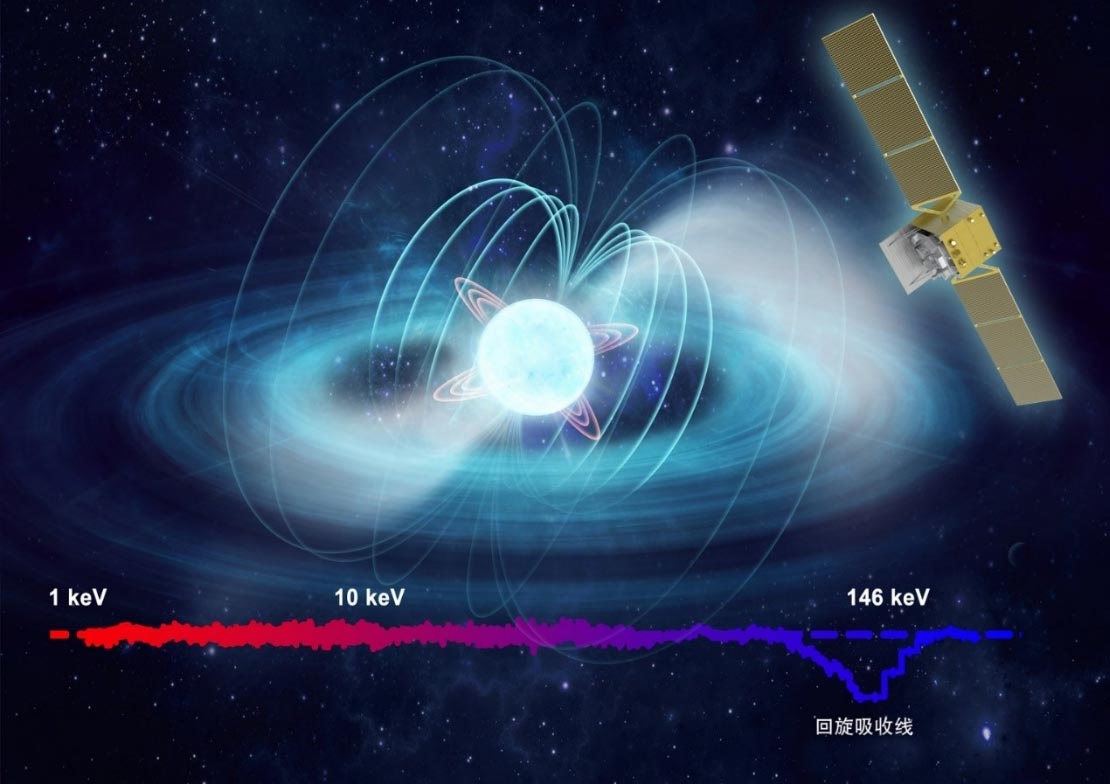
Neutron stars generate the strongest magnetic fields in the universe. However, the only way we have to measure their surface magnetic field directly is to observe the cyclotron absorption lines in their X-ray energy spectra. Recently, the Insight-HXMT team discovered a cyclotron absorption line with an energy of 146 keV in the neutron star X-ray binary Swift J0243.6+6124, which translates to a surface magnetic field of more than 1.6 billion Tesla.
After direct measurement of the strongest magnetic field in the universe at about 1 billion Tesla in 2020, the world records for the highest energy cyclotron absorption line and direct measurement of the strongest magnetic field in the universe have been smashed by a large margin.
The findings, which were published on June 28, 2022, in Astrophysical Journal Letters (ApJL), were obtained jointly by the Key Laboratory for Particle Astrophysics at the Institute of High Energy Physics (IHEP) of the Chinese Academy of Sciences and the Institute for Astronomy and Astrophysics, Kepler Center for Astro and Particle Physics, University of Tübingen (IAAT). Dr. Lingda Kong, Professor Shu Zhang, and Professor Shuangnan Zhang from IHEP are the corresponding authors of the paper. Dr. Victor Doroshenko and Professor Andrea Santangelo from the University of Tübingen significantly contributed to the discovery.
Neutron Star X-ray Binary Systems and Accretion Pulsars
A neutron star X-ray binary system consists of a neutron star and its companion star. Under the strong gravitational force of the neutron star, the gas of the companion star falls towards the neutron star, forming an accretion disk. The plasma in the accretion disk will fall along magnetic lines to the neutron star’s surface, where powerful X-ray radiation is released. Along with the rotation of the neutron star, such emissions result in periodic X-ray pulse signals, hence the name “X-ray accretion pulsar” for these objects.
Many observations have revealed that these types of objects have absorption structures in their X-ray radiation spectra, namely cyclotron absorption lines, which are thought to be caused by resonant scattering and thus absorption of X-rays by electrons moving along the strong magnetic fields. The energy of the absorption structure corresponds to the strength of the surface magnetic field of a neutron star; therefore, this phenomenon can be used to directly measure the strength of the magnetic field near the surface of the neutron star.

Ultraluminous X-ray Pulsars and the Significance of Swift J0243.6+6124
Ultraluminous X-ray pulsars are a class of objects whose X-ray luminosity far exceeds that of canonical X-ray accreting pulsars. They have previously been discovered in several galaxies far from the Milky Way. Astronomers have speculated that their pulsars have high magnetic field strengths even though direct measurement evidence is still lacking.
Insight-HXMT made detailed and broadband observations of the outburst of Swift J0243.6+6124, the Milky Way’s first ultraluminous X-ray pulsar, and unambiguously discovered its cyclotron absorption line. This line revealed energy up to 146 keV (with detection significance of about 10 times the standard deviation), which corresponds to a surface magnetic field of more than 1.6 billion Tesla. This is not only the strongest magnetic field directly measured in the universe to date but also the first detection of an electron cyclotron absorption line in an ultraluminous X-ray source, thus providing a direct measurement of the neutron star’s surface magnetic field.
Complexity of Neutron Star Magnetic Fields
It is believed that the surface magnetic fields of neutron stars have complex structures, ranging from dipole fields very far from the neutron star to multipole fields only influencing the area close to the neutron star. However, most earlier indirect estimates of the magnetic fields of neutron stars have probed only the dipole fields.
This time, the direct magnetic field measurement by Insight-HXMT based on the cyclotron absorption line is about an order of magnitude greater than that estimated using indirect means. This serves as the first concrete evidence that a neutron star’s magnetic field structure is more complex than that of a traditional symmetric dipole field, and it also provides the first measurement of the nonsymmetric component of a neutron star’s magnetic field.
Reference: “Insight-HXMT Discovery of the Highest-energy CRSF from the First Galactic Ultraluminous X-Ray Pulsar Swift J0243.6+6124” by Ling-Da Kong, Shu Zhang, Shuang-Nan Zhang, Long Ji, Victor Doroshenko, Andrea Santangelo, Yu-Peng Chen, Fang-Jun Lu, Ming-Yu Ge, Peng-Ju Wang, Lian Tao, Jin-Lu Qu, Ti-Pei Li, Cong-Zhan Liu, Jin-Yuan Liao, Zhi Chang, Jing-Qiang Peng and Qing-Cang Shui, 28 June 2022, The Astrophysical Journal Letters.
DOI: 10.3847/2041-8213/ac7711
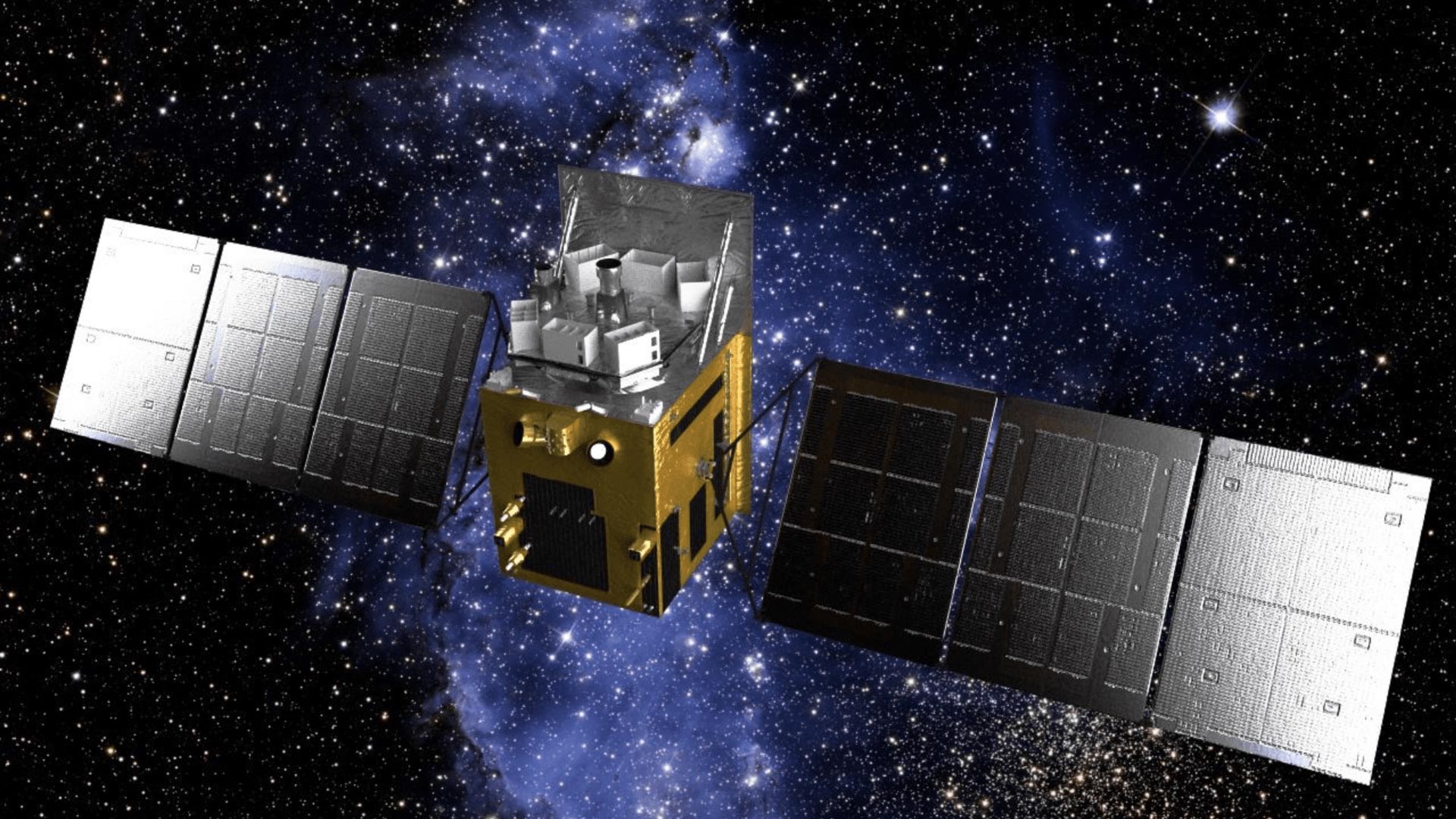
Insight-HXMT is the first Chinese X-ray astronomy satellite. It comprises scientific payloads including a high-energy telescope, medium-energy telescope, low-energy telescope, and a space environment monitor. Insight-HXMT has advantages over other X-ray satellites in terms of broadband (1-250 keV) spectral coverage, large effective area at high energies, high time resolution, low dead-time, and no pile-up effects for bright sources, thus opening up a new window for observing black holes, neutron stars with hard X-ray fast transitions, and energy spectrum studies.
In 2020, the Insight-HXMT team reported the detection of a 90 keV cyclotron absorption line from a neutron star in the X-ray binary system GRO J1008-57, corresponding to a surface magnetic field of 1 billion Tesla, which set a world record for direct measurement of the universe’s strongest magnetic field at the time. Later, a new record for a cyclotron absorption line—with its highest energy around 100 keV—was detected by Insight-HXMT from another neutron star in 1A 0535+262. Insight-HXMT has demonstrated its exceptional capacity to explore the energy spectrum by breaking its own records for cyclotron absorption line discoveries.
Insight-HXMT was proposed by Professor Tipei Li and Professor Mei Wu in 1993 at IHEP and was successfully launched on June 15, 2017. Its development is supported by the China National Space Administration and CAS. IHEP was responsible for satellite payloads, ground segments, and scientific research for this mission. The China Academy of Space Technology was responsible for the satellite system. Tsinghua University participated in the development of payload and ground segments. The National Space Science Center and Beijing Normal University were also involved in the mission. The calibration of the detectors on board Insight-HXMT was supported by the National Institute of Metrology, Ferrara University in Italy, and the Max Planck Institute for Extraterrestrial Physics.
Never miss a breakthrough: Join the SciTechDaily newsletter.
Follow us on Google and Google News.
3 Comments
I wonder what the strongest field is that life can survive. For example, can synapses function at even 1.6 MT? What about hormone receptors? Can molecules properly align with them despite potential cylcotron/precession effects on the charged parts of the molecule?
They have not a clue they act like all this highly intelligent designs was a big bang yay then we climbed out a slime pool how stupid sorry but you can’t accidently create a universe and earth with people I dare you to just study the design of one eyeball DNA design godis realyou no what’s realy funny he said every knee will bow and tounge confess that Jesus christ is lord so all you wise guys and atheists gonna have to admit it on your knees before you get a one way ticket for eternity in he’ll reap it
I love it when people judge others and say “you’re going to hell! Burn!”
What exactly does the Bible say happens to people who love to judge others? That’s a serious question by the way. If I go by the literal interpretation of what hell is like according to the Bible….I would not wish that on anyone. Not only that but, be excited about it?