
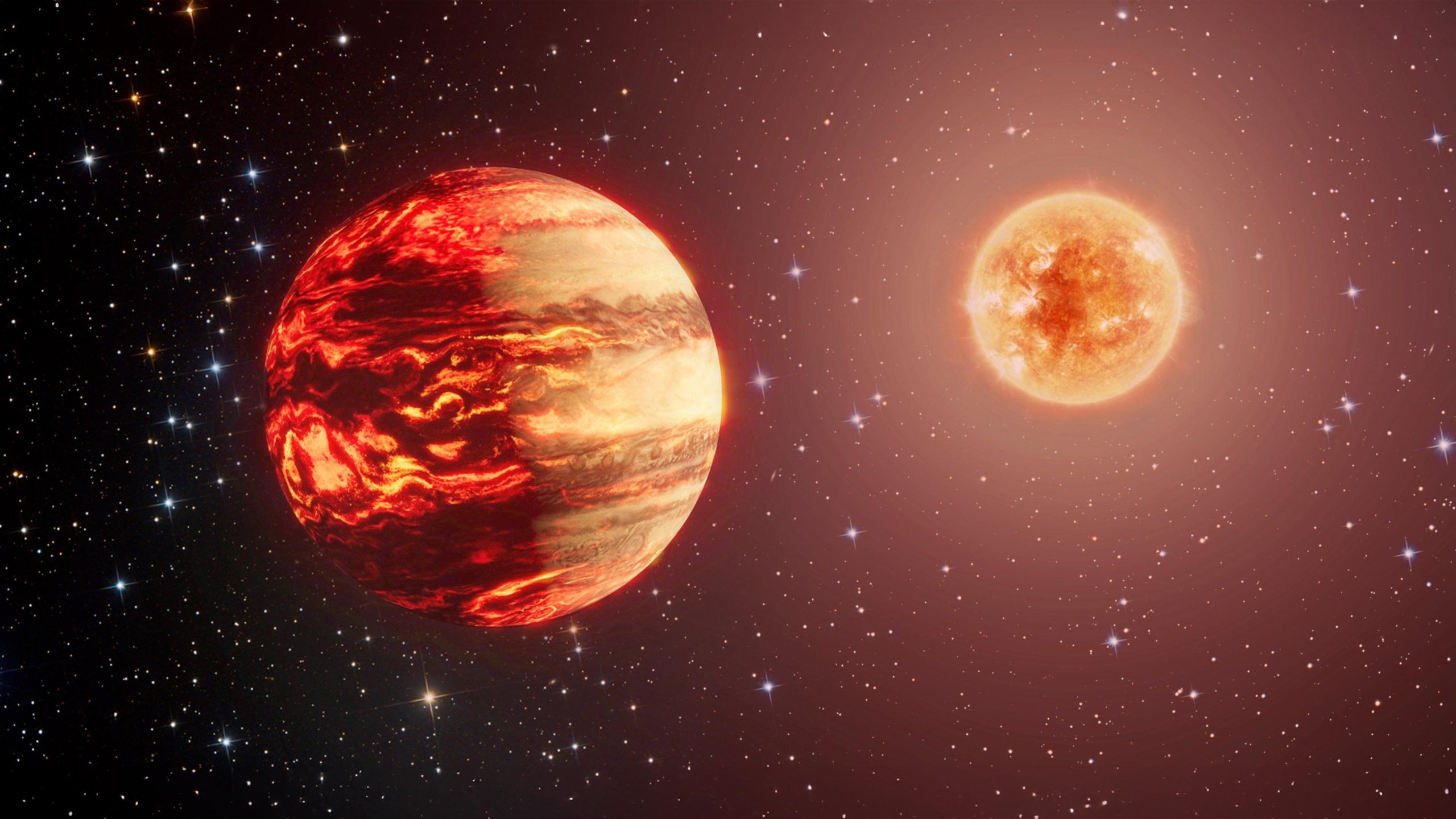
Astronomers combined Gaia and GRAVITY data to image dim objects near bright stars, potentially revolutionizing the search for nearby exoplanets.
Detecting faint objects close to bright stars is incredibly difficult. Yet, by combining data from ESA’s Gaia space telescope with ESO’s GRAVITY instrument on the ground, scientists managed just that. They captured the first light signals of so far unseen dim companions of eight luminous stars. The technique unlocks the tantalizing possibility to capture images of planets orbiting close to their host stars.
Scientists Spot Hidden Companions of Bright Stars
Have you ever tried to take a picture of a firefly next to a bright streetlight? Chances are that all you will see in your snapshot is the glare from the lamp post. This is the same problem faced by astronomers chasing faint, small, stars or planets next to a bright star.
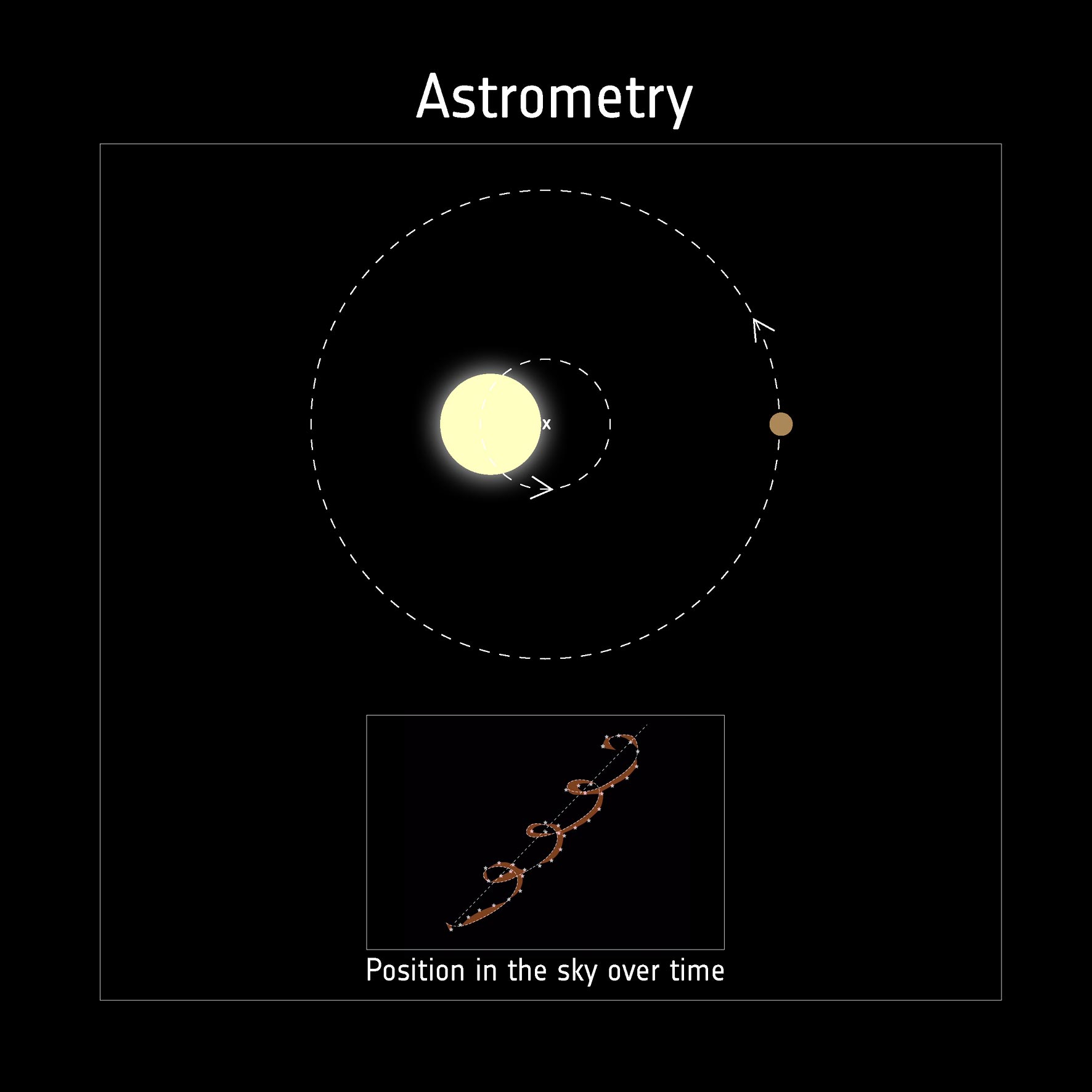
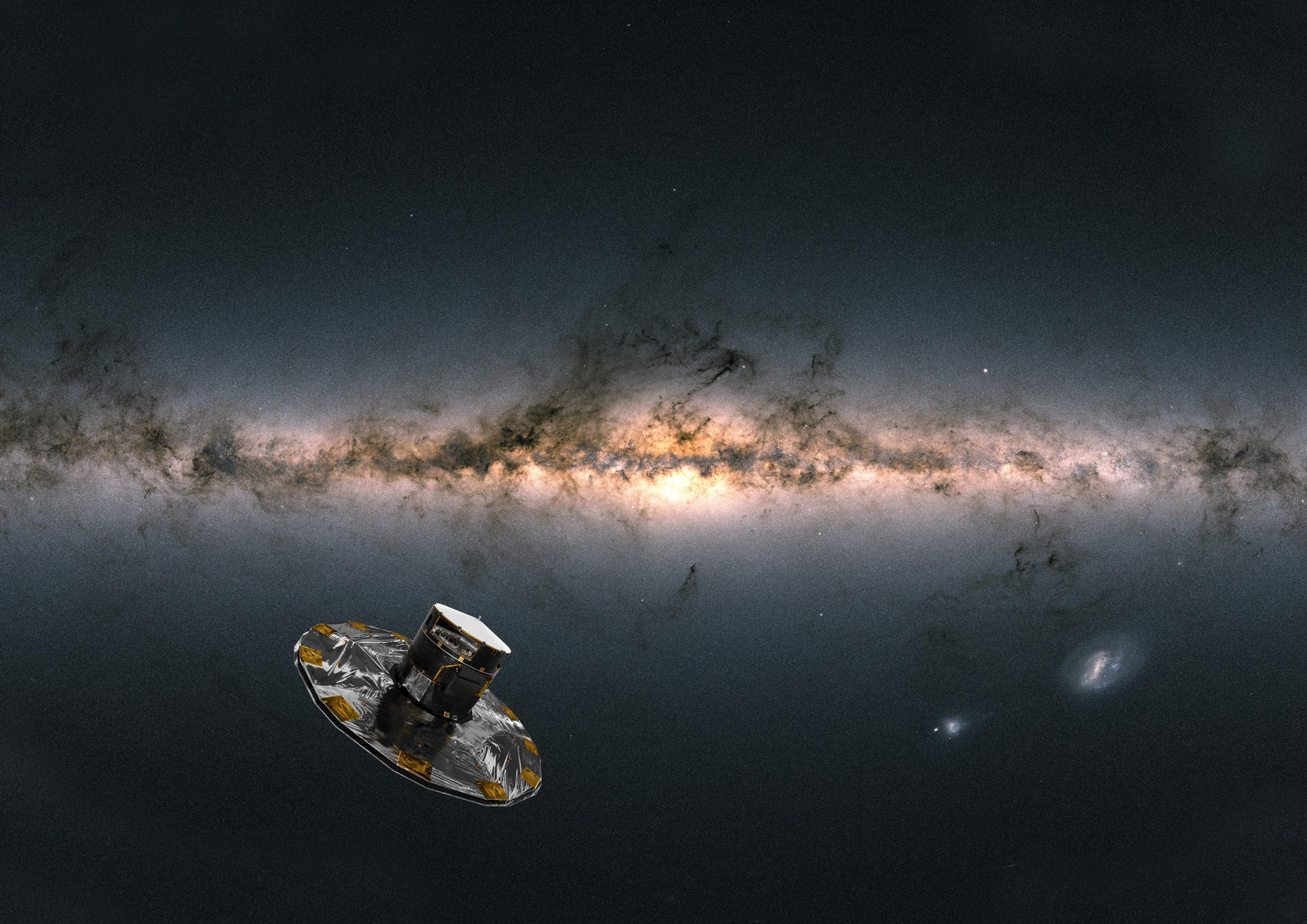
To tackle the problem, an international team of astronomers led by Thomas Winterhalder, scientist at the European Southern Observatory (ESO), started by searching through the catalog produced by Gaia, which lists hundreds of thousands of stars that are suspected to have a companion. Although the companion objects are not bright enough to be seen by Gaia directly, their presence leads to tiny wobbles in the paths of the more luminous host stars (see image below), which only Gaia can measure.
In Gaia’s catalog of stellar orbits, the team identified eight stars to be targeted by GRAVITY, the advanced near-infrared interferometer at the Very Large Telescope of ESO, at Cerro Paranal in Chile. GRAVITY combines infrared light from different telescopes to pick up tiny details in faint objects, in a technique called interferometry.
Breakthrough Discoveries
Thanks to GRAVITY’s uniquely sharp and sensitive eye, the team caught the light signal of all eight predicted companions, seven of which were previously unknown. Three of the companions are very small and faint stars, while the other five are brown dwarfs. These are celestial objects in between planets and stars: more massive than the heaviest of planets but lighter and fainter than the lightest of stars.
One of the brown dwarfs spotted in this study orbits its host star at the same distance as Earth from the Sun. This is the first time a brown dwarf so close to its host star could be directly captured.
Enhanced Space Research Collaboration
“We have demonstrated that it is possible to capture an image of a faint companion, even when it orbits very close to its bright host,” explains Thomas. “This achievement highlights the remarkable synergy between Gaia and GRAVITY. Only Gaia can identify such tight systems hosting a star and a ‘hidden’ companion, and then GRAVITY can take over to image the smaller and fainter object with unprecedented accuracy.”
In an earlier study, astronomers used Gaia data and a different ground-based observatory to capture the image of a giant gas exoplanet. This planet orbits its host star at about 17 times the distance of Earth from the Sun, tracing an angle in the sky considerably wider than the typical separation of the companions imaged by GRAVITY in this new result.
The small companions inferred from Gaia observations typically lie at tiny separation angles of a few dozen milliarcseconds, which is about the size of a one-Euro coin viewed from 100 km distance.
“In our observations, Gaia data act as a kind of signpost,” continues Thomas. “The part of the sky that we can see with GRAVITY is very small, so we need to know where to look. Gaia’s unparalleled precise measurements of the movements and positions of stars are essential to point our instrument to the right direction in the sky.”
Dream Team
The complementarity of Gaia and GRAVITY goes beyond using Gaia’s data to plan follow-up observations and enable detections. By combining the two data sets, the scientists were able to ‘weigh’ the individual celestial objects separately and tell apart the mass of the host star and the respective companion.
GRAVITY also measured the contrast between the companion and host star across a range of wavelengths in the infrared. Combined with the estimates of the mass, this knowledge enabled the team to assess the age of the companions. Surprisingly, two of the brown dwarfs turned out to be less luminous than one would expect given their size and age. A possible explanation for this could be that the dwarfs themselves have an even smaller companion.
More than 5000 exoplanets have been discovered to date, but what do they look like? ESA’s dedicated exoplanet missions Cheops, Plato, and Ariel are on a quest to find out. Credit: ESA
Hunting for Exoplanets
Having demonstrated the power of the Gaia-GRAVITY ensemble, the scientists are now looking forward to tracking down potential planet companions of the stars listed in the Gaia catalog.
“The ability to tease out the tiny motions of close-by pairs in the sky is unique to the Gaia mission. The next catalog, to be made available as part of the fourth data release (DR4), will contain an even richer collection of stars with potentially smaller companions,” remarks Johannes Sahlmann, ESA’s Gaia scientist. “This result breaks new ground in the hunt for planets in our galaxy and promises us glimpses of new distant worlds.”
For more on this research, see Gaia and GRAVITY Unmask Brown Dwarfs Lurking Near Bright Stars.
Reference: “Combining Gaia and GRAVITY: Characterising five new directly detected substellar companions” by T.O. Winterhalder, S. Lacour, A. Merand, J. Kammerer, A.-L. Maire, T. Stolker, N. Pourre, C. Babusiaux, A. Glindemann, R. Abuter, A. Amorim, R. Asensio-Torres, W.O. Balmer, M. Benisty, J.-P. Berger, H. Beust, S. Blunt, A. Boccaletti, M. Bonnefoy, H. Bonnet, M.S. Bordoni, G. Bourdarot, W. Brandner, F. Cantalloube, P. Caselli, B. Charnay, G. Chauvin, A. Chavez, E. Choquet, V. Christiaens, Y. Clénet, V. Coudé du Foresto, A. Cridland, R. Davies, R. Dembet, J. Dexter, A. Drescher, G. Duvert, A. Eckart, F. Eisenhauer, N.M. Forster Schreiber, P. Garcia, R. Garcia Lopez, T. Gardner, E. Gendron, R. Genzel, S. Gillessen, J.H. Girard, S. Grant, X. Haubois, G. Heißel, Th. Henning, S. Hinkley, S. Hippler, M. Houlle, Z. Hubert, L. Jocou, M. Keppler, P. Kervella, L. Kreidberg, N.T. Kurtovic, A.-M. Lagrange, V. Lapeyrere, J.-B. Le Bouquin, D. Lutz, F. Mang, G.-D. Marleau, P. Molliere, J.D. Monnier, C. Mordasini, D. Mouillet, E. Nasedkin, M. Nowak, T. Ott, G.P.L. Otten, C. Paladini, T. Paumard, K. Perraut, G. Perrin, O. Pfuhl, L. Pueyo, D.C. Ribeiro, E. Rickman, Z. Rustamkulov, J. Shangguan, T. Shimizu, D. Sing, J. Stadler, O. Straub, C. Straubmeier, E. Sturm, L.J. Tacconi, E.F. van Dishoeck, A. Vigan, F. Vincent, S.D. von Fellenberg, J. Wang, F. Widmann, J. Woillez and S. Yazici, 20 June 2024, Astronomy & Astrophysics.
DOI: 10.1051/0004-6361/202450018
Never miss a breakthrough: Join the SciTechDaily newsletter.
Follow us on Google and Google News.