
ESA’s Gaia mission has helped discover a new kind of black hole. The new family already has two members, and both are closer to Earth than any other black hole that we know of.
A team of astronomers studied the orbits of stars tracked by Gaia and noticed that some of them wobbled on the sky, as if they were gravitationally influenced by massive objects. Several telescopes looked for the objects, but no light could be found, leaving only one possibility: black holes.
New Population of Black Holes
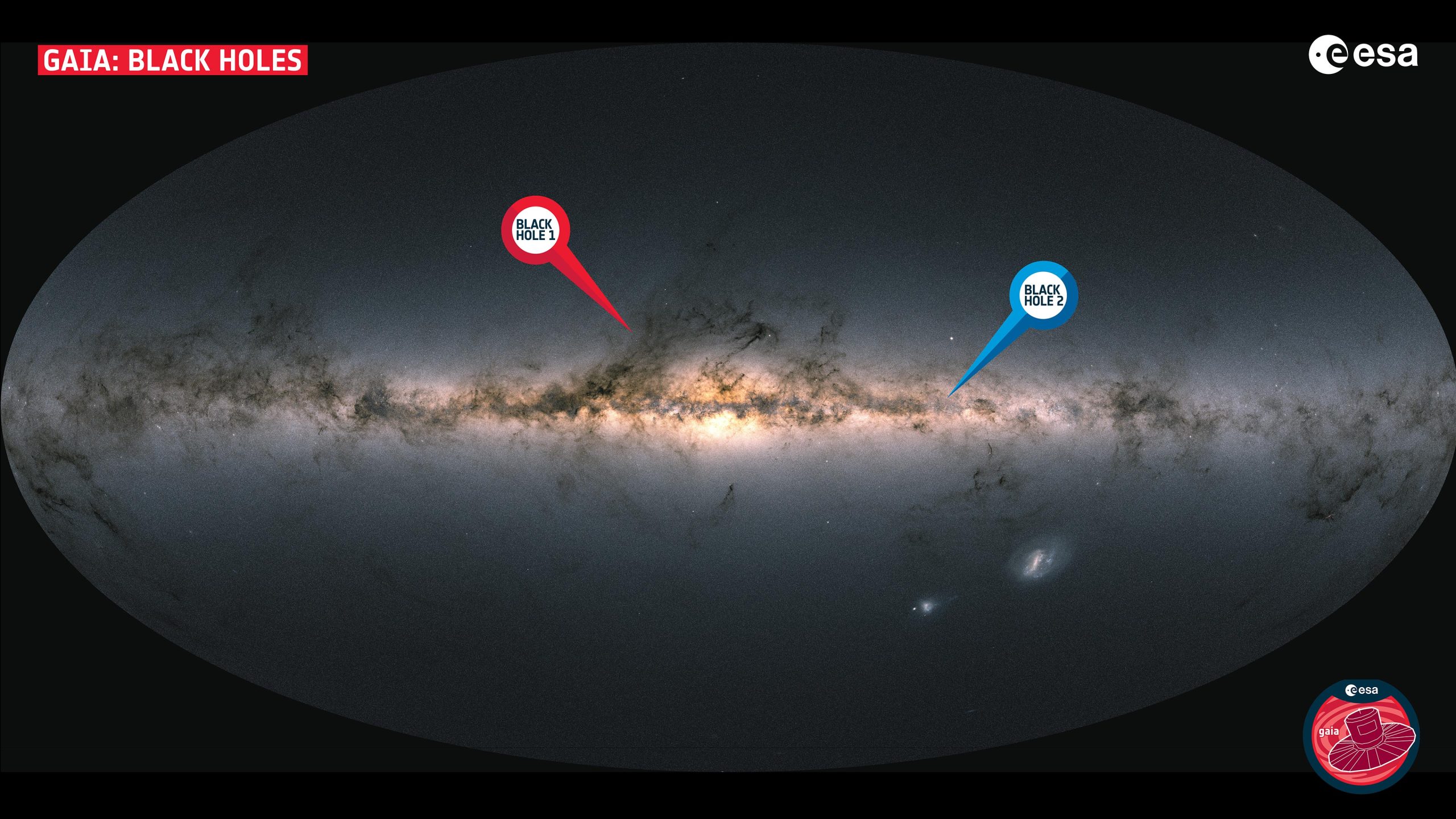
Using data from ESA’s Gaia mission, astronomers have discovered not only the closest but also the second closest black hole to Earth. The black holes, Gaia BH1 and Gaia BH2, are respectively located just 1560 light-years away from us in the direction of the constellation Ophiuchus and 3800 light-years away in the constellation Centaurus. In galactic terms, these black holes reside in our cosmic backyard.
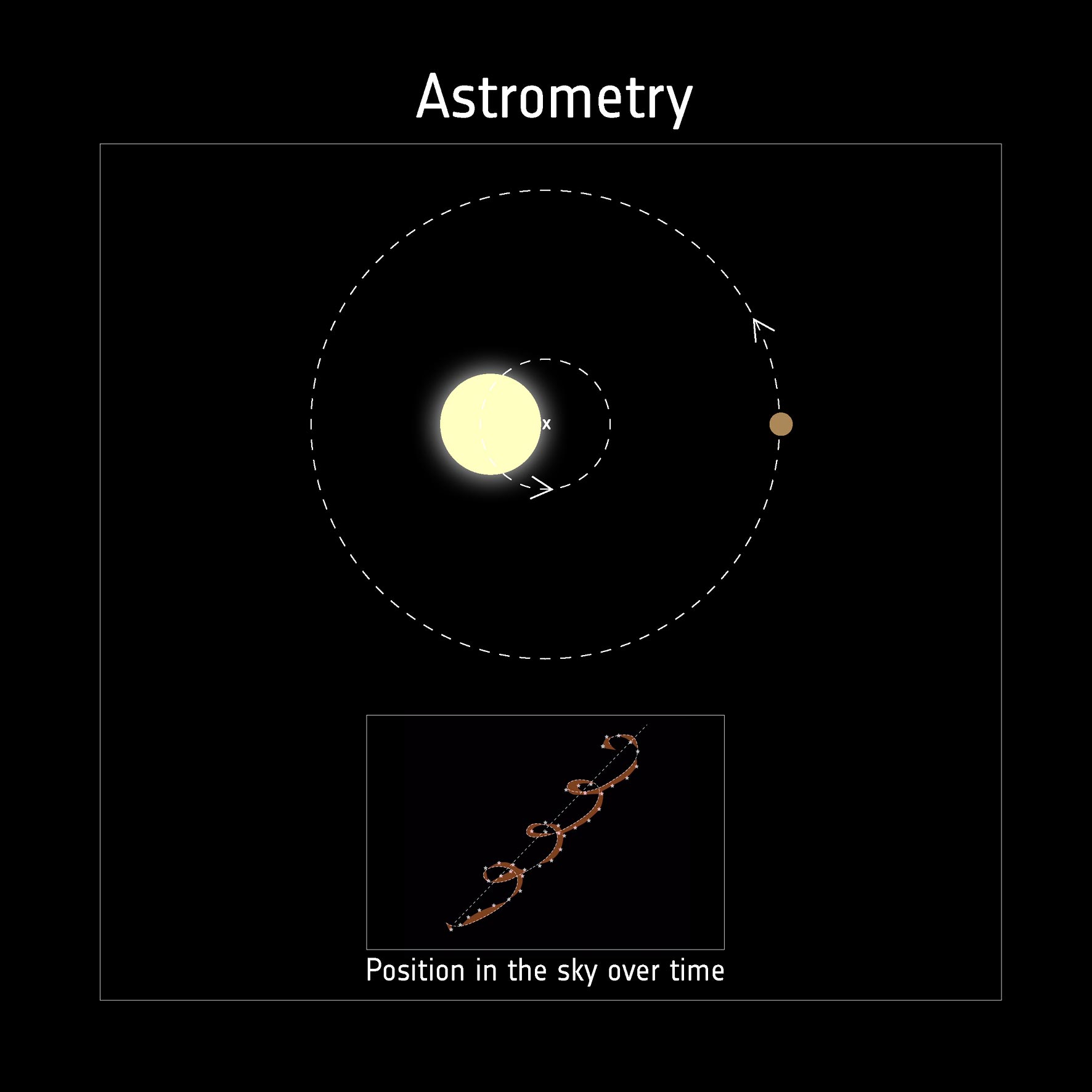
The two black holes were discovered by studying the movement of their companion stars. A strange ‘wobble’ in the movement of the stars on the sky indicated that they are orbiting a very massive object. In both cases, the objects are approximately ten times more massive than our Sun. Other explanations for these massive companions, like double-star systems, were ruled out since they do not seem to emit any light.
Until recently, all the black holes astronomers knew of were discovered by emission of light – usually at X-ray and radio wavelengths – produced by material falling in. The new black holes are truly black and can only be detected by their gravitational effects. The distance of the stars to the black hole, and the orbits of the stars around them, are much longer than for other known binary systems of black holes and stars. Those closer star-black hole pairs, called X-ray binaries, tend to be very bright in X-ray and radio light, and thus easier to find. But the new discoveries suggest that black holes in wider binaries are more common.
“What sets this new group of black holes apart from the ones we already knew about is their wide separation from their companion stars. These black holes likely have a completely different formation history than X-ray binaries,” explains Kareem El-Badry, discoverer of the new black holes and researcher at the Harvard-Smithsonian Center for Astrophysics in the US and the Max-Planck Institute for Astronomy in Heidelberg, Germany.
ESA’s Gaia mission has helped discover a new kind of black hole. The new family already has two members, and both are closer to Earth than any other black hole that we know of. The two black holes were discovered by studying ultra-precise measurements of stellar positions and motions in Gaia’s third data release. A strange ‘wobble’ in the movement of two stars on the sky indicated that they are orbiting a very massive object. In both cases, the objects are approximately ten times more massive than our Sun. Other explanations for these massive companions, like double-star systems, were ruled out since they do not seem to emit any light. Gaia’s second black hole, BH2, is located 3800 light-years away from Earth. It is a binary system consisting of a red giant star and likely a black hole. In this animation of Gaia BH2, created in Gaia Sky, the orbits are accurately sized, but the back hole diameter is not to scale. Credit: ESA/Gaia/DPAC, CC BY-SA 3.0 IGO
Movement of Billions of Stars
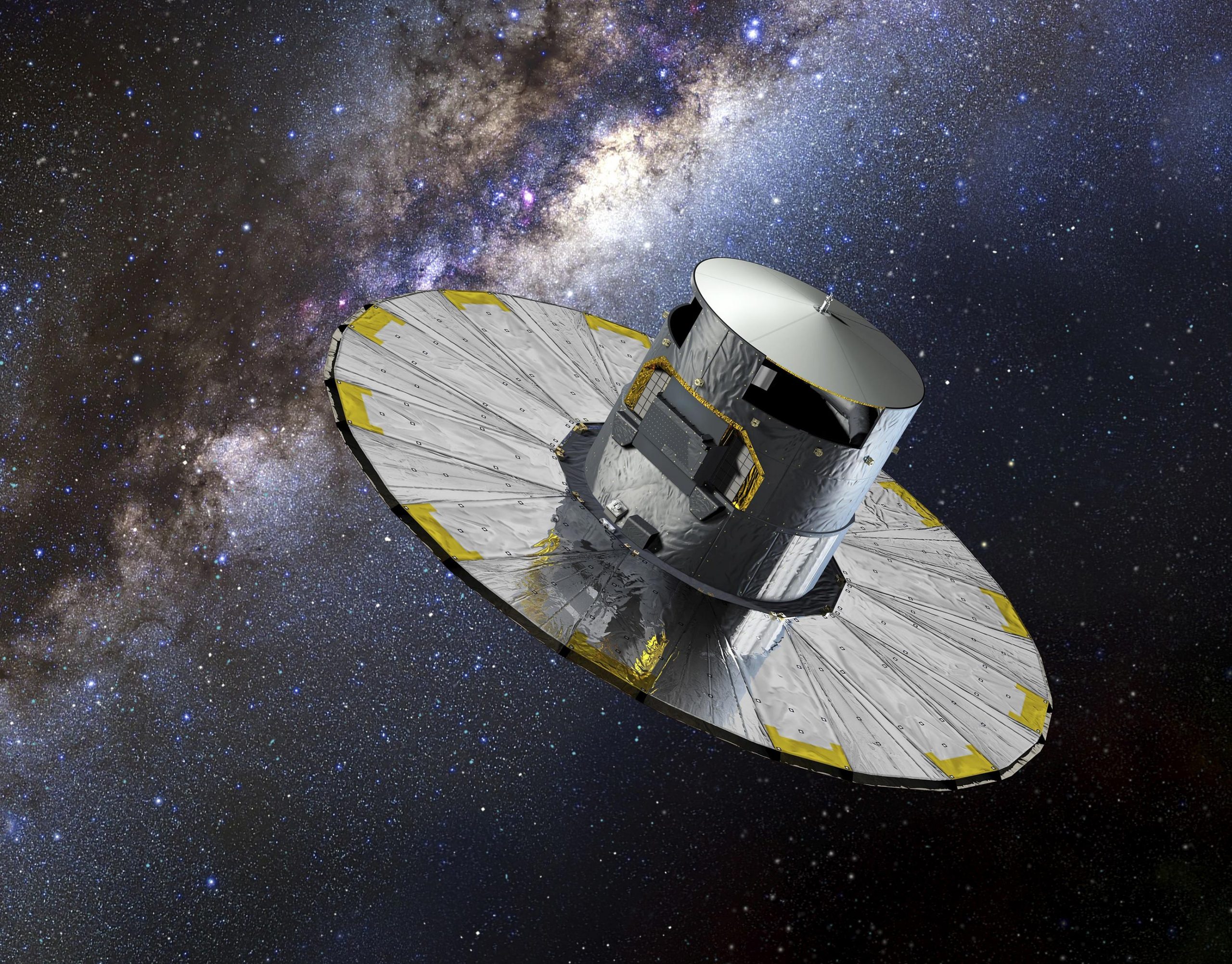
The black holes were discovered using Gaia data. Gaia accurately measures the positions and motions of billions of stars. The movement of stars against the sky can give essential clues about objects that gravitationally influence these stars. These objects can include other stars, exoplanets, and also black holes.
“The accuracy of Gaia’s data was essential for this discovery. The black holes were found by spotting the tiny wobble of its companion star while orbiting around it. No other instrument is capable of such measurements,” says Timo Prusti, ESA’s Gaia project scientist.
Gaia provided accurate measurements of the movement in three directions, but to understand more precisely how the stars moved away and towards us, additional radial velocity measurements were needed. Ground-based observatories provided these for the newly found black holes, and this gave the final clue to conclude that the astronomers had detected black holes.
Invisible Black Holes
Black holes are often not completely invisible. When material falls onto them, they may emit light in radio and X-ray. For Gaia’s second black hole, NASA’s Chandra X-ray Observatory and the South African MeerKAT radio telescope on the ground looked for this light, but they were not able to spot any signal.
“Even though we detected nothing, this information is incredibly valuable because it tells us a lot about the environment around a black hole. There are a lot of particles coming off the companion star in the form of stellar wind. But because we didn’t see any radio light, that tells us the black hole isn’t a great eater and not many particles are crossing its event horizon. We don’t know why that is, but we want to find out!” says Yvette Cendes who helped discover the second black hole and is an astronomer at the Harvard-Smithsonian Center for Astrophysics in the US.
The new type of black hole does not emit any light, making them practically invisible, probably because they are much further away from their companion stars. Gaia BH1 and Gaia BH2 have the most widely separated orbits of all known black holes. The fact that they are also the closest known black holes to Earth suggests that many more similar black holes in wide binaries are still waiting to be discovered.
“This is very exciting because it now implies that these black holes in wide orbits are actually common in space – more common than binaries where the black hole and star are closer. But the trouble is detecting them. The good news is that Gaia is still taking data, and its next data release (in 2025) will contain many more of these stars with mystery black hole companions in it,” Yvette explains.
Gaia’s next data release will be based on 66 months of observations and will contain improved information on the orbits of stars. In the meantime, astronomers will be busy figuring out where these black holes in wide orbits come from.
Kareem El-Badry points out: “We suspected that there could exist black holes in wider systems, but we were not sure how they would have formed. Their discovery means that we must adapt our theories about the evolution of binary star systems as it is not clear yet how these systems form.”
“Gaia’s Data Processing and Analysis Consortium is developing methods to identify astrometric binaries with compact companions. We expect to provide a good sample of candidates in the next Gaia data release,” says team member Tsevi Mazeh from Tel Aviv University. The scientific community looks forward to further expand this new population of dormant black holes.
On June 13, 2022 Gaia released, for the first time, results from its non-single star processing. The Gaia binary star survey surpasses all the work on binary stars from the past two centuries. These two black holes were found by investigating two of the solutions from this catalog of more than 813,000 binary star systems. Gaia Data Release 4 is expected to further increase the accuracy of binary star solutions, possibly revealing many more exciting candidates for follow-up.
Reference: “A red giant orbiting a black hole” by Kareem El-Badry, Hans-Walter Rix, Yvette Cendes, Antonio C Rodriguez, Charlie Conroy, Eliot Quataert, Keith Hawkins, Eleonora Zari, Melissa Hobson, Katelyn Breivik, Arne Rau, Edo Berger, Sahar Shahaf, Rhys Seeburger, Kevin B Burdge, David W Latham, Lars A Buchhave, Allyson Bieryla, Dolev Bashi, Tsevi Mazeh and Simchon Faigler, 30 March 2023, Monthly Notices of the Royal Astronomical Society.
DOI: 10.1093/mnras/stad799
Never miss a breakthrough: Join the SciTechDaily newsletter.
Follow us on Google and Google News.
2 Comments
Lower verbiage to different level.
You are a very successful scientist.