
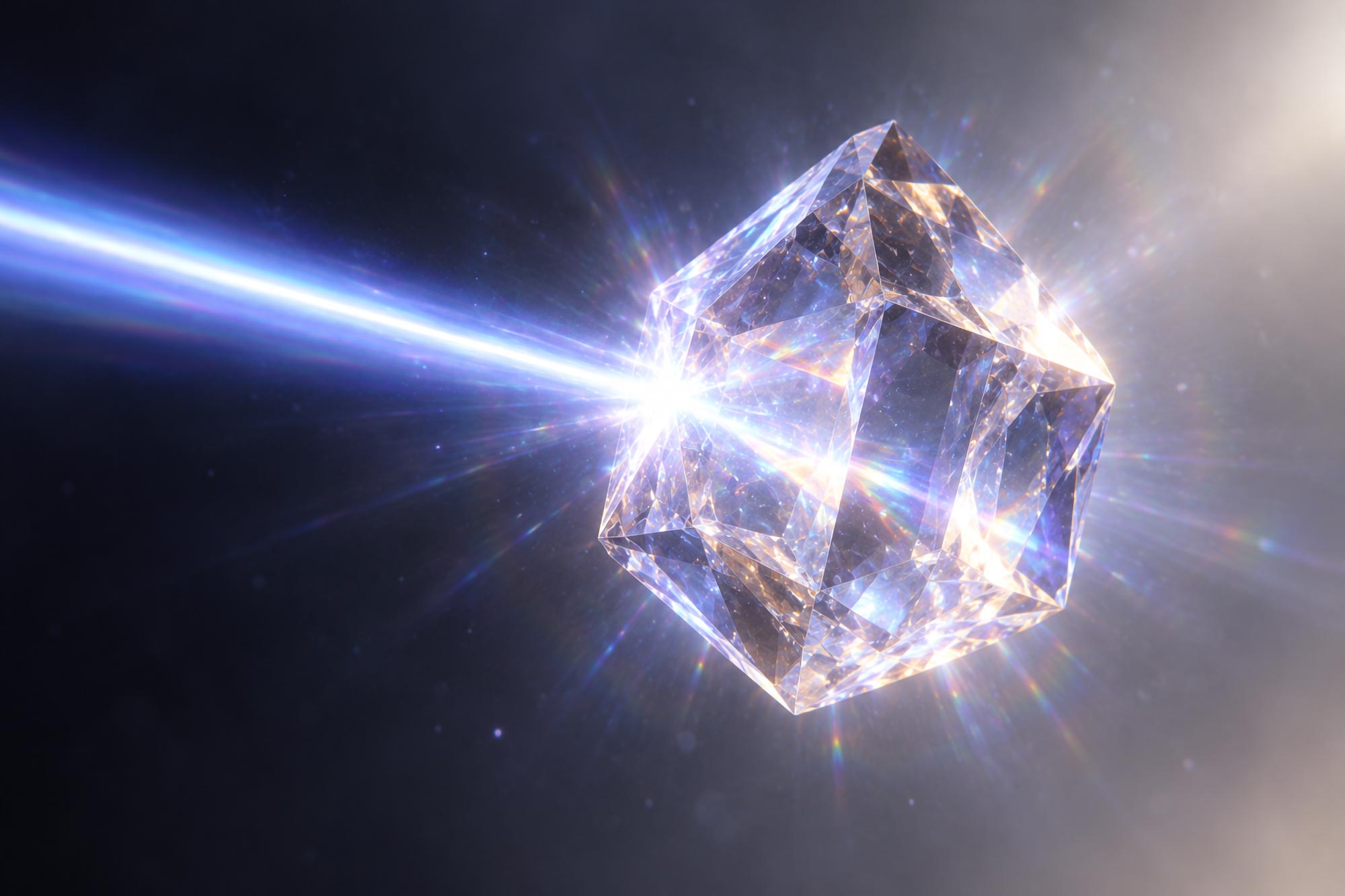
A crystal’s laser-induced electrical order lasts just a trillionth of a second, giving researchers a way to explore ultrafast approaches to processing and storing information.
Inside a crystal, tiny electrical regions can point in different directions or line up in an organized pattern. Cooling helps bring them into alignment, but physicists at Auburn University have now shown that brief flashes of laser light can also produce order at warmer temperatures, where those regions would otherwise remain disorganized.
The team worked with single crystals of a modified form of strontium titanate. The material allows electrons to move through it while also containing tiny regions with distinct positive and negative sides, an unusual combination of electrical properties. These regions are known as polar nanoregions.
Cooling aligns existing polar regions
For decades, physicists have debated whether atoms shift together to create the material’s polarized state or whether its polar regions already exist and become organized as it cools. Telling those explanations apart has been difficult because the regions are so small and their signals so faint.
Wencan Jin, the Thomas and Jean Walter Endowed Associate Professor in Auburn’s Department of Physics, led the research with graduate student Mohamed Kandil. The project began at the 2023 American Physical Society March Meeting, where Jin connected with researchers in Japan who could grow the crystals. Collaborators at Japan’s National Institute of Advanced Industrial Science and Technology grew the samples used in the experiments.
The Auburn researchers built a highly sensitive laser-based measurement system, then spent nearly a year improving the equipment before detecting the regions’ faint optical signal. By measuring how the crystal changed incoming light, they could track the regions’ alignment through repeated rounds of warming and cooling. The measurements showed disordered directions at higher temperatures giving way to preferred orientations as the crystal cooled. This provided strong evidence that the polar regions were already present before they lined up.
A picosecond of laser-induced order
The team still had to capture the fleeting moment when laser illumination brought the regions into alignment. “The breakthrough came in 2025, when Mohamed finally observed the disordered polar regions becoming aligned under laser illumination,” Jin said. “Seeing that signal emerge was a thrilling moment for the team.”
The light-induced alignment lasted only a picosecond, or one trillionth of a second (10⁻¹² second), but an optical measurement could still detect the resulting pattern. Being able to create and read that brief arrangement with light gives researchers a way to investigate extremely fast approaches to processing and storing information. It also provides a tool for studying electrical behavior that is otherwise difficult to observe.
“This experiment has truly been Mohamed’s odyssey,” Jin said. “It took him three years of dedication to complete the work and achieve his first publication.”
Reference: “Optical Poling of a Quantum Ferroelectric Metal across the Order-Disorder Phase Transition” by Mohamed Kandil, Yasuhide Tomioka, Yafei Ren, Ryan Comes, Isao H. Inoue and Wencan Jin, 14 October 2026, Physical Review Letters.
DOI: 10.1103/nx3d-1mqf
Never miss a breakthrough: Join the SciTechDaily newsletter.
Follow us on Google and Google News.
3 Comments
Physicists Use Light To Unlock a Crystal’s Hidden Electrical Powers
VERY GOOD.
Physicists, please think deeply: What is the fundamental difference between your research and the photosynthesis of plants on principle?
I don’t know if it’s the intenet, but you’re coming off very condescending–as if using lasers, with crystal, to generate an electrical moment is at all the same as plants using sunlight for a biological process that figuratively “cooks” glucose.
Forgive me, but I’m not quite convinced that you read the article. Or perhaps you didn’t know any of the finer things about photosynthesis.
You’d have a better time comparing photovoltaic panels to plant processes, and even that’s not a like comparison.
Do you believe my analysis?
Current physics and mathematics are flooded with overworshipped formalism: parity nonconservation, the pretense of infinitedimensional Hilbert spaces, abstract algebraic structures devoid of geometric reality, the alleged inherent asymmetry between topological vortices and antivortices, the halfdead cat, quantum nonlocality, and the arbitrary definition of matter and antimatter unconstrained by time. These “theories” proliferate in academic journals because their proponents believe that by manipulating intricate mathematical symbols they can negate the empirical essence of nature and geometric entities.