
Close Menu
    Facebook X (Twitter) Instagram
    SciTechDaily
    • Biology
    • Chemistry
    • Earth
    • Health
    • Physics
    • Science
    • Space
    • Technology
    Facebook X (Twitter) Pinterest YouTube RSS
    SciTechDaily
    Home»Physics»New Method for Detecting the Invisible Properties of Nano-Structured Light Fields
    Physics

    New Method for Detecting the Invisible Properties of Nano-Structured Light Fields

    By University of MünsterSeptember 20, 2019No Comments3 Mins Read
    Facebook Twitter Pinterest Telegram LinkedIn WhatsApp Email Reddit
    Share
    Facebook Twitter LinkedIn Pinterest Telegram Email Reddit
    New Method for the Measurement of Nano Structured Light Fields
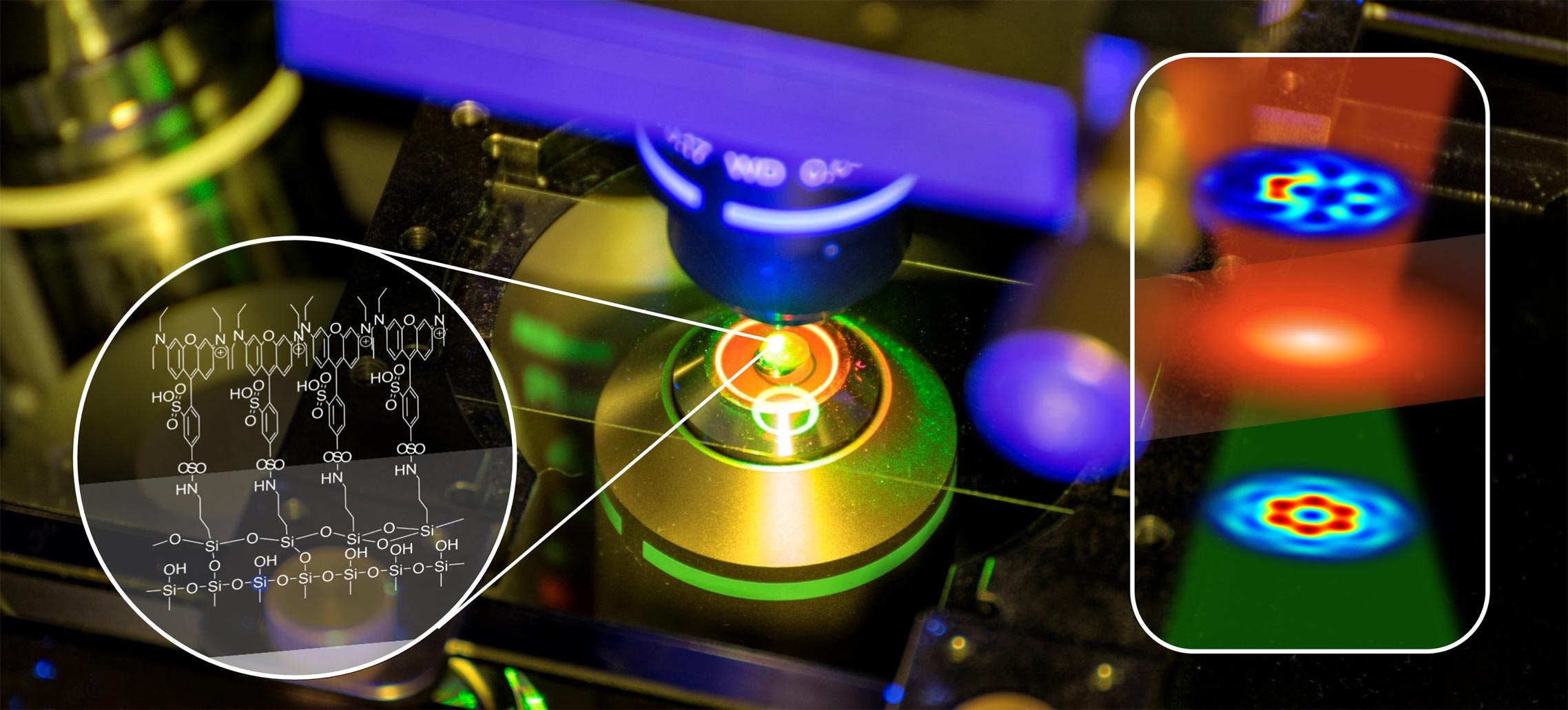
    A monolayer of organic molecules is placed in the focused light field and replies to this illumination by fluorescence, embedding all information about the invisible properties. Credit: Pascal Runde

    Researchers combine nano-optics and organic chemistry to measure complex light landscapes in the tight focus of a laser beam in a study published in Nature Communications.

    Structured laser light has already opened up various different applications: it allows for precise material machining, trapping, manipulating of defined movement of small particles or cell compartments, as well as increasing the bandwidth for next-generation intelligent computing.

    If these light structures are tightly focused by a lens, like a magnifying glass used as burning glass, highly intense three-dimensional light landscapes will be shaped, facilitating a significantly enhanced resolution in named applications. These kinds of light landscapes have paved the way to pioneering applications such as the Nobel prize awarded STED microscopy.

    However, these nano-fields themselves could not be measured yet, since components are formed by tight focusing which are invisible for typical measurement techniques. Up to now, this lack of appropriate metrological methods has impeded the breakthrough of nano-structured light landscapes as a tool for material machining, optical tweezers, or high-resolution imaging.

    A team around physicist Prof. Dr. Cornelia Denz of the Institute of Applied Physics and chemist Prof. Dr. Bart Jan Ravoo of the Center for Soft Nanoscience at the University of Münster (Germany) successfully developed a nano-tomographic technique which is able to detect the typically invisible properties of nano-structured fields in the focus of a lens – without requiring any complex analysis algorithms or data post-processing. For this purpose, the team combined their knowledge in the field of nano-optics and organic chemistry to realize an approach based on a monolayer of organic molecules. This monolayer is placed in the focused light field and replies to this illumination by fluorescence, embedding all information about the invisible properties.

    By the detection of this reply, the distinct identification of the nano-field by a single, fast, and straightforward camera image is enabled. “This approach finally opens the till now unexploited potential of these nano-structured light landscapes for many more applications,” says Cornelia Denz, who is heading the study. The study has been published in the journal “Nature Communications.”

    Reference: “Polarization nano-tomography of tightly focused light landscapes by self-assembled monolayers” by Eileen Otte, Kemal Tekce, Sebastian Lamping, Bart Jan Ravoo and Cornelia Denz, 20 September 2019, Nature Communications.
    DOI: 10.1038/s41467-019-12127-3

    The study received financial support from the Cells-in-Motion Cluster of Excellence and the Transregio Collaborative Research Center 61 “Multilevel Molecular Assemblies: Structure, Dynamics and Function,” both at Münster University.

    Never miss a breakthrough: Join the SciTechDaily newsletter.
    Follow us on Google and Google News.

    Lasers Nanotechnology Optics Organic Chemistry University of Münster
    Share. Facebook Twitter Pinterest LinkedIn Email Reddit

    Related Articles

    Revolutionary Imaging Technique Unlocks Secrets of Matter at Extreme Speeds

    High-Power Vortex Lasers Could Transform Manufacturing and Imaging

    Rewriting the Rules of Magnetism: How Laser Pulses Could Redefine Data Storage

    Nanostructures Enable Record High-Harmonic Generation From Ultra-Intense Laser Pulses

    Solid-State Laser Refrigeration of Nanoscale Sensors Achieved – Could Revolutionize Bio-Imaging and Quantum Communication

    Physics Process Yielding Nanolasers in 2D Semiconductors Could Be Game-Changer for High Speed Communications

    Cathodoluminescence Used to Probe Metamaterials

    Fastest Laser Blast – 67 Quintillionths of a Second

    New Nanofabrication Process for Metamaterials

    Leave A Reply Cancel Reply

    • Facebook
    • Twitter
    • Pinterest
    • YouTube

    Don't Miss a Discovery

    Subscribe for the Latest in Science & Tech!

    Trending News

    New Pill Lowers Stubborn Blood Pressure and Protects the Kidneys

    Humans May Have Hidden Regenerative Powers, New Study Suggests

    Scientists Just Solved the Mystery of Why Crabs Walk Sideways

    Doctors Are Surprised by What This Vaccine Is Doing to the Heart

    This Popular Supplement May Boost Your Brain, Not Just Your Muscles

    Scientists Say This Simple Supplement May Actually Reverse Heart Disease

    Warming Oceans Could Trigger a Dangerous Methane Surge

    This Simple Movement Could Be Secretly Cleaning Your Brain

    Follow SciTechDaily
    • Facebook
    • Twitter
    • YouTube
    • Pinterest
    • Newsletter
    • RSS
    SciTech News
    • Biology News
    • Chemistry News
    • Earth News
    • Health News
    • Physics News
    • Science News
    • Space News
    • Technology News
    Recent Posts
    • Researchers Discover Efficient New Way To Split Hydrogen From Water for Energy
    • This Korean Skincare Ingredient Could Help Fight Deadly Superbugs
    • Giant Squid Detected off Western Australia in Stunning Deep-Sea Discovery
    • Popular Sugar-Free Sweetener Linked to Liver Disease, Study Warns
    • Why Weight Loss Isn’t Enough for Everyone at Risk of Diabetes
    Copyright © 1998 - 2026 SciTechDaily. All Rights Reserved.
    • Science News
    • About
    • Contact
    • Editorial Board
    • Privacy Policy
    • Terms of Use

    Type above and press Enter to search. Press Esc to cancel.