
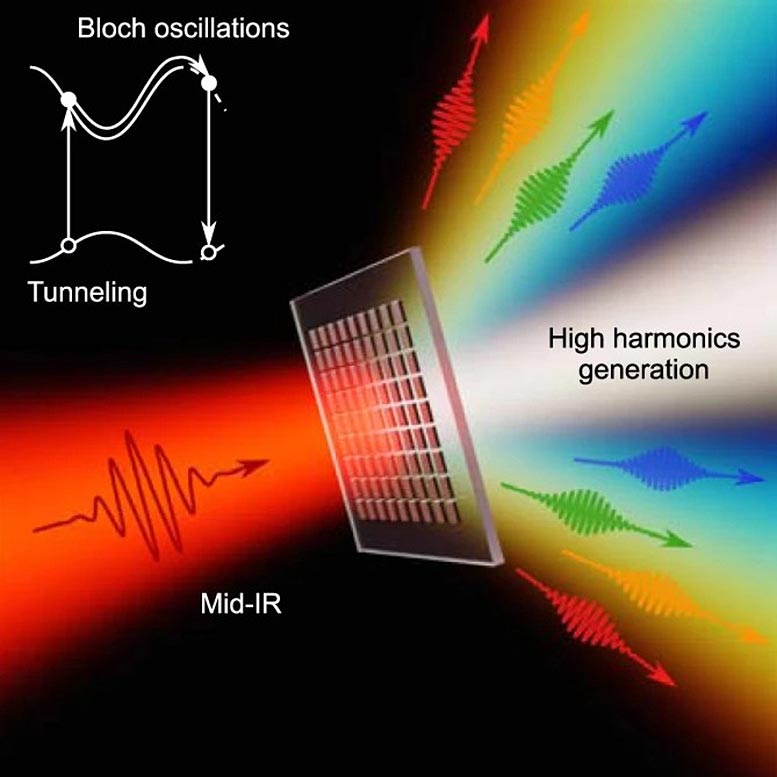
Cornell researchers have set a new record for converting laser pulses into high-harmonic radiation, paving the way for advanced imaging and attosecond science.
Cornell researchers have developed nanostructures that enable record-breaking conversion of laser pulses into high-harmonic generation, paving the way for new scientific tools for high-resolution imaging and studying physical processes that occur at the scale of an attosecond – one quintillionth of a second.
High-harmonic generation has long been used to merge photons from a pulsing laser into one, ultrashort photon with much higher energy, producing extreme ultraviolet light and X-rays used for a variety of scientific purposes. Traditionally, gases have been used as sources of harmonics, but a research team led by Gennady Shvets, professor of applied and engineering physics in the College of Engineering, has shown that engineered nanostructures have a bright future for this application.
The research is detailed in the paper “Generation of Even and Odd High Harmonics in Resonant Metasurfaces Using Single and Multiple Ultra-Intense Laser Pulses,” published on July 7, 2021, in Nature Communications. Maxim Shcherbakov, who conducted the research as a Cornell postdoctoral associate before becoming an assistant professor at the University of California, Irvine, is the lead author.
Ultrathin Gallium-Phosphide Metasurfaces: The Secret Sauce
The nanostructures created by the team make up an ultrathin resonant gallium-phosphide metasurface that overcomes many of the usual problems associated with high-harmonic generation in gases and other solids. The gallium-phosphide material permits harmonics of all orders without reabsorbing them, and the specialized structure can interact with the laser pulse’s entire light spectrum.
“Achieving this required engineering of the metasurface’s structure using full-wave simulations,” Shcherbakov said. “We carefully selected the parameters of the gallium-phosphide particles to fulfill this condition, and then it took a custom nanofabrication flow to bring it to light.”
The result is nanostructures capable of generating both even and odd harmonics – a limitation of most other harmonic materials – covering a wide range of photon energies between 1.3 and 3 electron volts. The record-breaking conversion efficiency enables scientists to observe molecular and electronic dynamics within a material with just one laser shot, helping to preserve samples that may otherwise be degraded by multiple high-powered shots.
First Single-Pulse High-Harmonic Generation in Metasurfaces
The study is the first to observe high-harmonic generated radiation from a single laser pulse, which allowed the metasurface to withstand high powers – five to 10 times higher than previously shown in other metasurfaces.
“It opens up new opportunities to study matter at ultrahigh fields, a regime not readily accessible before,” Shcherbakov said. “With our method, we envision that people can study materials beyond metasurfaces, including but not limited to crystals, 2D materials, single atoms, artificial atomic lattices and other quantum systems.”
Now that the research team has demonstrated the advantages of using nanostructures for high-harmonic generation, it hopes to improve high-harmonic devices and facilities by stacking the nanostructures together to replace a solid-state source, such as crystals.
Reference: “Generation of even and odd high harmonics in resonant metasurfaces using single and multiple ultra-intense laser pulses” by Maxim R. Shcherbakov, Haizhong Zhang, Michael Tripepi, Giovanni Sartorello, Noah Talisa, Abdallah AlShafey, Zhiyuan Fan, Justin Twardowski, Leonid A. Krivitsky, Arseniy I. Kuznetsov, Enam Chowdhury and Gennady Shvets, 7 July 2021, Nature Communications.
DOI: 10.1038/s41467-021-24450-9
Co-authors include Cornell postdoctoral researchers Zhiyuan Fan and Giovanni Sartorello, and researchers from the Ohio State University and the Institute of Materials Research and Engineering in Singapore.
The research was funded by the Office of Naval Research, the Cornell Center for Materials Research through the National Science Foundation’s Materials Research Science and Engineering Centers program, and the Air Force Office of Scientific Research.
Never miss a breakthrough: Join the SciTechDaily newsletter.
Follow us on Google and Google News.