
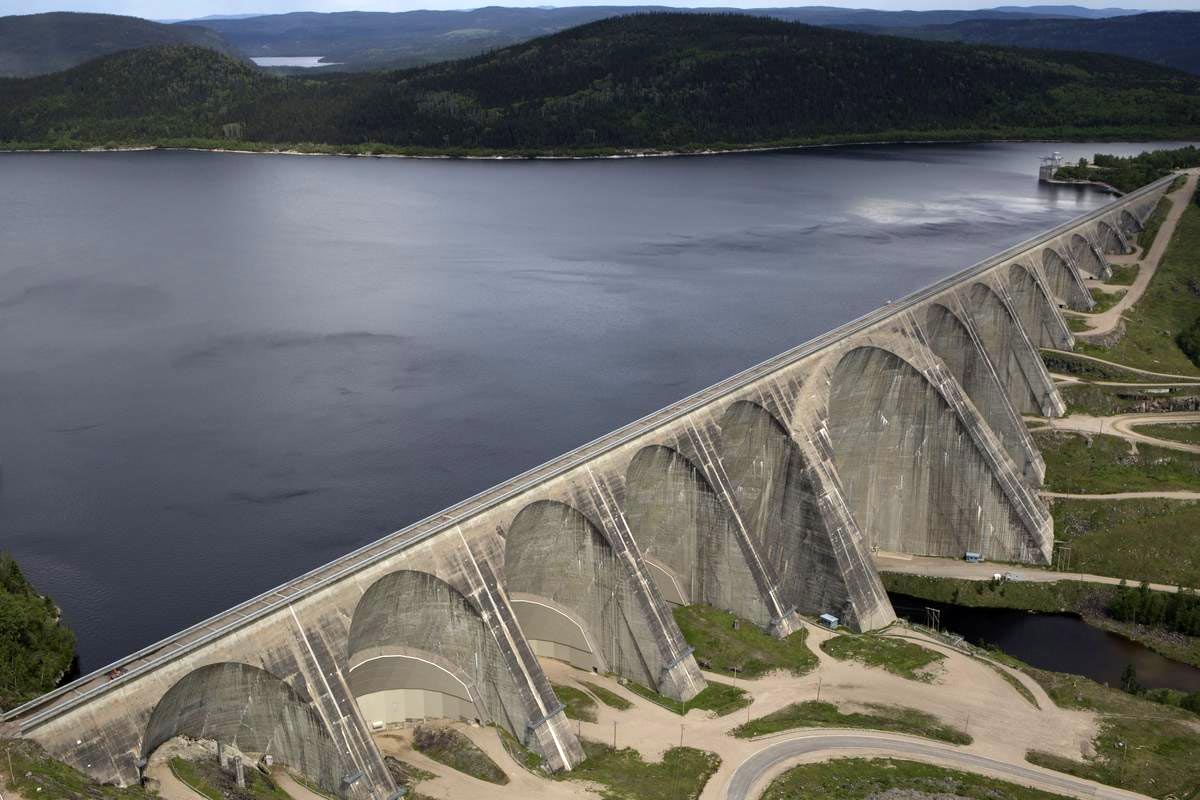
Expanding Quebec hydro imports could slash energy costs and boost electrification, helping the Northeast meet net-zero climate goals.
The Commonwealth of Massachusetts recently passed a climate bill that sets a target of net-zero emissions for the state by the year 2050. The bill is one of several successful legislative efforts in Northeastern states to reduce greenhouse gas emissions by as much as 80 to 100 percent by mid-century. To achieve these ambitious targets — which align with the Paris Agreement’s long-term goal of keeping global warming well below 2 degrees Celsius to avoid the worst impacts of climate change — will require a significant ramp-up of zero-carbon, intermittent, renewable energy technologies.
Hydropower is a particularly appealing renewable energy option for policymakers in the region; substantial hydro resources available in nearby Quebec could be used to dispatch power to consumers in Northeastern states during periods of low wind and solar generation. But environmental and aesthetic concerns have mobilized communities along proposed hydro transmission line routes to nip that notion in the bud. To stand a chance of overcoming these concerns, policymakers in the U.S. Northeast and Quebec will need to demonstrate compelling benefits to consumers and transmission line abutters alike.
Economic Impact of Hydropower Expansion
To that end, researchers at the MIT Joint Program on the Science and Policy of Global Change and MIT Energy Initiative have conducted a study to assess the economic impacts of expanding hydropower transmission capacity from Quebec to the Northeast. Using a unique modeling framework that represents both regional economic behavior and hourly electricity operations, they project these impacts under three scenarios. In each scenario, transmission capacity is expanded by 10, 30, or 50 percent above existing capacity into New York and all New England states starting in 2026, and carbon emissions are capped in alignment with regional climate goals.
Compared to a reference scenario in which current and projected state renewable energy technology policies are implemented with carbon emissions capped to achieve mid-century regional goals, the researchers estimate that by 2050, electricity imports enabled by these three transmission expansions save the New York state economy 38-40 cents per kilowatt hour (KWh) and the New England economy 30-33 cents per kWh. The results appear in the journal Energy Policy.
Significant Economic and Environmental Benefits
“These economy-wide savings are significantly higher than the cost of the electricity itself,” says Joint Program research scientist Mei Yuan, the lead author of the study. “Moreover, the carbon limits that we impose in these scenarios raise fuel prices enough to make electricity cost-competitive in multiple economic sectors. This accelerates electrification in both New England and New York, particularly between 2030 and 2050.”
The overall economic impact of the three transmission capacity expansion scenarios is a significantly lower cost of meeting the emissions reduction goals of all states in the region.
Reference: “The role of cross-border electricity trade in transition to a low-carbon economy in the Northeastern U.S” by Mei Yuan, Karen Tapia-Ahumada and John Reilly, 16 April 2021, Energy Policy.
DOI: 10.1016/j.enpol.2021.112261
The study is an outgrowth of an Energy Modeling Forum effort, EMF34, which aims to improve understanding of how energy markets affect one another throughout North America. The researchers were supported by sponsors of the MIT Joint Program sponsors and the MIT Energy Initiative Seed Fund Program.
Never miss a breakthrough: Join the SciTechDaily newsletter.
Follow us on Google and Google News.
2 Comments
It should be noted that in the western USA, environmentalists are pushing to remove existing dams!
Even if political forces weren’t at cross-purposes, almost all of the best USA locations for dams have already been developed, save for a few Designated Wilderness Areas. Thus, there is not much opportunity for expansion of dams. Will Canadians have a different attitude towards new dams?
Oh but MA is going to reduce emmisions by switching off the last of the New England nuclear reactors in Plymouth and largely replacing it with nat gas with some offsetting from wind. You gotta love inverted logic.
Hydro is a low energy density form of production, a few W/sq m is all you get, similar to PV or wind farms. It has some limited ability to supply power on demand but is still limited by seasonal weather. We aren’t blessed like Norway.
Take a look at the LLNL Energy Flow Graph, hydro is typically about 2.5% of the entire US energy inputs since for ever, and there is little support for increasing it.