

Weather conditions shown to have big influence on migration numbers.
A species of butterfly found in Sub-Saharan Africa is able to migrate thousands of miles to Europe, crossing the Saharan Desert, in years when weather conditions are favorable, scientists have found.
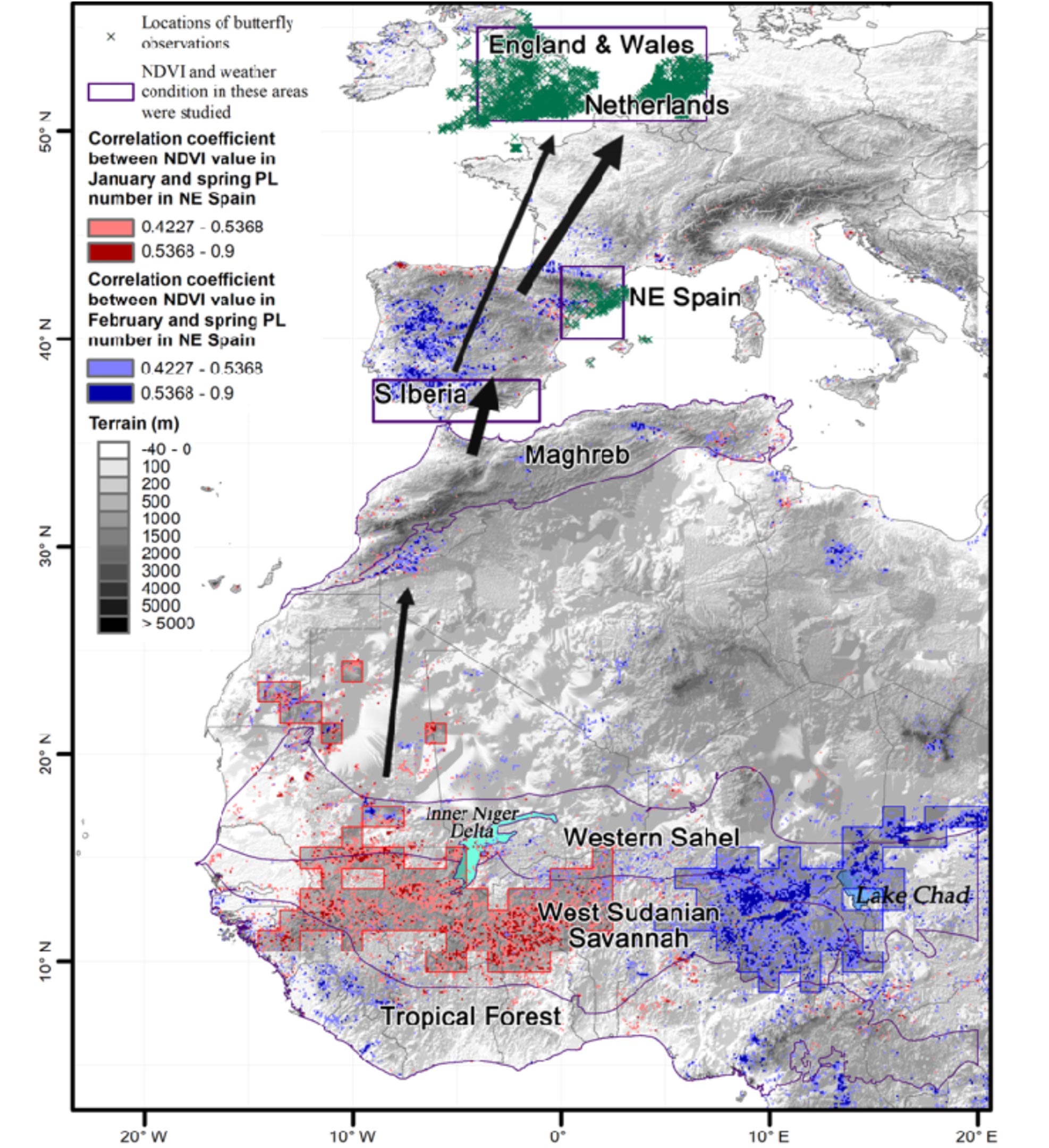
The striking Painted Lady (Vanessa cardui) butterfly has been shown for the first time to be capable of making the 12,000-14,000km (7,500-8,700mi) round trip — the longest insect migration known so far — in greater numbers, when wetter conditions in the desert help the plants on which it lays eggs.
The international research team’s findings increase understanding of how insects, including pollinators, pests, and the diseases they carry could spread between continents in the future as climate change alters seasonal conditions.
How Weather Shapes Butterfly Numbers and Movements
Professor Tom Oliver, an ecologist at the University of Reading and co-author of the study, said: “We know that the number of Painted Lady butterflies in Europe varies wildly, sometimes with 100 times more from one year to the next. However, the conditions that caused this were unknown, and the suggestion the butterflies could cross the Sahara desert and oceans to reach Europe was not proven.”
“This research shows this unlikely journey is possible, and that certain climate conditions leading up to migration season have a big influence on the numbers that make it. It demonstrates how the wildlife we see in the UK can transcend national boundaries, and protecting such species requires strong international cooperation”.
Predicting the Future of Insect Migrations
As well as answering long-asked questions about butterfly migrations, the findings could help predictions of the movements of other insects that affect people, such as the locusts currently plaguing East Africa, or by malaria-carrying mosquitoes.
Professor Oliver said: “We enjoy seeing the beautiful Painted Lady butterflies in our gardens in Europe, but climate change will also lead to shifts in invasive species that are crop pests or those that spread diseases. Food shortages in East Africa are a reminder that the impacts of climate change can be much more dramatic than a few degrees of warming might first seem.”
The Painted Lady migrates during the spring, following a winter breeding season. Researchers used long-term monitoring data from thousands of trained volunteer recorders, along with climate and atmospheric data in regions of Sub-Saharan Africa and Europe to learn about their movement.
The study, published in the Proceedings of the National Academy of Sciences journal, found that increased vegetation in the African Savanna during the winter and in North Africa in the spring, combined with favorable tailwinds, are the three most important factors in the number that migrate to Europe.
Painted Lady caterpillars feed on the leaves of plants that thrive in wetter winter conditions in the Savannah and Sahel regions of sub-Saharan Africa, causing population numbers to explode. They migrate across the Sahara, and when there are also wet and green spring conditions in North Africa these allow further breeding and swell the numbers that cross the Mediterranean Sea to reach Europe.
Simulations by the scientists also showed that there are regularly favorable tailwinds between Africa and Western Europe, offering insects opportunities for transcontinental travel.
The Physiology of Epic Flight
The team calculated that the butterflies must fly non-stop during the day and rest during the night to cross the Sahara, making stops to feed on nectar. This is similar to the pattern in which night-flying songbirds migrate.
They concluded the butterflies must fly up to 1-3km above sea level to take advantage of favorable tailwinds, as their maximum self-powered flying speed of around 6 meters per second would make a Sahara crossing extremely difficult.
The researchers used observations of similar butterfly species to calculate that Painted Ladies have enough body fat after metamorphosis to sustain 40 hours of non-stop flying, and keep this topped up by feeding on nectar whenever possible in order to cross the Sahara.
The findings may help improve predictions of which insect species might be found in different regions in the future due to climate change, and the numbers they could arrive in.
Reference: “Environmental drivers of annual population fluctuations in a trans-Saharan insect migrant” by Gao Hu, Constanti Stefanescu, Tom H. Oliver, David B. Roy, Tom Brereton, Chris Van Swaay, Don R. Reynolds and Jason W. Chapman, 21 June 2021, Proceedings of the National Academy of Sciences.
DOI: 10.1073/pnas.2102762118
Never miss a breakthrough: Join the SciTechDaily newsletter.
Follow us on Google and Google News.