
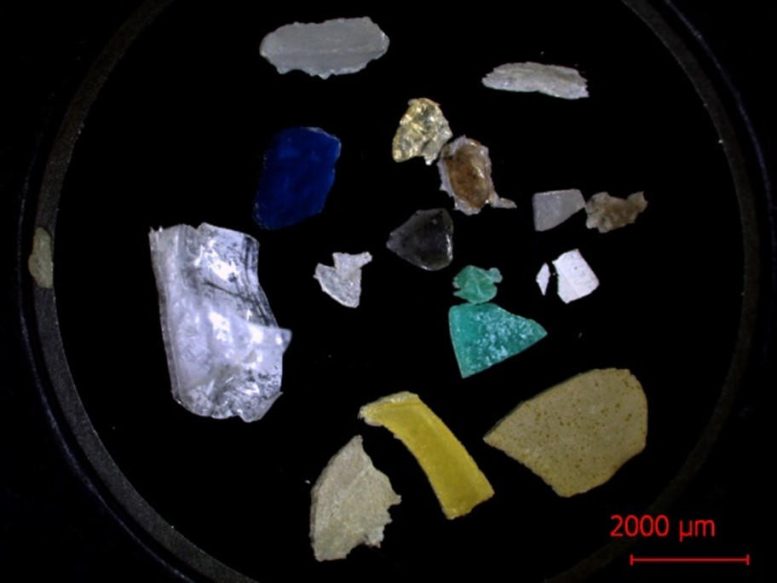
A novel approach has been devised by researchers to determine the age of microplastics in the ocean. Their findings reveal that offshore microplastics can range from 1 to 3 years old, whereas nearshore microplastics can range from 0 to 5 years old.
A new technique for determining the age of microplastics in the upper oceans has been developed by a team of researchers from Asahi Kasei Corporation and Kyushu University. This approach merges the analysis of plastic oxidation levels with the consideration of environmental aspects such as UV exposure and ambient temperature.
Applying their novel method, the researchers estimated the ages of microplastics collected from nearshore and offshore locations in the North Pacific Ocean. Their results revealed that the nearshore microplastics ranged in age from 0 to 5 years, while those from offshore locations were between 1 to 3 years old. Their findings were recently published in the journal, Marine Pollution Bulletin.
In marine environments from lakes to oceans, plastics are the most abundant type of pollutant. As plastic waste is exposed to the elements they eventually break down and fragment. Plastic waste that has broken down to less than 5 mm in length are called ‘microplastics.’
“Microplastic pollution is recognized as a global problem. In a previous study, we found that there are about 24 trillion grains of microplastics floating on the surface layer of the ocean,” explains Professor Atsuhiko Isobe of Kyushu University’s Research Institute for Applied Mechanics, who led the study. “However, there is still little we know about its effects on the environment or on living creatures. Another big question we have is how long microplastics drift through the ocean.”
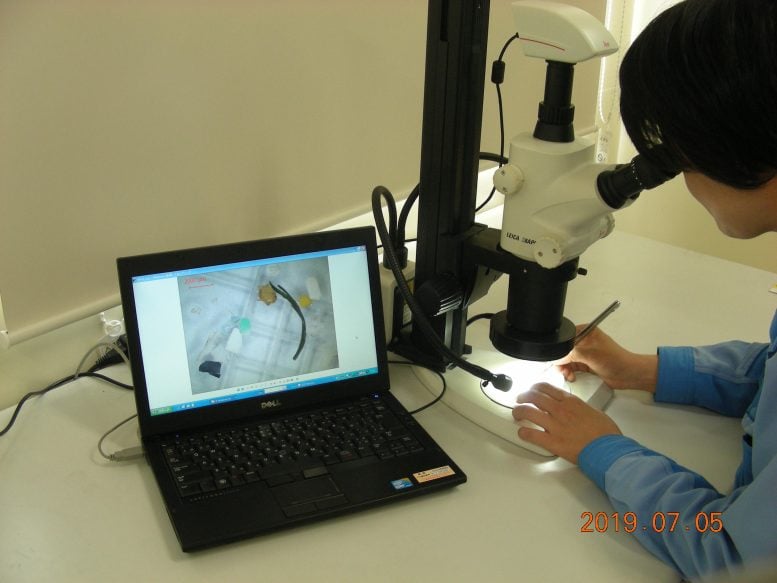
To find out how old microplastics found in the ocean can be, Isobe and his team began by investigating what metrics could be used to measure microplastic age in the first place.
“The most common material in plastic is called polyethylene. We know that as polyethylene interacts with the environment it, oxidizes and degrades,” explains Rie Okubo, a researcher at Asahi Kasei Corporation and first author of the study. “This degradation level can be measured using the change in the material’s molecular weight and something called the carbonyl index. Simply, when polyethylene degrades its carbonyl index increases and molecular weight decreases.”
Of course, that’s not enough. Since microplastics are being exposed to the elements the team also needed to standardize how temperature and UV radiation affect plastic degradation. The team first conducted a series of exposure experiments to polyethylene material and collected data on how various combinations of UV and temperature affected the material’s molecular weight and carbonyl index.
The team found that UVER—ultraviolet erythemal radiation, a measurement of UV radiation at ground level—and seawater temperature were the two biggest contributors to plastic degradation.
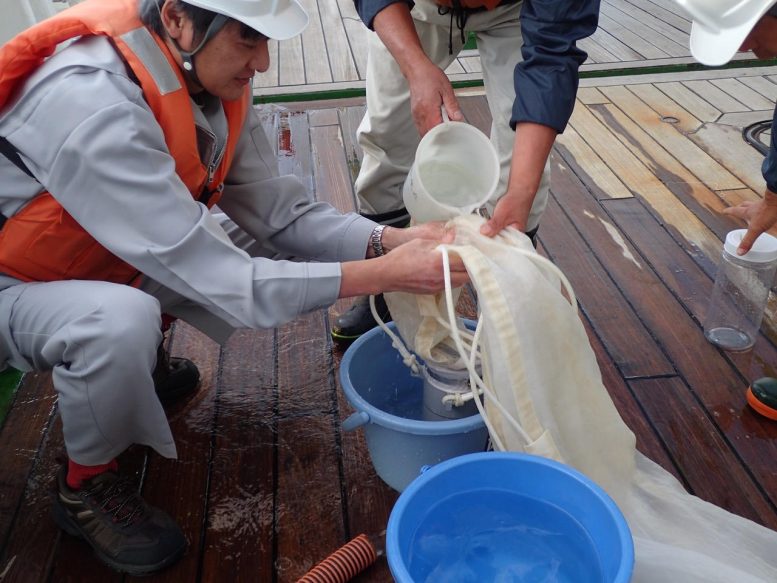
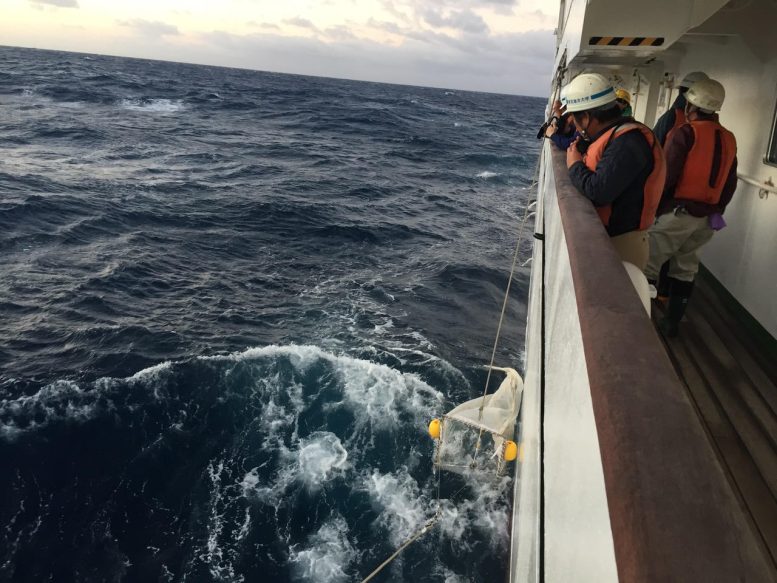
“Once we had this data, we began to apply it to our microplastic samples. All our samples came from the upper ocean, up to one meter from the water surface,” continues Okubo. “We also collected microplastics from a range of areas. Some samples were collected from nearshore to Japan, ranging from 10 to 80 km (6 to 50 mi) off the coast. Other samples were collected offshore, in the middle of the North Pacific Ocean and the Philippine Sea.”
Insights into Microplastic Distribution Patterns
By analyzing the collected microplastics, the team was able to estimate the age of each individual sample. They found that nearshore microplastics ranged from 0 to 5 years old, whereas offshore samples ranged from 1 to 3 years old.
“We hypothesize the reason why nearshore microplastics range from 0 to 5 years is because they are being frequently washed ashore and ‘surviving’ for a longer time. Offshore microplastics on the other hand take longer to reach that part of the ocean, hence why we didn’t find microplastics over 3 years old,” Okubo explains. “These offshore microplastics are also likely removed from the upper oceans by settling deeper into the waters.”
The researchers hope that the new method will give them better insights into how microplastics are generated and spread in the environment. The data will also help in developing more accurate simulations to track microplastics across the ocean.
Isobe concludes, “Our research and understanding of microplastics is still very new, and thanks to this data we’ve gained a little more understanding on the fundamental science of microplastics. Our next step will be to investigate how mechanical stimuli like ocean waves and currents can degrade plastics, so we can collect even more accurate data.
Reference: “Estimation of the age of polyethylene microplastics collected from oceans: Application to the western North Pacific Ocean” by Rie Okubo, Aguru Yamamoto, Akihiro Kurima, Terumi Sakabe, Youichiroh Ide and Atsuhiko Isobe, 10 May 2023, Marine Pollution Bulletin.
DOI: 10.1016/j.marpolbul.2023.114951
The study was funded by the Japan Society for the Promotion of Science and the Asahi Kasei Corporation.
Never miss a breakthrough: Join the SciTechDaily newsletter.
Follow us on Google and Google News.