
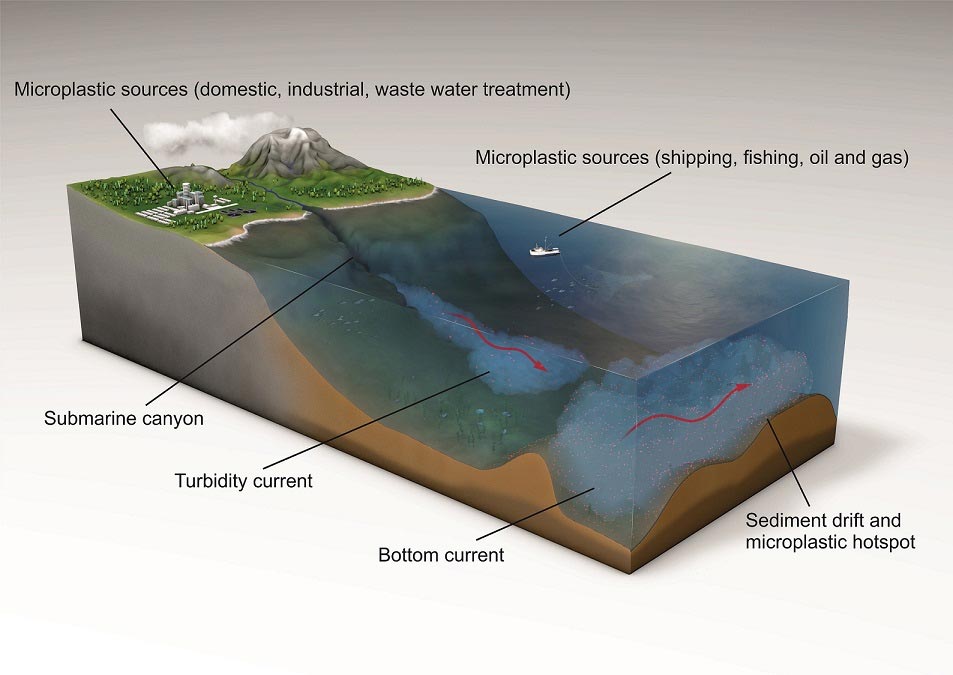
An international research project has revealed the highest levels of microplastic ever recorded on the seafloor, with up to 1.9 million pieces in a thin layer covering just 1 square meter.
Over 10 million tons of plastic waste enters the oceans each year. Floating plastic waste at sea has caught the public’s interest thanks to the ‘Blue Planet Effect’ seeing moves to discourage the use of plastic drinking straws and carrier bags. Yet such accumulations account for less than 1% of the plastic that enters the world’s oceans.
The missing 99% is instead thought to occur in the deep ocean, but until now it has been unclear where it actually ended up. Published this week in the journal Science, the research conducted by The University of Manchester (UK), National Oceanography Centre (UK), University of Bremen (Germany), IFREMER (France) and Durham University (UK) showed how deep-sea currents act as conveyor belts, transporting tiny plastic fragments and fibers across the seafloor.
These currents can concentrate microplastics within huge sediment accumulations, which they termed ‘microplastic hotspots.’ These hotspots appear to be the deep-sea equivalents of the so-called ‘garbage patches’ formed by currents on the ocean surface.
The lead author of the study, Dr. Ian Kane of The University of Manchester said: “Almost everybody has heard of the infamous ocean ‘garbage patches’ of floating plastic, but we were shocked at the high concentrations of microplastics we found in the deep-seafloor.
“We discovered that microplastics are not uniformly distributed across the study area; instead they are distributed by powerful seafloor currents which concentrate them in certain areas.”
Microplastics on the seafloor are mainly comprised of fibers from textiles and clothing. These are not effectively filtered out in domestic waste water treatment plants, and easily enter rivers and oceans.
In the ocean they either settle out slowly, or can be transported rapidly by episodic turbidity currents — powerful underwater avalanches — that travel down submarine canyons to the deep seafloor (see the group’s earlier research in Environmental Science & Technology). Once in the deep sea, microplastics are readily picked up and carried by continuously flowing seafloor currents (‘bottom currents’) that can preferentially concentrate fibers and fragments within large drifts of sediment.
These deep ocean currents also carry oxygenated water and nutrients, meaning that seafloor microplastic hotspots can also house important ecosystems that can consume or absorb the microplastics. This study provides the first direct link between the behavior of these currents and the concentrations of seafloor microplastics and the findings will help to predict the locations of other deep-sea microplastic hotspots and direct research into the impact of microplastics on marine life.
The team collected sediment samples from the seafloor of the Tyrrhenian Sea (part of the Mediterranean Sea) and combined these with calibrated models of deep ocean currents and detailed mapping of the seafloor. In the laboratory, the microplastics were separated from sediment, counted under the microscope, and further analyzed using infra-red spectroscopy to determine the plastic types. Using this information the team were able to show how ocean currents controlled the distribution of microplastics on the seafloor.
Dr. Mike Clare of the National Oceanography Centre, who was a co-lead on the research, stated: “Our study has shown how detailed studies of seafloor currents can help us to connect microplastic transport pathways in the deep-sea and find the ‘missing’ microplastics. The results highlight the need for policy interventions to limit the future flow of plastics into natural environments and minimize impacts on ocean ecosystems.”
Dr. Florian Pohl, Department of Earth Sciences, Durham University, said: “It’s unfortunate, but plastic has become a new type of sediment particle, which is distributed across the seafloor together with sand, mud and nutrients. Thus, sediment-transport processes such as seafloor currents will concentrate plastic particles in certain locations on the seafloor, as demonstrated by our research.”
Never miss a breakthrough: Join the SciTechDaily newsletter.
Follow us on Google and Google News.
5 Comments
My comment on microplastics is on the effects that they can have when PLA (plastic) teabags are immersed in boiling water, and the water is then imbibed by a human with prostate/urinary issues. I am one person with those issues, and a wake up an average of once/night to pass urine, unless I have consumed tea from a PLA bag. Then I will be up every hour on the hour to relieve myself, for a minimum of 4 or 5 hours. The reason for this is the imbibed microplastics created by the breakdown of the bag in hot/boiling water. These particles are well known, and have been implicated in breast and prostate cancers, and show up in people with these cancers in greater amounts than what is normal. If you want to check your teabags for plastic, hold a lighter or match close to one and see if it deforms or melts, or hold the bag close to a fairly intense heat source, like a stove element; if the bag wilts or melts, it contains plastic. The tea in question was Red Rose, made by Unilever Corporation, and when I removed the tea from the PLA (Poly Lactic acid) bag, and used it in a tea strainer, I had none of the negative symptoms that I described earlier. Thus my experiment proved that the bag was the trigger of the increased urinations, without a doubt, and that microplastics were the reason for the problems that followed! There are many articles online about their negative effects on the human body; why any company would want to use plastic in any situation where the plastic is highly heated, and the consumable foodstuff is going to be ingested, is beyond my comprehension. It shows an attitude that has lost it’s connection with the old adage: Safety First! I communicated with the customer support department of the company, c/w links to articles about the negative effects of some ingested plastics, and they recommended that I try another of their tea products with LESS PLASTIC in the bags! What was the matter with paper bags, anyway? I got no answer….
To better connect my previous comment with the subject article, I must also mention that perhaps it is time that we move away from using the oceans as our personal plastic dumps. If these materials are in the water, what are they doing to marine life if a little teabag can have such an effect on one human? The ocean’s creatures live in the water, and breath by filtering oxygen out of the water with their gills, and eat creatures that must be carrying a lot of microplastic in their bodies as well, so intake the stuff through eating as well. Perhaps this is one of the reasons for the huge dead zones that are appearing in our oceans. We’re the only ones that can change this, and I’m looking at am empty potato chip bag on the table in front of me. So maybe I/we have to quit buying things packaged in plastic, to make the food processors find other materials in which to encase food products? This is a very serious issue!
Too bad no one will listen.. people are focused on other piece of sh1t right now, for example why Trump administration allows companies to break pollution laws is beyond a$$hole level
I was wondering why, since so many deposits, we don’t just drag them up. Use them and forget. I bet that much plastic is worth tons.
We all use plastics. They are light, flexible, and cheap. Changing our everyday habits is going to be hard, maybe impossible. So, let the people of earth move on and settle a new planet and start the destruction process again.