
Close Menu
    Facebook X (Twitter) Instagram
    SciTechDaily
    • Biology
    • Chemistry
    • Earth
    • Health
    • Physics
    • Science
    • Space
    • Technology
    Facebook X (Twitter) Pinterest YouTube RSS
    SciTechDaily
    Home»Technology»Highly Effective New Way Developed to Paint Complex 3D-Printed Objects
    Technology

    Highly Effective New Way Developed to Paint Complex 3D-Printed Objects

    By Rutgers UniversityMay 1, 2020No Comments3 Mins Read
    Facebook Twitter Pinterest Telegram LinkedIn WhatsApp Email Reddit
    Share
    Facebook Twitter LinkedIn Pinterest Telegram Email Reddit
    Painting 3D-Printed Objects
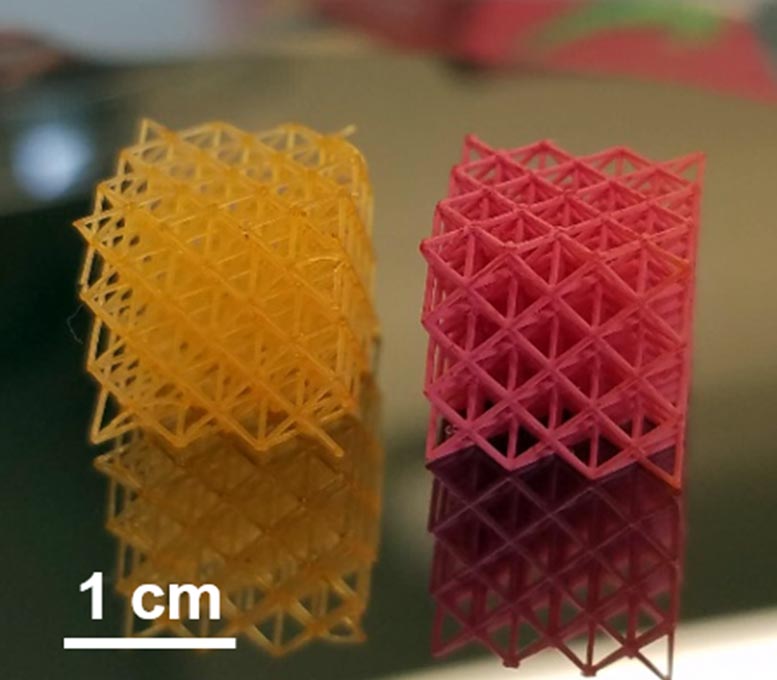
    A hydrogel lattice without (left) and with (right) coating. Credit: Jonathan P. Singer/Rutgers University-New Brunswick

    Efficient painting method reaches nooks and crannies.

    Rutgers engineers have created a highly effective way to paint complex 3D-printed objects, such as lightweight frames for aircraft and biomedical stents, that could save manufacturers time and money and provide new opportunities to create “smart skins” for printed parts.

    The findings are published in the journal ACS Applied Materials & Interfaces.

    Conventional sprays and brushes can’t reach all nooks and crannies in complex 3D-printed objects, but the new technique coats any exposed surface and fosters rapid prototyping.

    “Our technique is a more efficient way to coat not only conventional objects, but even hydrogel soft robots, and our coatings are robust enough to survive complete immersion in water and repeated swelling and de-swelling by humidity,” said senior author Jonathan P. Singer, an assistant professor in the Department of Mechanical and Aerospace Engineering in the School of Engineering at Rutgers University-New Brunswick.

    The engineers discovered new capabilities of a technology that creates a fine spray of droplets by applying a voltage to fluid flowing through a nozzle. This technique (electrospray deposition) has been used mainly for analytical chemistry. But in recent decades, it has also been used in lab-scale demonstrations of coatings that deliver vaccines, light-absorbing layers of solar cells, and fluorescent quantum dots (tiny particles) for LED displays.

    Using their approach, Rutgers engineers are building an accessory for 3D printers that will, for the first time, allow automated coating of 3D-printed parts with functional, protective or aesthetic layers of paint. Their technique features much thinner and better-targeted paint application, using significantly fewer materials than traditional methods. That means engineers can use cutting-edge materials, such as nanoparticles and bioactive ingredients, that would otherwise be too costly in paints, according to Singer.

    Next steps include creating surfaces that can change their properties or trigger chemical reactions to create paints that can sense their environment and report stimuli to onboard electronics. The engineers hope to commercialize their technique and create a new paradigm of rapid coating immediately after printing that complements 3D printing.

    Reference: “Self-Limiting Electrospray Deposition for the Surface Modification of Additively Manufactured Parts” by Dylan A. Kovacevich, Lin Lei, Daehoon Han, Christianna Kuznetsova, Steven E. Kooi, Howon Lee and Jonathan P. Singer, 15 April 2020, ACS Applied Materials & Interfaces.
    DOI: 10.1021/acsami.9b23544

    Rutgers co-lead authors are Dylan A. Kovacevich, a master’s degree student, and Lin Lei, a doctoral student in Singer’s lab. Other Rutgers co-authors include doctoral student Daehoon Han (currently a postdoc at the University of Minnesota), Christianna Kuznetsova, an undergraduate student, and Professor Howon Lee. A researcher at the Massachusetts Institute of Technology contributed to the study.

    Never miss a breakthrough: Join the SciTechDaily newsletter.
    Follow us on Google and Google News.

    Materials Science Rutgers University
    Share. Facebook Twitter Pinterest LinkedIn Email Reddit

    Related Articles

    3D-Printed “Artificial Muscle” Inspired by Color-Changing Octopus Skin

    Plant-Based Nanowire Spray Could Be Used to Improve N95 Mask Filters, Energy Harvesters

    Engineers Create 3D-Printed Smart Gel That Walks Underwater, Moves Objects

    Spray Paint Battery Can be Painted on Virtually Any Surface

    Nano-Sandwich Design Results in Slimmer Solar Cells With Decreased Costs

    SLIPS Prevents Ice From Sticking on Metal Surfaces

    3D Self-Assembling Polymer Materials Could Lead to New Microchips

    Elastomeric “Soft” Robots Running on Pneumatic Actuators

    Researchers Develop World’s Lightest Material

    Leave A Reply Cancel Reply

    • Facebook
    • Twitter
    • Pinterest
    • YouTube

    Don't Miss a Discovery

    Subscribe for the Latest in Science & Tech!

    Trending News

    Monster Storms on Jupiter Unleash Lightning Beyond Anything on Earth

    Scientists Create “Liquid Gears” That Spin Without Touching

    The Simple Habit That Could Help Prevent Cancer

    Millions Take These IBS Drugs, But a New Study Finds Serious Risks

    Scientists Unlock Hidden Secrets of 2,300-Year-Old Mummies Using Cutting-Edge CT Scanner

    Bread Might Be Making You Gain Weight Even Without Eating More Calories

    Scientists Discover Massive Magma Reservoir Beneath Tuscany

    Europe’s Most Active Volcano Just Got Stranger – Here’s Why Scientists Are Rethinking It

    Follow SciTechDaily
    • Facebook
    • Twitter
    • YouTube
    • Pinterest
    • Newsletter
    • RSS
    SciTech News
    • Biology News
    • Chemistry News
    • Earth News
    • Health News
    • Physics News
    • Science News
    • Space News
    • Technology News
    Recent Posts
    • Scientists Discover a Surprising Reason Intermittent Fasting Extends Life
    • Scientists Discover a New Meteor Shower From a Mysterious Crumbling Asteroid
    • This Simple Fruit Wash Could Make Produce Safer and Last Days Longer
    • These Tiny Robots 50x Smaller Than a Hair Can Hunt and Move Bacteria
    • Simple Blood Test May Predict Alzheimer’s Years Before Brain Scans Show Signs
    Copyright © 1998 - 2026 SciTechDaily. All Rights Reserved.
    • Science News
    • About
    • Contact
    • Editorial Board
    • Privacy Policy
    • Terms of Use

    Type above and press Enter to search. Press Esc to cancel.