
Instead of pigment-based colored paint, which requires artificially synthesized molecules, a UCF researcher has developed an alternative way to produce colored paint that is more natural, environmentally friendly, and lightweight.
A researcher has developed an environmentally friendly, lightweight, and long-lasting paint inspired by butterflies. Instead of using artificially synthesized pigment molecules, the plasmonic paint employs nanoscale structural arrangements of colorless materials, such as aluminum and aluminum oxide, to produce colors. This structural color is more eco-friendly and energy-efficient, as it reflects the entire infrared spectrum, keeping surfaces cooler and potentially reducing air conditioning usage. The paint is also extremely lightweight, with a full coloration achieved at a thickness of only 150 nanometers, making it the lightest paint in the world. Future research will focus on scaling up production and exploring the paint’s energy-saving potential for commercial applications.
University of Central Florida researcher Debashis Chanda, a professor in UCF’s NanoScience Technology Center, has drawn inspiration from butterflies to create the first environmentally friendly, large-scale, and multicolor alternative to pigment-based colorants, which can contribute to energy-saving efforts and help reduce global warming.
The development was published in the journal Science Advances as a featured article.
Structural Color: A Sustainable Alternative
“The range of colors and hues in the natural world are astonishing — from colorful flowers, birds and butterflies to underwater creatures like fish and cephalopods,” Chanda says. “Structural color serves as the primary color-generating mechanism in several extremely vivid species where geometrical arrangement of typically two colorless materials produces all colors. On the other hand, with manmade pigment, new molecules are needed for every color present.”
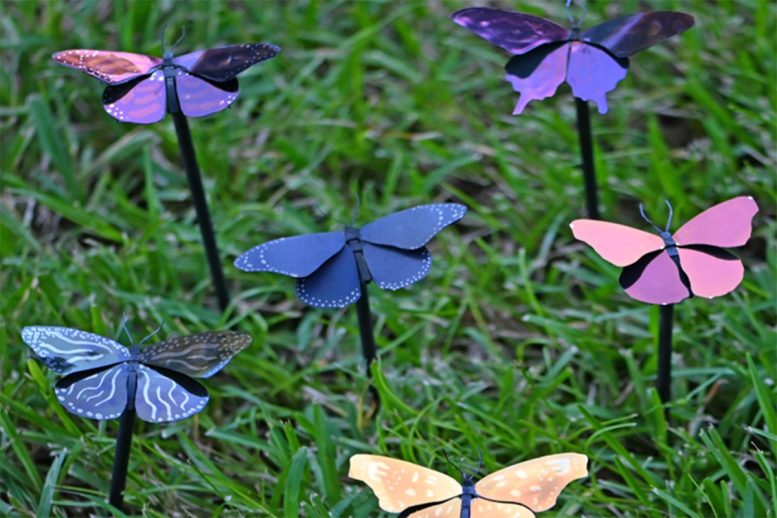
Based on such bio-inspirations, Chanda’s research group innovated a plasmonic paint, which utilizes nanoscale structural arrangement of colorless materials — aluminum and aluminum oxide — instead of pigments to create colors.
While pigment colorants control light absorption based on the electronic property of the pigment material and hence every color needs a new molecule, structural colorants control the way light is reflected, scattered or absorbed based purely on the geometrical arrangement of nanostructures.
Such structural colors are environmentally friendly as they only use metals and oxides, unlike present pigment-based colors that use artificially synthesized molecules.
The researchers have combined their structural color flakes with a commercial binder to form long-lasting paints of all colors.

“Normal color fades because pigment loses its ability to absorb photons,” Chanda says. “Here, we’re not limited by that phenomenon. Once we paint something with structural color, it should stay for centuries.”
Energy and Weight Savings with Plasmonic Paint
Additionally, because plasmonic paint reflects the entire infrared spectrum, less heat is absorbed by the paint, resulting in the underneath surface staying 25 to 30 degrees Fahrenheit cooler than it would if it were covered with standard commercial paint, the researcher says.
“Over 10% of total electricity in the U.S. goes toward air conditioner usage,” Chanda says. “The temperature difference plasmonic paint promises would lead to significant energy savings. Using less electricity for cooling would also cut down carbon dioxide emissions, lessening global warming.”
Plasmonic paint is also extremely lightweight, the researcher says.
This is due to the paint’s large area-to-thickness ratio, with full coloration achieved at a paint thickness of only 150 nanometers, making it the lightest paint in the world, Chanda says.
The paint is so lightweight that only about 3 pounds of plasmonic paint could cover a Boeing 747, which normally requires more than 1,000 pounds of conventional paint, he says.
Chanda says his interest in structural color stems from the vibrancy of butterflies.
“As a kid, I always wanted to build a butterfly,” he says. “Color draws my interest.”
Future Research
Chanda says the next steps of the project include further exploration of the paint’s energy-saving aspects to improve its viability as commercial paint.
“The conventional pigment paint is made in big facilities where they can make hundreds of gallons of paint,” he says. “At this moment, unless we go through the scale-up process, it is still expensive to produce at an academic lab.”
“We need to bring something different like, non-toxicity, cooling effect, ultralight weight, to the table that other conventional paints can’t,” Chanda says.
Reference: “Ultralight plasmonic structural color paint” by Pablo Cencillo-Abad, Daniel Franklin, Pamela Mastranzo-Ortega, Javier Sanchez-Mondragon and Debashis Chanda, 8 March 2023, Science Advances.
DOI: 10.1126/sciadv.adf7207
Chanda has joint appointments in UCF’s NanoScience Technology Center, Department of Physics and College of Optics and Photonics. He received his doctorate in photonics from the University of Toronto and worked as a postdoctoral fellow at the University of Illinois at Urbana-Champaign. He joined UCF in Fall 2012.
Abstract
All present commercial colors are based on pigments. While such traditional pigment-based colorants offer a commercial platform for large-volume and angle insensitiveness, they are limited by their instability in atmosphere, color fading, and severe environmental toxicity. Commercial exploitation of artificial structural coloration has fallen short due to the lack of design ideas and impractical nanofabrication techniques. Here, we present a self-assembled subwavelength plasmonic cavity that overcomes these challenges while offering a tailorable platform for rendering angle and polarization-independent vivid structural colors. Fabricated through large-scale techniques, we produce stand-alone paints ready to be used on any substrate. The platform offers full coloration with a single layer of pigment, surface density of 0.4 g/m2, making it the lightest paint in the world.
Never miss a breakthrough: Join the SciTechDaily newsletter.
Follow us on Google and Google News.
1 Comment
cvbnm