
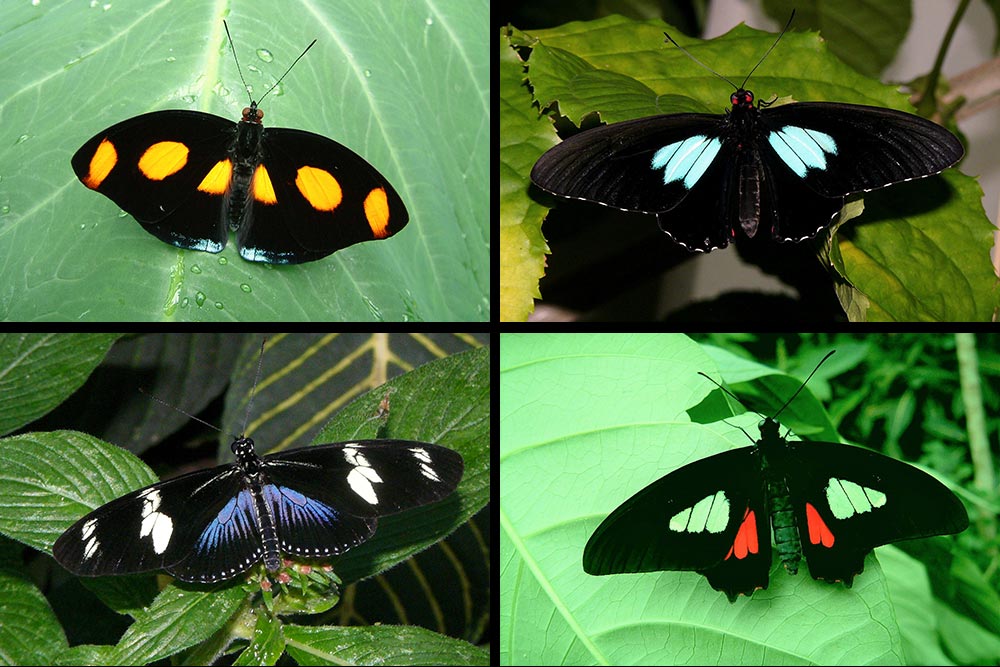
Some butterflies have ultra-black wings that rival the blackest materials made by humans, using wing scales that are only a fraction as thick — here’s how they do it.
Set against a piece of black construction paper, the wings of the male cattleheart butterfly look even blacker than black.
“Some animals have taken black to an extreme,” said Alex Davis, a graduate student in the lab of Duke University biologist Sönke Johnsen.
The butterflies they study are 10 to 100 times darker than charcoal, fresh asphalt, black velvet, and other everyday black objects. As little as 0.06% of the light that hits them is reflected back to the eye. That approaches the blackest black coatings made by humans to help solar panels absorb more energy from the sun, or that line telescopes to reduce stray light.
Yet they achieve this light-trapping effect using wing scales that are only a few microns deep, just a fraction as thick as the blackest synthetic coatings.
In a study in the March 10 issue of the journal Nature Communications, Duke researchers report that ultra-black butterflies from disparate regions of the globe appear to have converged on the same trick. The secret to making blacks this dark and lightweight, they say, isn’t a surplus of melanin — the pigment responsible for a crow’s feathers or a black cat’s fur. It’s an optical illusion created by the 3-D structure of the butterflies’ wing scales.
Light goes into their scales, but very little of it bounces back out.
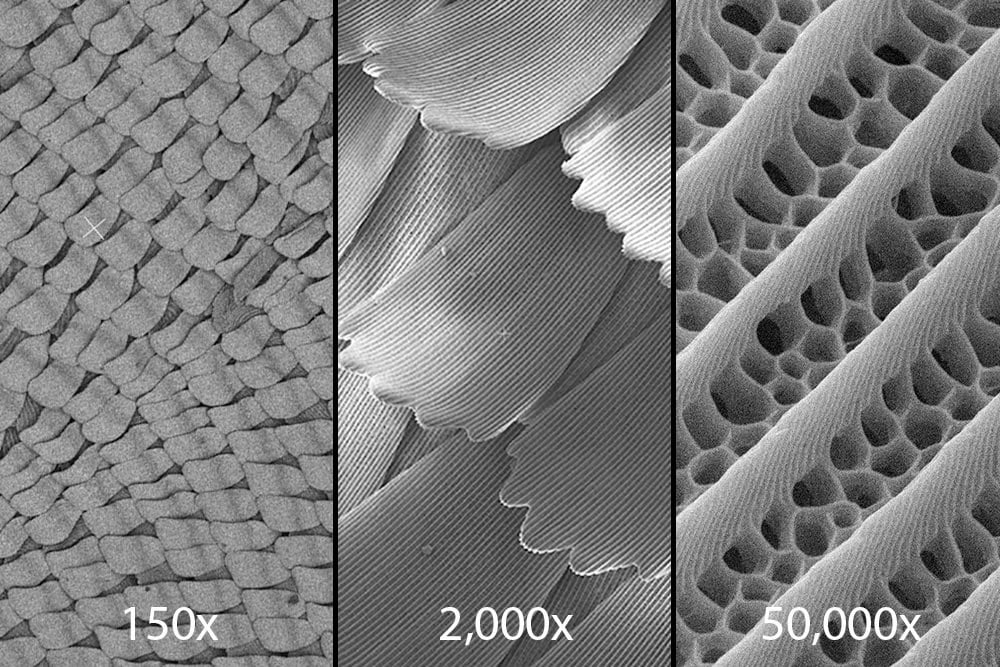
In the study, Davis, Johnsen, and Duke professor Fred Nijhout used high-resolution scanning electron microscopy and computer simulations to examine the microscopic structures on the wings of 10 species of ultra-black butterflies and four regular black or dark brown butterflies from Central and South America and Asia.
Butterfly wings may look smooth to the naked eye. Up close it’s a different story. Magnified thousands of times, butterfly wings are covered in scales with a mesh-like surface of ridges and holes that channel light into the scale’s spongy interior. There, pillar-like beams of tissue scatter light until it is absorbed.
Until recently, the explanation for the incredible light-absorbing properties of some black butterflies was that it was due to a honeycomb-like pattern in the tiny holes on the scales’ surface.
But the new study suggests “that doesn’t matter,” Johnsen said. Looking at butterflies from four subfamilies — the widest range of ultra-black butterflies that have been examined to date — the team found that other ultra-black butterflies suck up similar amounts of light using holes with a variety of shapes and sizes, from honeycombs and rectangles to a chevron pattern.
It turns out the key differences between ultra-black and regular black scales lie elsewhere. When they looked at the butterflies’ wings under an electron microscope, they found that both ultra-black and regular black scales have parallel ridges on their surface and pillars within. But the ridges and pillars are deeper and thicker in ultra-black scales compared to “normal” black scales.
When the team mimicked different wing scales in computer simulations, scales lacking either the ridged surface or interior pillars reflected up to 16 times more light. That would be like going from ultra-black to dark brown, Davis said.
This 3-D architecture is so good at swallowing light that the ultra-black scales still looked black even when coated with gold.
“You almost can’t make them shiny,” Davis said.
Similar deep blacks have popped up in other animals, such as peacock spiders and birds of paradise, which are known to reflect as little as 0.05% of visible light.
None of these natural beauties is quite as dark as the blackest synthetic blacks on record, which absorb more than 99.99% of incoming light using tightly packed “forests” of carbon nanotubes around 10 to 50 microns high. But what makes butterflies interesting, the researchers say, is they rival the best light-trapping nanotechnology, using structures that are only a fraction as thick.
Ultimately, the findings could help engineers design thinner ultra-black coatings that reduce stray light without weighing things down, for applications ranging from military camouflage — for stealth aircraft that can’t be seen at night or detected by radar — to lining space telescopes aimed at faint, distant stars.
Why ultra-black coloration has popped up again and again across the butterfly family tree is still unclear, Johnsen said.
The blackness on the wings of many male butterflies is darker than it is on their female counterparts, so one theory is it helps them show off to potential mates. The black regions always border white, colored, or iridescent patches, so the idea is they might work like a dark picture frame to make the brighter blotches pop.
“Artists have known for a long time that the same color can look very different on different backgrounds,” Johnsen said.
The next step, Davis said, is to figure out how many times butterflies have evolved ultra-black wings, and determine whether those species have anything in common that might help explain what favored the change.
“Why be so black?” Davis said. “We think it’s likely some sort of signal to mates or maybe a predator. But there’s a host of other possibilities, and we’re hoping to clear that up.”
“Diverse nanostructures underlie thin ultra-black scales in butterflies” by Alexander L. Davis, H. Frederik Nijhout and Sönke Johnsen, 10 March 2020, Nature Communications.
DOI: 10.1038/s41467-020-15033-1
This research was supported by the Duke University Department of Biology and a Sigma Xi Grant-in-Aid.
Never miss a breakthrough: Join the SciTechDaily newsletter.
Follow us on Google and Google News.