
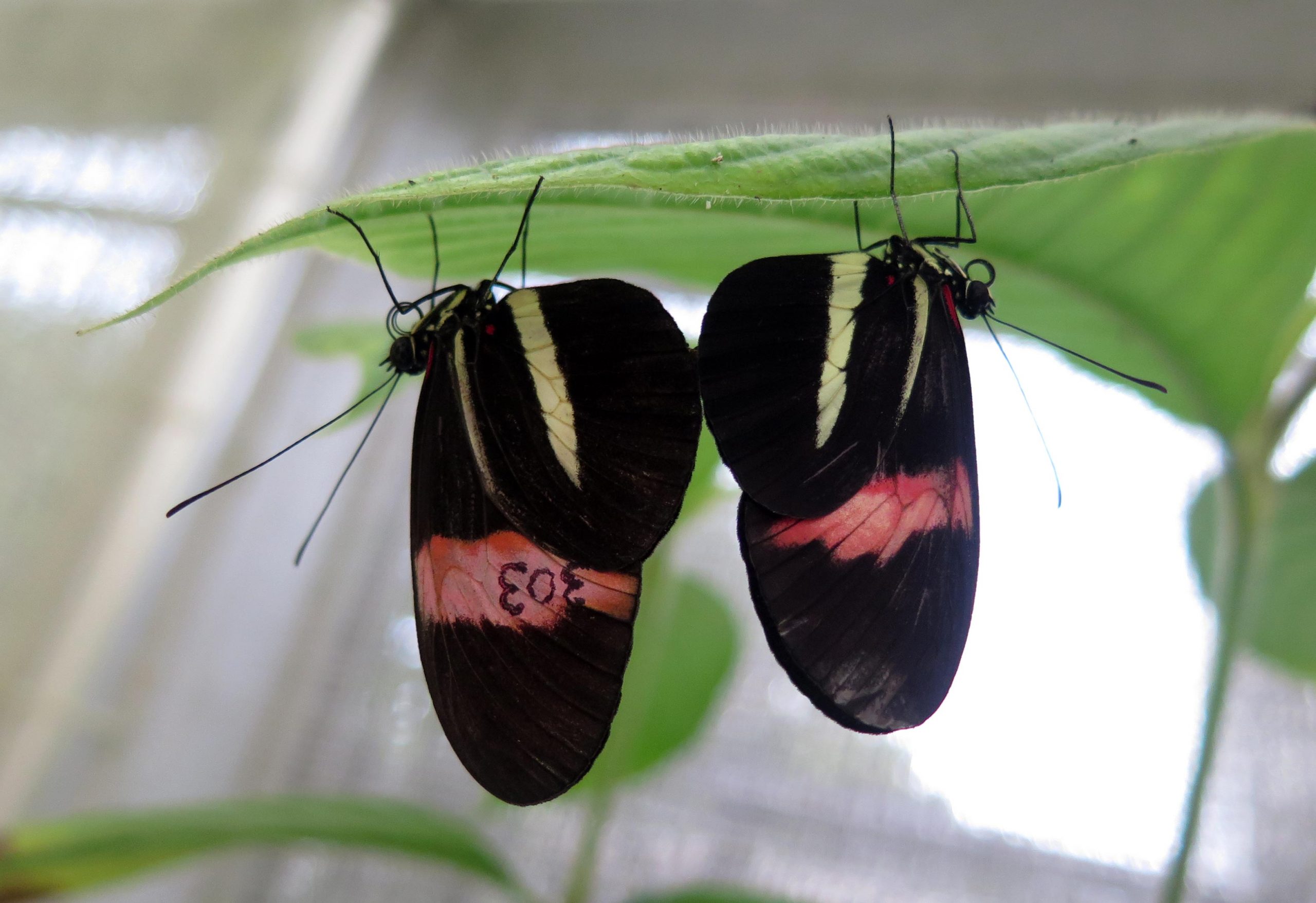
Butterflies have evolved to produce a strongly scented chemical in their genitals that they leave behind after sex to deter other males from pursuing their women — scientists have found.
Researchers discovered that a chemical made in the sex glands of the males of one species of tropical butterfly is identical to a chemical produced by flowers to attract butterflies.
The study published in PLOS Biology today (January 19, 2021) identified a gene for the first time that shows butterflies and flowers independently evolved to make the same chemical for different purposes.
Scientists led by Professor Chris Jiggins, St John’s College, University of Cambridge, mapped production of the scented chemical compound to the genome of a species of butterfly, called Heliconius melponene, and discovered a new gene.
Butterflies Produce Ocimene for Reproductive Strategy
Dr. Kathy Darragh, lead author of the paper, said: “We identified the gene responsible for producing this powerful anti-aphrodisiac pheromone called ocimene in the genitals of male butterflies. This shows that the evolution of ocimene production in male butterflies is independent of the evolution of ocimene production in plants.

“For a long time it was thought insects took the chemical compounds from plants and then used them, but we have shown butterflies can make the chemicals themselves — but with very different intentions. Male butterflies use it to repulse competitors and flowers use the same smell to entice butterflies for pollination.”
Behavioral Differences Among Butterfly Species
There are around 20,000 species of butterflies worldwide. Some only live for a month but the Heliconius melponene butterflies found in Panama that were studied live for around six months. The females typically have few sexual partners and they store the sperm and use it to fertilize their eggs over a number of months after a single mating.
Male butterflies have as many mates ‘as they can’ and each time they transfer the anti-aphrodisiac chemical because they want to be the one to fertilize the offspring. This chemical, however, is not produced by all Heliconius butterflies. Whilst Heliconius melpomene does produce ocimene, another closely related species that was analyzed — Heliconius cydno — does not produce the strong smelling pheromone.
If the smell has such a powerful effect, how do the butterflies know when to be attracted or when to steer clear?
Dr. Darragh, now based at the University of California, Davis, explained: “The visual cues the butterflies get will be important — when the scent is detected in the presence of flowers it will be attractive but when it is found on another butterfly it is repulsive to the males — context is key.”
Scent as a Tool for Communication and Control
This new analysis of the power of smell — also called chemical signaling — sheds new light on the importance of scent as a form of communication.
Professor Jiggins said: “The butterflies presumably adapted to detect it and find flowers and they have then evolved to use it in this very different way. The males want to pass their genes onto the next generation and they don’t want the females to have babies with other fathers so they use this scent to make them unsexy.
“Male butterflies pester the females a lot so it might benefit the females too if the smell left behind means they stop being bothered for sex after they have already mated.”
Reference: “A novel terpene synthase controls differences in anti-aphrodisiac pheromone production between closely related Heliconius butterflies” by Kathy Darragh, Anna Orteu, Daniella Black, Kelsey J. R. P. Byers, Daiane Szczerbowski, Ian A. Warren, Pasi Rastas, Ana Pinharanda, John W. Davey, Sylvia Fernanda Garza, Diana Abondano Almeida, Richard M. Merrill, W. Owen McMillan, Stefan Schulz and Chris D. Jiggins, 19 January 2021, PLOS Biology.
DOI: 10.1371/journal.pbio.3001022
Never miss a breakthrough: Join the SciTechDaily newsletter.
Follow us on Google and Google News.