
NASA’s Fermi Gamma-ray Space Telescope recently detected a solar flare that produced enough gamma rays to briefly make the sun the brightest object in the gamma-ray sky. The flare earned a classification of X5.4 and the flux of high-energy gamma rays was 1,000 times greater than the sun’s steady output.
During a powerful solar blast on March 7, NASA’s Fermi Gamma-ray Space Telescope detected the highest-energy light ever associated with an eruption on the sun. The discovery heralds Fermi’s new role as a solar observatory, a powerful new tool for understanding solar outbursts during the sun’s maximum period of activity.
A solar flare is an explosive blast of light and charged particles. The powerful March 7 flare, which earned a classification of X5.4 based on the peak intensity of its X-rays, is the strongest eruption so far observed by Fermi’s Large Area Telescope (LAT). The flare produced such an outpouring of gamma rays — a form of light with even greater energy than X-rays — that the sun briefly became the brightest object in the gamma-ray sky.
NASA’s Solar Dynamics Observatory (SDO) captured dramatic views of the March 7 X5.4 solar flare in extreme ultraviolet light. The gold images show the sun at a wavelength of 171 Angstroms, which corresponds to a temperature of 1 million degrees F (600,000 degrees C). Teal images (131 Angstroms) show features 18 times hotter. The blast triggers waves that traverse the sun at 1 million mph. Credit: NASA/SDO; NASA’s Goddard Space Flight Center
“For most of Fermi’s four years in orbit, its LAT saw the sun as a faint, steady gamma-ray source thanks to the impacts of high-speed particles called cosmic rays,” said Nicola Omodei, an astrophysicist at Stanford University in California. “Now we’re beginning to see what the sun itself can do.”
Omodei described Fermi’s solar studies to journalists today at the 220th meeting of the American Astronomical Society in Anchorage, Alaska.
At the flare’s peak, the LAT detected gamma rays with two billion times the energy of visible light, or about four billion electron volts (GeV), easily setting a record for the highest-energy light ever detected during or immediately after a solar flare. The flux of high-energy gamma rays, defined as those with energies beyond 100 million electron volts (MeV), was 1,000 times greater than the sun’s steady output.
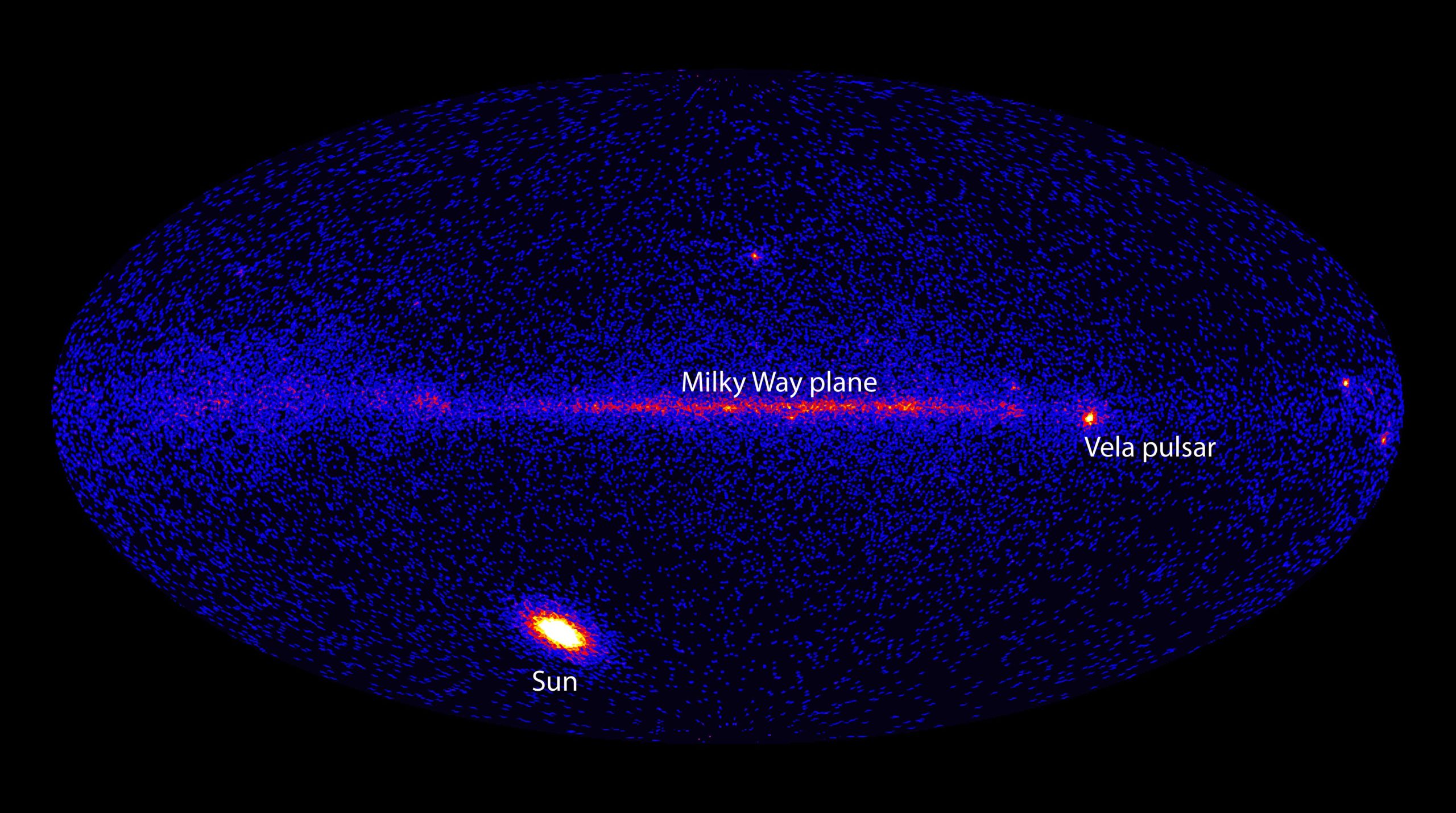
The March flare also is notable for the persistence of its gamma-ray emission. Fermi’s LAT detected high-energy gamma rays for about 20 hours, two and a half times longer than any event on record.
Additionally, the event marks the first time a greater-than-100-MeV gamma-ray source has been localized to the sun’s disk, thanks to the LAT’s keen angular resolution.
Flares and other eruptive solar events produce gamma rays by accelerating charged particles, which then collide with matter in the sun’s atmosphere and visible surface. For instance, interactions among protons result in short-lived subatomic particles called pions, which produce high-energy gamma rays when they decay. Nuclei excited by collisions with lower-energy ions give off characteristic gamma rays as they settle down. Accelerated electrons emit gamma rays as they collide with protons and atomic nuclei.
Solar flares produce gamma rays by several processes, one of which is illustrated here. The energy released in a solar flare rapidly accelerates charged particles. When a high-energy proton strikes matter in the sun’s atmosphere and visible surface, the result may be a short-lived particle — a pion — that emits gamma rays when it decays. Credit: NASA’s Goddard Space Flight Center
Fermi’s LAT scans the entire sky every 3 hours, looking for gamma rays with energies ranging from 20 MeV to more than 300 GeV. Its high sensitivity and wide field of view make the LAT an excellent tool for solar monitoring.
Another Fermi instrument, the Gamma-ray Burst Monitor (GBM), observes the entire sky not blocked by the Earth at any given moment. Designed to detect light at energies from 8,000 eV to 40 MeV, the GBM’s complementary capabilities give scientists access to a lower, but overlapping energy range where solar phenomena produce interesting features.
Both instruments observed a strong, but less powerful solar flare on June 12, 2010.
“Seeing the rise and fall of this brief flare in both instruments allowed us to determine that some of these particles were accelerated to two-thirds of the speed of light in as little as 3 seconds,” said Michael Briggs, a member of GBM team at the University of Alabama in Huntsville.
Solar eruptions are on the rise as the sun progresses toward the peak of its roughly 11-year-long activity cycle, now expected in mid-2013.
“Merged with available theoretical models, Fermi observations will give us the ability to reconstruct the energies and types of particles that interact with the sun during flares, an understanding that will open up whole new avenues in solar research,” said Gerald Share, an astrophysicist at the University of Maryland in College Park.
NASA’s Fermi Gamma-ray Space Telescope is an astrophysics and particle physics partnership. Fermi is managed by NASA’s Goddard Space Flight Center, Greenbelt, Maryland. It was developed in collaboration with the U.S. Department of Energy, with contributions from academic institutions and partners in France, Germany, Italy, Japan, Sweden, and the United States.
Never miss a breakthrough: Join the SciTechDaily newsletter.
Follow us on Google and Google News.