
Close Menu
    Facebook X (Twitter) Instagram
    SciTechDaily
    • Biology
    • Chemistry
    • Earth
    • Health
    • Physics
    • Science
    • Space
    • Technology
    Facebook X (Twitter) Pinterest YouTube RSS
    SciTechDaily
    Home»Space»New Technique Leads to the Discovery of 5 New Pulsars
    Space

    New Technique Leads to the Discovery of 5 New Pulsars

    By David Reffkin, SLAC National Accelerator LaboratoryMay 22, 2012No Comments3 Mins Read
    Facebook Twitter Pinterest Telegram LinkedIn WhatsApp Email Reddit
    Share
    Facebook Twitter LinkedIn Pinterest Telegram Email Reddit
    New Way to Discover Pulsars
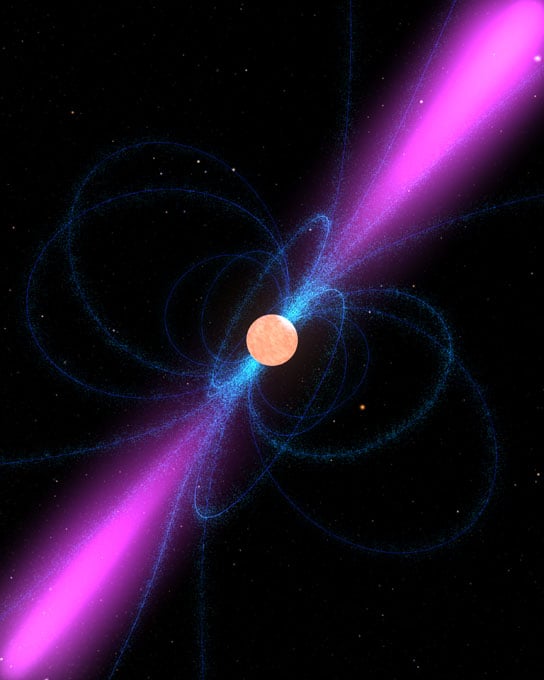
    Simulation of a pulsar, showing magnetic field (blue lines) and high-energy jets at the poles (purple). Credit: NASA

    By combining observations from the Large Area Telescope and the Parkes Radio Telescope in Australia, scientists have found a new technique for hunting pulsars. The team has already found five new “millisecond” pulsars, including one particularly intriguing object, proving that the technique is successful.

    The Large Area Telescope (LAT), built by SLAC for the Fermi Gamma-ray Space Telescope, collects information on high-energy gamma rays from numerous sources in the sky. Among these are small, elusive objects called pulsars, which spin up to hundreds of times per second. Their name derives from the beams their magnetic fields produce as a result of this spin, which look like the pulsing beam of a lighthouse when, by chance, they happen to sweep across our field of view.

    Pulsars are very interesting to scientists because they are special types of neutron stars. Small (about 10 miles or 16 kilometers in diameter) and dense (one teaspoon weighs about a billion tons), they exhibit immense gravitational and magnetic forces not found on Earth.

    The LAT has seen the gamma-ray signatures of more than 100 pulsars and is revolutionizing the study of these flashy objects in gamma rays, which are the most energetic form of light.

    A team led by postdoctoral researcher Matthew Kerr of the Kavli Institute for Particle Astrophysics and Cosmology (KIPAC), and Columbia University radio astronomer Fernando Camilo is reporting the use of new techniques for hunting pulsars. They and their colleagues have found a way to look for likely pulsar candidates by combining observations from the LAT and the Parkes radio telescope in Australia. This approach combines the broad reach of an all-sky telescope (the LAT) with the deep sensitivity of a radio telescope, which can view only a tiny part of the sky at a time.

    So far, the discovery of five more rapidly rotating, or “millisecond” pulsars, including one particularly intriguing object, prove that the technique is successful and likely to uncover many more pulsars in our galaxy. One especially interesting object discovered with this technique seems to have a previously unknown waveform – a gamma-ray peak before and after each radio peak – an effect the team could not explain using standard models of pulsar geometry. This suggests that the radio part of the beam may originate at two distinct points above the object’s surface. This variation increases the mystery and allure of these fascinating astrophysical phenomena.

    This work is described in part in a paper published in the Astrophysical Journal (ApJ, 2012, 748, 2), and based in part on a KIPAC Tidbit by Jack Singal.

    Reference: “Five New Millisecond Pulsars From a Radio Survey of 14 Unidentified Fermi-Lat Gamma-Ray Sources” by M. Kerr, F. Camilo, T. J. Johnson, E. C. Ferrara, L. Guillemot, A. K. Harding, J. Hessels, S. Johnston, M. Keith, M. Kramer, S. M. Ransom, P. S. Ray, J. E. Reynolds, J. Sarkissian and K. S. Wood, 27 February 2012, The Astrophysical Journal.
    DOI: 10.1088/2041-8205/748/1/L2

    Never miss a breakthrough: Join the SciTechDaily newsletter.
    Follow us on Google and Google News.

    Astronomy Astrophysics Fermi Gamma-ray Space Telescope NASA Pulsars SLAC National Accelerator Laboratory Telescope
    Share. Facebook Twitter Pinterest LinkedIn Email Reddit

    Related Articles

    Mysterious Gamma-Ray Glow at the Center of the Milky Way Most Likely Caused by Pulsars, Not Dark Matter

    Scientists Expect High-Energy Explosions When Pulsar J2032 Swings Around Its Companion Star

    Fermi Discovers a Pulsar That Switched from Radio Emissions to High-Energy Gamma Rays

    Fermi Reveals Distinctive Properties of Blazars

    Fermi Data Reveal New Clues to Dark Matter

    Astronomers Take a Closer Look at Black Widow and Redback Binary Systems

    Fermi Enters Extended Phase of Its Mission – A Deeper Study of the High-Energy Cosmos

    NASA’s Fermi, Swift View Record-Setting Gamma-Ray Burst

    NASA’s Swift Discovers Three Unusually Long-Lasting Stellar Explosions

    Leave A Reply Cancel Reply

    • Facebook
    • Twitter
    • Pinterest
    • YouTube

    Don't Miss a Discovery

    Subscribe for the Latest in Science & Tech!

    Trending News

    New Study Reveals Why Ozempic Works Better for Some People Than Others

    Climate Change Is Altering a Key Greenhouse Gas in a Way Scientists Didn’t Expect

    New Study Suggests Gravitational Waves May Have Created Dark Matter

    Scientists Discover Why the Brain Gets Stuck in Schizophrenia

    Scientists Engineer “Tumor-Eating” Bacteria That Devour Cancer From Within

    Even “Failed” Diets May Deliver Long-Term Health Gains, Study Finds

    NIH Scientists Discover Powerful New Opioid That Relieves Pain Without Dangerous Side Effects

    Collapsing Plasma May Hold the Key to Cosmic Magnetism

    Follow SciTechDaily
    • Facebook
    • Twitter
    • YouTube
    • Pinterest
    • Newsletter
    • RSS
    SciTech News
    • Biology News
    • Chemistry News
    • Earth News
    • Health News
    • Physics News
    • Science News
    • Space News
    • Technology News
    Recent Posts
    • This 15,000-Year-Old Discovery Changes What We Know About Early Human Creativity
    • 35-Million-Year-Old Mystery: Strange Arachnid Discovered Preserved in Amber
    • Revolutionary Gas Turbine Generates Power Without Air Compression
    • Is AI Really Just a Tool? It Could Be Altering How You See Reality
    • JWST Reveals a “Forbidden” Planet With a Baffling Composition
    Copyright © 1998 - 2026 SciTechDaily. All Rights Reserved.
    • Science News
    • About
    • Contact
    • Editorial Board
    • Privacy Policy
    • Terms of Use

    Type above and press Enter to search. Press Esc to cancel.