
Close Menu
    Facebook X (Twitter) Instagram
    SciTechDaily
    • Biology
    • Chemistry
    • Earth
    • Health
    • Physics
    • Science
    • Space
    • Technology
    Facebook X (Twitter) Pinterest YouTube RSS
    SciTechDaily
    Home»Biology»Yale Researchers Stop Sugar-Craving in Fruit Flies
    Biology

    Yale Researchers Stop Sugar-Craving in Fruit Flies

    By Bill Hathaway, Yale UniversityMay 2, 2017No Comments3 Mins Read
    Facebook Twitter Pinterest Telegram LinkedIn WhatsApp Email Reddit
    Share
    Facebook Twitter LinkedIn Pinterest Telegram Email Reddit
    Scientists Stop Sugar Craving
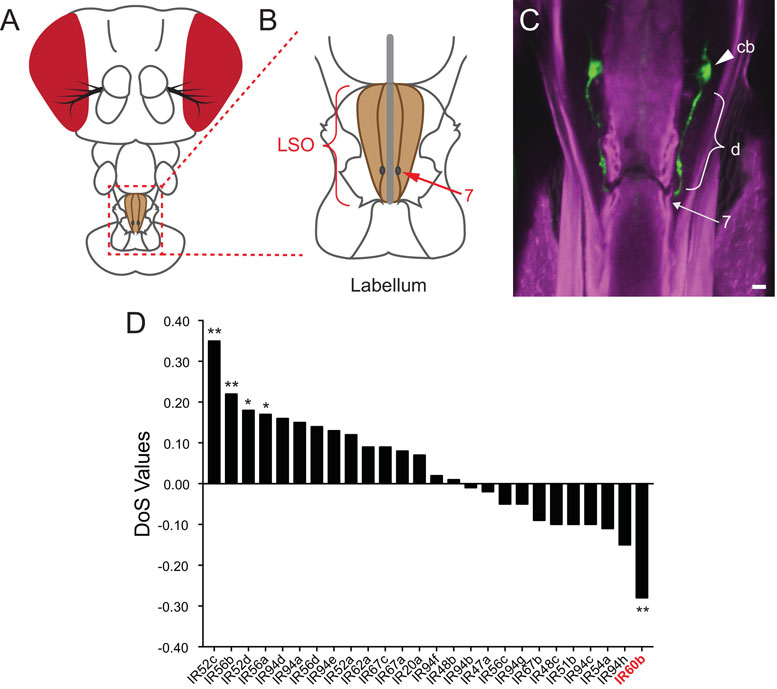
    (A) Drosophila head. The box indicates the region of the proboscis containing the labral sense organ (LSO, shaded) of the pharynx. (B) The pharyngeal region containing the LSO. The position of sensillum 7 is indicated. (C) IR60b-GAL4; UAS-GFP shows expression in a single pair of neurons that project dendrites (d) to the pore of sensillum 7, whose position is indicated. (cb), cell body. To maximize the fidelity of the driver, GAL4 was placed between sequences lying 5’ and 3’ to IR60b. Scale bar = 5 μm. Green color represents UAS-GFP fluorescence, visualized with a 488 nm laser. Magenta color represents cuticular autofluorescence, visualized with a 514 nm laser. (D) IR60b is the only member of the IR20a clade that shows a significantly negative Direction of Selection (DoS) signature.

    Working with fruit flies, researchers from Yale University have discovered ways to blunt the craving for sugar.

    A single pair of neurons in the throat of Drosophila act as a brake on the consumption of sucrose, according to a new study published in April in the journal eLife.

    “This was very surprising because most sugar-sensing taste cells promote eating, but these are doing just the opposite,” said John Carlson, the Eugene Higgins Professor of Molecular, Cellular & Developmental Biology and senior author of the study.

    The control of fundamental processes such as eating, Carlson points out, is often very similar in Drosophila and humans, which are in the midst of a rapidly growing global obesity epidemic.

    The Yale team — including first author Ryan M. Joseph, Jennifer S. Sun, and Edric Tam — investigated a Drosophila gene of unknown function. They found that the gene, IR60b, was expressed only in a single pair of nerve cells found in the pharynx of flies. When either this gene or these nerve cells were disabled, flies ate more sucrose. Alternately, when the nerve cells were activated by red light via optogenetics, the flies ate less.

    Carlson noted that this genetic brake on sucrose consumption was slow to activate, suggesting that mechanisms to induce feeding are activated quickly and are then inhibited by IR60b.

    The scientists now plan to see if mammals use the same system to control the amount of sugar they consume.

    The research was funded by the National Institutes of Health.

    Reference: “A receptor and neuron that activate a circuit limiting sucrose consumption” Ryan M Joseph, Jennifer S Sun, Edric Tam and John R Carlson, 23 March 2017, eLife.
    DOI: 10.7554/eLife.24992

    Never miss a breakthrough: Join the SciTechDaily newsletter.
    Follow us on Google and Google News.

    Fruit Flies Sugar Yale University
    Share. Facebook Twitter Pinterest LinkedIn Email Reddit

    Related Articles

    Anthropologists Seek to Protect Chimpanzees of the Ugandan Jungle

    Immune System May Trigger Melanoma Growth

    Human Presence Increases Indoor Bacteria

    Researchers Study Regulatory Gene’s Role in Sperm Quality Control

    Trip to Rainforest Yields Organisms Capable of Degrading Polyurethane

    Altered Microbes that Cause Obesity & Chronic Liver Disease May be Infectious

    Controversial Proposal Wants Sugar to be Regulated as a Toxic Substance

    Ecuador Rainforest Fungus Survives on Polyurethane without Oxygen

    Gene Discovery Sheds Light on How Fruit Flies Retreat from Heat

    Leave A Reply Cancel Reply

    • Facebook
    • Twitter
    • Pinterest
    • YouTube

    Don't Miss a Discovery

    Subscribe for the Latest in Science & Tech!

    Trending News

    Massive Study Warns Marijuana Use in Teens Is Linked to Serious Mental Illness

    Scientists Discover a Completely Unexpected Way T Cells Kill Cancer

    Scientists Just Found the Solar System’s Original “Planet Factory”

    Study Warns Widely Used Food Preservatives Linked to High Blood Pressure and Heart Disease

    New Treatment Could Reverse Osteoarthritis Within Weeks

    Physicists Have Measured “Negative Time” in Bizarre Quantum Experiment

    The Deadly Tapeworm Spreading Across America Has Reached the Pacific Northwest

    Could Low Vitamin D Be Making Your Pain Worse?

    Follow SciTechDaily
    • Facebook
    • Twitter
    • YouTube
    • Pinterest
    • Newsletter
    • RSS
    SciTech News
    • Biology News
    • Chemistry News
    • Earth News
    • Health News
    • Physics News
    • Science News
    • Space News
    • Technology News
    Recent Posts
    • Scientists Discover Surprising Anemia Benefits of Guava Juice
    • Your Blood May Carry a 700-Million-Year-Old Secret
    • Scientists Discover Some “Zombie Cells” May Actually Help You Live Longer
    • Scientists Discover Two Strange Dead Stars That Defy Astronomical Expectations
    • Scientists Find a Smarter Way To Measure the Universe Using Exploding Stars
    Copyright © 1998 - 2026 SciTechDaily. All Rights Reserved.
    • Science News
    • About
    • Contact
    • Editorial Board
    • Privacy Policy
    • Terms of Use

    Type above and press Enter to search. Press Esc to cancel.