
Close Menu
    Facebook X (Twitter) Instagram
    SciTechDaily
    • Biology
    • Chemistry
    • Earth
    • Health
    • Physics
    • Science
    • Space
    • Technology
    Facebook X (Twitter) Pinterest YouTube RSS
    SciTechDaily
    Home»Science»27-Foot Long Crocodylus Thorbjarnarsoni Roamed Kenya
    Science

    27-Foot Long Crocodylus Thorbjarnarsoni Roamed Kenya

    By SciTechDailyMay 22, 2012No Comments2 Mins Read
    Facebook Twitter Pinterest Telegram LinkedIn WhatsApp Email Reddit
    Share
    Facebook Twitter LinkedIn Pinterest Telegram Email Reddit
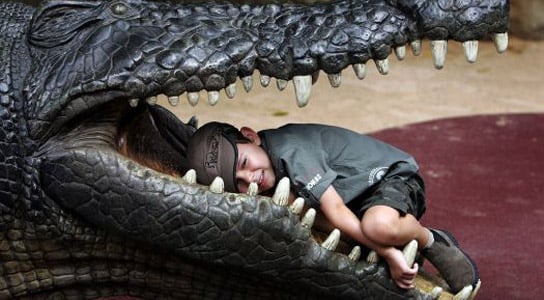
    Crocodylus_thorbjarnarsoni-swallowing-kid
    Crocodylus thorbjarnarsoni is the largest known crocodilian species.

    The remains of the largest crocodilian known to have existed, Crocodylus thorbjarnarsoni, were unearthed in the Turkana Basin, in Kenya. The large crocodile was big enough to swallow humans whole, and probably did as much two to four million years ago, from the mid-Pliocene to the early Pleistocene eras.

    The enormous horned crocodilian, named Crocodylus thorbjarnarsoni, after the famed crocodile expert John Thorbjarnarson, exceeded 27 feet in length and was described in the latest Journal of Vertebrate Paleontology. C. thorbjarnarsoni was most probably the dominant predator of its ecosystem and preyed upon many different organisms. Remains of Australopithecus were found nearby.
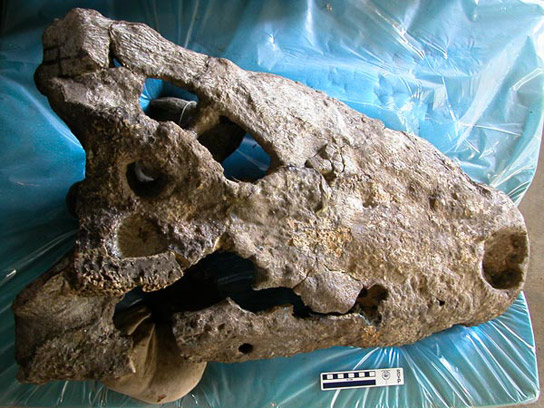
    Crocodylus_thorbjarnarsoni-skull

    Early hominidae would have come in contact with C. thorbjarnarsoni near lakesides or riverbanks. The fossils were discovered stored at the National Museum of Kenya in Nairobi. The crocodile would have looked similar to a Nile crocodile, except with a larger snout and horn-like protuberances behind its eyes. Given these similarities, the prehistoric species had a lifestyle that resembled the one of their modern counterparts.
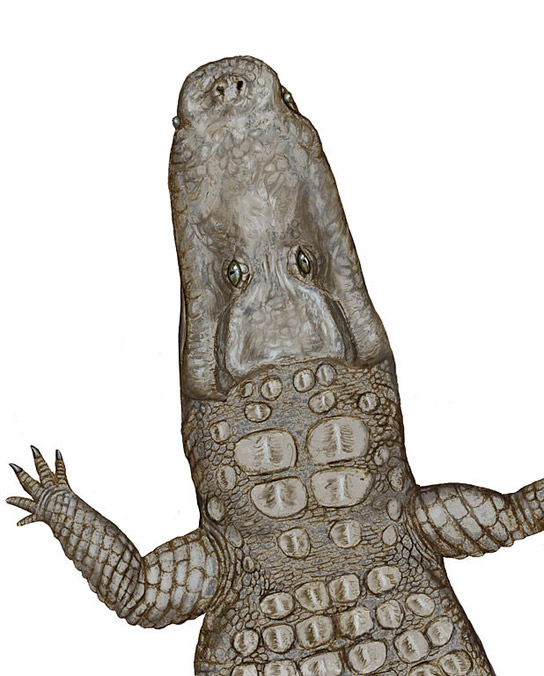
    Crocodylus_thorbjarnarsoni-reconstruction

    It took four men to lift the animal’s skull, and Christopher Brochu states that it was related to Crocodylus anthropophagus, another man-eating horned crocodilian from Tanzania. As well as preying on Australopithecus, C. thorbjarnarsoni probably ate other hominidae, including early species of homo sapiens.

    Reference: “A giant crocodile from the Plio-Pleistocene of Kenya, the phylogenetic relationships of Neogene African crocodylines, and the antiquity of Crocodylus in Africa” by Christopher A. Brochu and Glenn W. Storrs, 3 May 2012, Journal of Vertebrate Paleontology.
    DOI: 10.1080/02724634.2012.652324

    Never miss a breakthrough: Join the SciTechDaily newsletter.
    Follow us on Google and Google News.

    Archaeology Crocodiles Fossils Paleontology Reptile
    Share. Facebook Twitter Pinterest LinkedIn Email Reddit

    Related Articles

    When Did Animals Leave Their First Footprint on Earth?

    Jurassic Fossil Links Ancient Crocodiles With Dolphin-Like Animals

    Paleontologists Identify a New Species of Ancient Whale

    Paleontologists Provide New Perspective on Triassic Period, Emergence of Dinosaurs

    Paleontologists Identify a New Species of Prehistoric Reptile, Colobops Noviportensis

    Paleontologists Discover Never-Before-Seen Ancient Fish Species

    Archaeologists Discover Oldest Known Funereal Fish Hooks

    Turtles Share a Recent Common Ancestor with Birds and Crocodiles

    Carnufex Carolinensis – North America’s Top Predator Before Dinosaurs?

    Leave A Reply Cancel Reply

    • Facebook
    • Twitter
    • Pinterest
    • YouTube

    Don't Miss a Discovery

    Subscribe for the Latest in Science & Tech!

    Trending News

    Largest-Ever Study Finds Medicinal Cannabis Ineffective for Anxiety, Depression, PTSD

    250-Million-Year-Old Egg Solves One of Evolution’s Biggest Mysteries

    Living With Roommates Might Be Changing Your Gut Microbiome Without You Knowing

    Century-Old Cleaning Chemical Linked to 500% Increased Risk of Parkinson’s Disease

    What if Your Memories Never Happened? Physicists Take a New Look at the Boltzmann Brain Paradox

    One of the Universe’s Largest Stars May Be Getting Ready To Explode

    Scientists Discover Enzyme That Could Supercharge Ozempic-Like Weight Loss Drugs

    Popular Sweetener Linked to DNA Damage – “It’s Something You Should Not Be Eating”

    Follow SciTechDaily
    • Facebook
    • Twitter
    • YouTube
    • Pinterest
    • Newsletter
    • RSS
    SciTech News
    • Biology News
    • Chemistry News
    • Earth News
    • Health News
    • Physics News
    • Science News
    • Space News
    • Technology News
    Recent Posts
    • The Most Elusive Number in Physics Just Got Even More Mysterious
    • Scientists Uncover Hidden Trigger Behind Stem Cell Aging
    • Scientists Discover Coral Reefs Are Teeming With Previously Unknown Life
    • Scientists Find Way to Reverse Fatty Liver Disease Without Changing Diet
    • Could Humans Regrow Limbs? New Study Reveals Promising Genetic Pathway
    Copyright © 1998 - 2026 SciTechDaily. All Rights Reserved.
    • Science News
    • About
    • Contact
    • Editorial Board
    • Privacy Policy
    • Terms of Use

    Type above and press Enter to search. Press Esc to cancel.