
Close Menu
    Facebook X (Twitter) Instagram
    SciTechDaily
    • Biology
    • Chemistry
    • Earth
    • Health
    • Physics
    • Science
    • Space
    • Technology
    Facebook X (Twitter) Pinterest YouTube RSS
    SciTechDaily
    Home»Space»Dwarf Galaxy Movement Challenges to Our Understanding the Universe
    Space

    Dwarf Galaxy Movement Challenges to Our Understanding the Universe

    By University of SydneyJuly 21, 2014No Comments3 Mins Read
    Facebook Twitter Pinterest Telegram LinkedIn WhatsApp Email Reddit
    Share
    Facebook Twitter LinkedIn Pinterest Telegram Email Reddit
    New Study on Dwarf Galaxies May Force a Cosmic Rethink
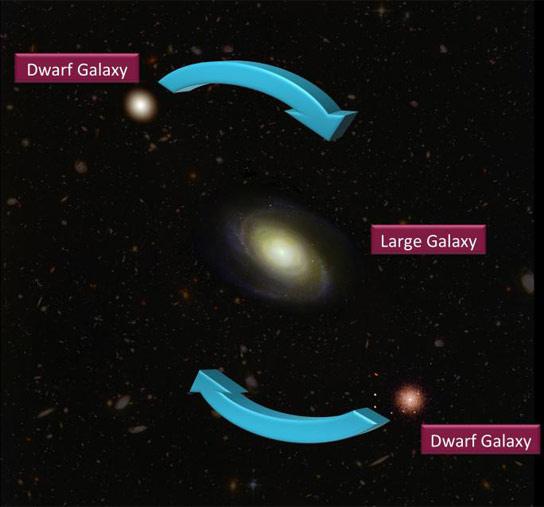
    This is an artist’s impression of the coherent orbit of dwarf galaxies about a large galaxy. Credit: Geraint Lewis

    A newly published study examines the movement of small galaxies throughout the universe, finding that they ‘dance’ in orderly disc-shaped orbits around larger galaxies.

    The discovery that many small galaxies throughout the universe do not ‘swarm’ around larger ones like bees do but ‘dance’ in orderly disc-shaped orbits is a challenge to our understanding of how the universe formed and evolved.

    The finding, by an international team of astronomers, including Professor Geraint Lewis from the University of Sydney’s School of Physics, is announced in the journal Nature.

    “Early in 2013 we announced our startling discovery that half of the dwarf galaxies surrounding the Andromeda Galaxy are orbiting it in an immense plane,” said Professor Lewis. “This plane is more than a million light-years in diameter, but is very thin, with a width of only 300,000 light-years.”

    The universe contains billions of galaxies. Some, such as the Milky Way, are immense, containing hundreds of billions of stars. Most galaxies, however, are dwarfs, much smaller and with only a few billion stars.

    For decades astronomers have used computer models to predict how these dwarf galaxies should orbit large galaxies. They had always found that they should be scattered randomly.

    “Our Andromeda discovery did not agree with expectations, and we felt compelled to explore if it was true of other galaxies throughout the universe,” said Professor Lewis.

    Using the Sloan Digital Sky Survey, a remarkable resource of color images and 3-D maps covering more than a third of the sky, the researchers dissected the properties of thousands of nearby galaxies.

    “We were surprised to find that a large proportion of pairs of satellite galaxies have oppositely directed velocities if they are situated on opposite sides of their giant galaxy hosts”, said lead author Neil Ibata of the Lycée International in Strasbourg, France.

    “Everywhere we looked we saw this strangely coherent coordinated motion of dwarf galaxies. From this we can extrapolate that these circular planes of dancing dwarfs are universal, seen in about 50 percent of galaxies,” said Professor Geraint Lewis.

    “This is a big problem that contradicts our standard cosmological models. It challenges our understanding of how the universe works including the nature of dark matter.”

    The researchers believe the answer may be hidden in some currently unknown physical process that governs how gas flows in the universe, although, as yet, there is no obvious mechanism that can guide dwarf galaxies into narrow planes.

    Some experts, however, have made more radical suggestions, including bending and twisting the laws of gravity and motion. “Throwing out seemingly established laws of physics is unpalatable,” said Professor Lewis, “but if our observations of nature are pointing us in this direction, we have to keep an open mind. That’s what science is all about.”

    Reference: “Velocity anti-correlation of diametrically opposed galaxy satellites in the low-redshift Universe” by Neil G. Ibata, Rodrigo A. Ibata, Benoit Famaey and Geraint F. Lewis, 20 July 2014, Nature.
    DOI: 10.1038/nature13481

    Never miss a breakthrough: Join the SciTechDaily newsletter.
    Follow us on Google and Google News.

    Astronomy Astrophysics University of Sydney
    Share. Facebook Twitter Pinterest LinkedIn Email Reddit

    Related Articles

    “Extraordinary” Slow-Spinning Neutron Star Shakes Astrophysics

    Shattering Astronomical Records: The Coldest Star to Emit Radio Waves

    Milky Way’s Graveyard of Dead Stars Found – First Map of the “Galactic Underworld”

    New Type Neutron Star Discovered in Unusual Galactic Graveyard

    An Intragalactic Treasure Hunt: Red Giant Stars’ Mass “Stolen” by Stellar Neighbors

    Could There Be Alien Life Next Door? Looking for Habitable Planets Around Alpha Centauri

    Mysterious Flashing Radio Signal Emanating From Near the Center of the Galaxy

    Strange Radio Signals From the Heart of the Milky Way Tantalize Scientists

    Student Astronomer Uses Ingenious Method to Find Galactic Missing Matter

    Leave A Reply Cancel Reply

    • Facebook
    • Twitter
    • Pinterest
    • YouTube

    Don't Miss a Discovery

    Subscribe for the Latest in Science & Tech!

    Trending News

    Monster Storms on Jupiter Unleash Lightning Beyond Anything on Earth

    Scientists Create “Liquid Gears” That Spin Without Touching

    The Simple Habit That Could Help Prevent Cancer

    Millions Take These IBS Drugs, But a New Study Finds Serious Risks

    Scientists Unlock Hidden Secrets of 2,300-Year-Old Mummies Using Cutting-Edge CT Scanner

    Bread Might Be Making You Gain Weight Even Without Eating More Calories

    Scientists Discover Massive Magma Reservoir Beneath Tuscany

    Europe’s Most Active Volcano Just Got Stranger – Here’s Why Scientists Are Rethinking It

    Follow SciTechDaily
    • Facebook
    • Twitter
    • YouTube
    • Pinterest
    • Newsletter
    • RSS
    SciTech News
    • Biology News
    • Chemistry News
    • Earth News
    • Health News
    • Physics News
    • Science News
    • Space News
    • Technology News
    Recent Posts
    • Sharks Are Overheating as Warming Oceans Push Them to the Edge
    • Scientists Discover Plants “Scream” – We Just Couldn’t Hear Them Until Now
    • 25-Year Study Uncovers Hidden Paths and Early Warning Signs of Blood Cancer
    • Not Just Snoring – New Research Reveals Sleep Apnea May Be Damaging Your Muscles
    • Scientists Discover a Surprising Reason Intermittent Fasting Extends Life
    Copyright © 1998 - 2026 SciTechDaily. All Rights Reserved.
    • Science News
    • About
    • Contact
    • Editorial Board
    • Privacy Policy
    • Terms of Use

    Type above and press Enter to search. Press Esc to cancel.