
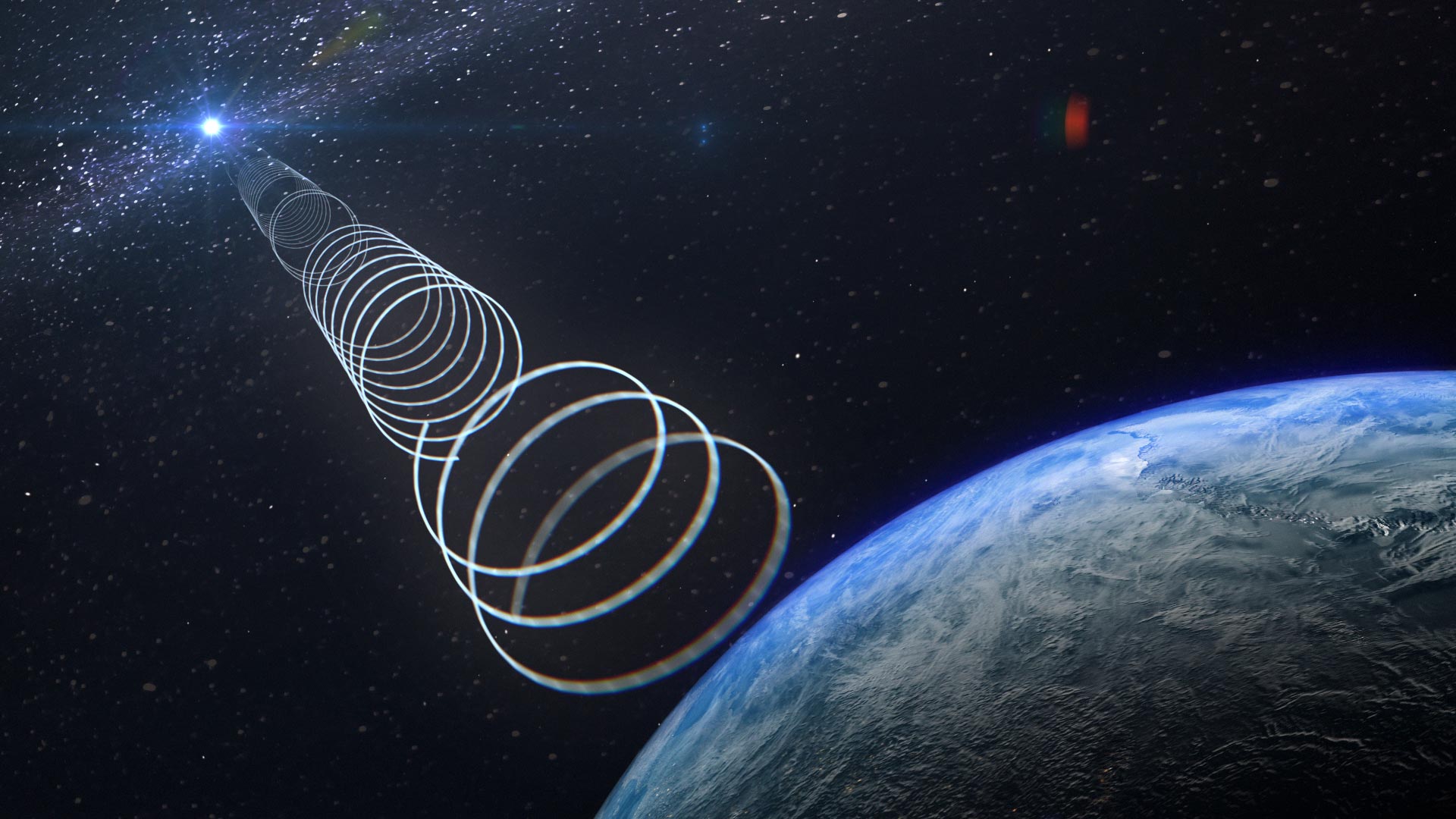
Astronomers have uncovered a puzzling radio signal near the Milky Way’s core that resists all known explanations.
In early 2020, we detected an unusual radio signal coming from somewhere near the center of our galaxy. The signal blinked on and off, growing 100 times brighter and dimmer over time.
What’s more, the radio waves in the signal had an uncommon “circular polarisation,” which means the electric field in the radio waves spirals around as the waves travel through space.
We first spotted the signal using the Australian Square Kilometer Array Pathfinder Telescope (ASKAP), then followed up with other telescopes around the world and in space. Despite our best efforts, we are still unable to work out exactly what produced these mysterious radio waves.
A Strange Signal From the Heart of the Milky Way
We have been surveying the sky with ASKAP throughout 2020 and 2021 in search of unusual new objects, in a project called the Variables and Slow Transients (VAST) survey.
Most things astronomers see in outer space are fairly stable and don’t change much on human time scales. That’s why objects that do change (known as variables) or appear and disappear (known as transients) are so interesting.
Transients are usually connected with some of the most energetic and violent events in the Universe, such as the death of massive stars. The past decade has seen thousands of transients discovered at optical and X-ray wavelengths, but radio wavelengths are largely untapped.
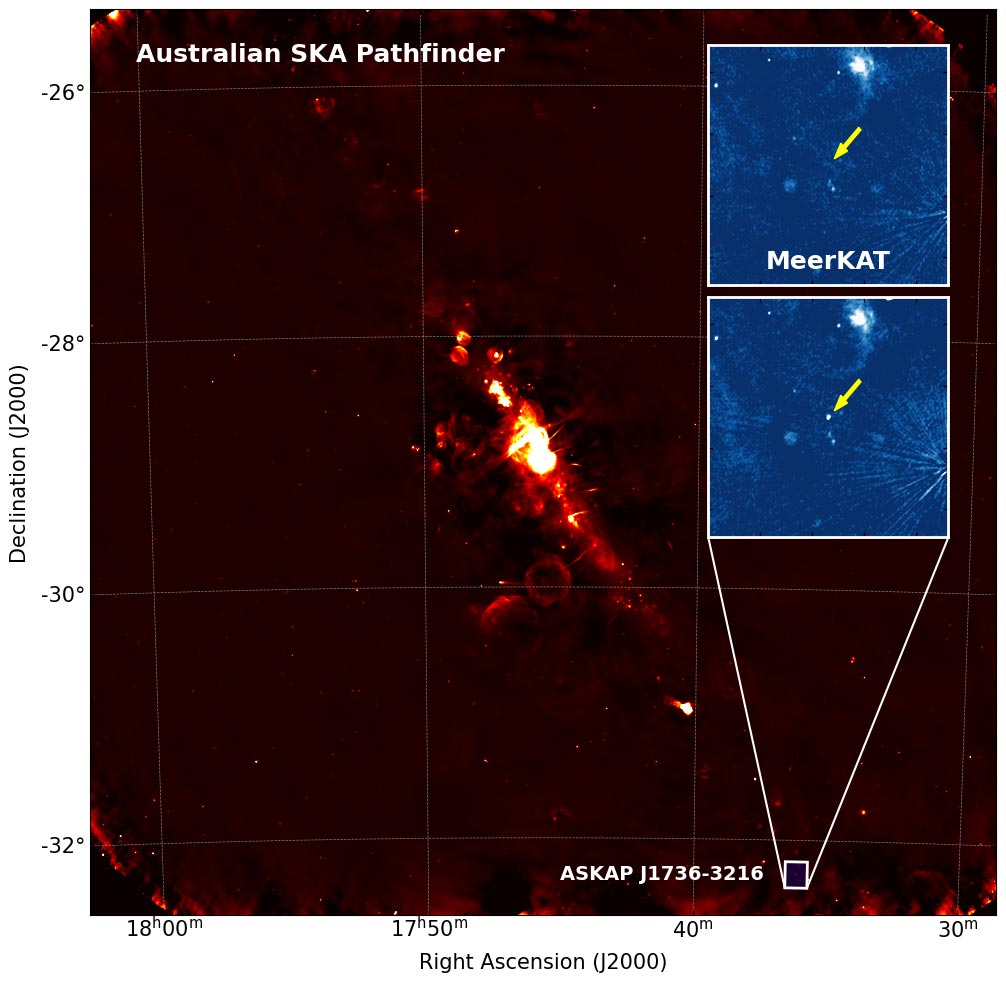
When we looked towards the center of our galaxy (the Milky Way), we found a source we called ASKAP J173608.2-321635 (this catchy name comes from its coordinates in the sky). This object was unique in that it started out invisible, became bright, faded away, and then reappeared. This behavior was extraordinary.
As well as changing over time, the signal was circularly polarised. Our eyes cannot distinguish between polarized and unpolarized light, but ASKAP has the equivalent of polaroid sunglasses for radio waves.
Polarised radio sources are extremely rare: we might find fewer than ten circularly polarised sources out of thousands. Almost all of them are sources we understand well, such as pulsars (the rapidly rotating, highly magnetized remnants of exploded stars) or highly magnetized red dwarf stars.
Finding More Evidence
Investigating a new astronomical object is a bit like a detective job. We need evidence to determine what it is.
Based on our ASKAP data, we thought the new object might be a pulsar or a flaring star: both types of object can be polarised, and change in brightness. However, we needed to find more clues.
We next observed the source with the Parkes radio telescope in New South Wales to decide whether it was a pulsar. However, these observations yielded nothing.
We then tried the more sensitive MeerKAT radio telescope in South Africa. Because the signal was intermittent, we observed it for 15 minutes every few weeks, hoping we would see it again. Luckily, the signal returned, but the behavior of the source was now dramatically different. The source disappeared in the course of a single day, even though it had lasted for weeks in our previous ASKAP observations.

It is always a good idea to investigate from multiple perspectives. Telescopes working at other wavelengths can serve as another pair of eyes to help us find new clues.
After the MeerKAT detection, we searched for the source in X-rays (using the space-based Neil Gehrels Swift Observatory and Chandra X-ray Observatory) and infrared (using the Gemini telescope in Chile). However, we saw nothing.
Still a Mystery
We have observed this strange object at multiple wavelengths using telescopes on three continents and in space. What can we say about what it actually is?
Can it be a star? It seems unlikely because stars also emit much of their light in the optical and infrared (like the Sun), but we detect nothing at these wavelengths.
Can it be a pulsar? Like our signal, pulsars produce polarised radio waves and can vary dramatically in brightness. But the characteristic of pulsars is rapid pulses between milliseconds to seconds long, and we did not detect these with Parkes or MeerKAT.
Is the source’s proximity to the center of our galaxy a clue? Over the past 15 years, a number of intriguing radio sources have been discovered toward the Galactic center (including one dubbed the “cosmic burper”). We don’t know what they are, but they are imaginatively called Galactic Center Radio Transients (GCRTs).
Are they related to ASKAP J173608.2-321635? There are some similarities, but there are also differences. And even the known GCRTs exhibit diversity, and may not share a common origin. So our signal is still a mystery.
We will keep observing this source in new ways. It is just the first of many unusual transient sources that we expect to find with the powerful ASKAP array, and it gives a hint of the future of radio astronomy.
Written by:
- Ziteng Wang – PhD researcher, University of Sydney
- David Kaplan – Associate professor of Physics, University of Wisconsin-Milwaukee
- Tara Murphy – Professor, University of Sydney
This article was first published in The Conversation.
Never miss a breakthrough: Join the SciTechDaily newsletter.
Follow us on Google and Google News.