
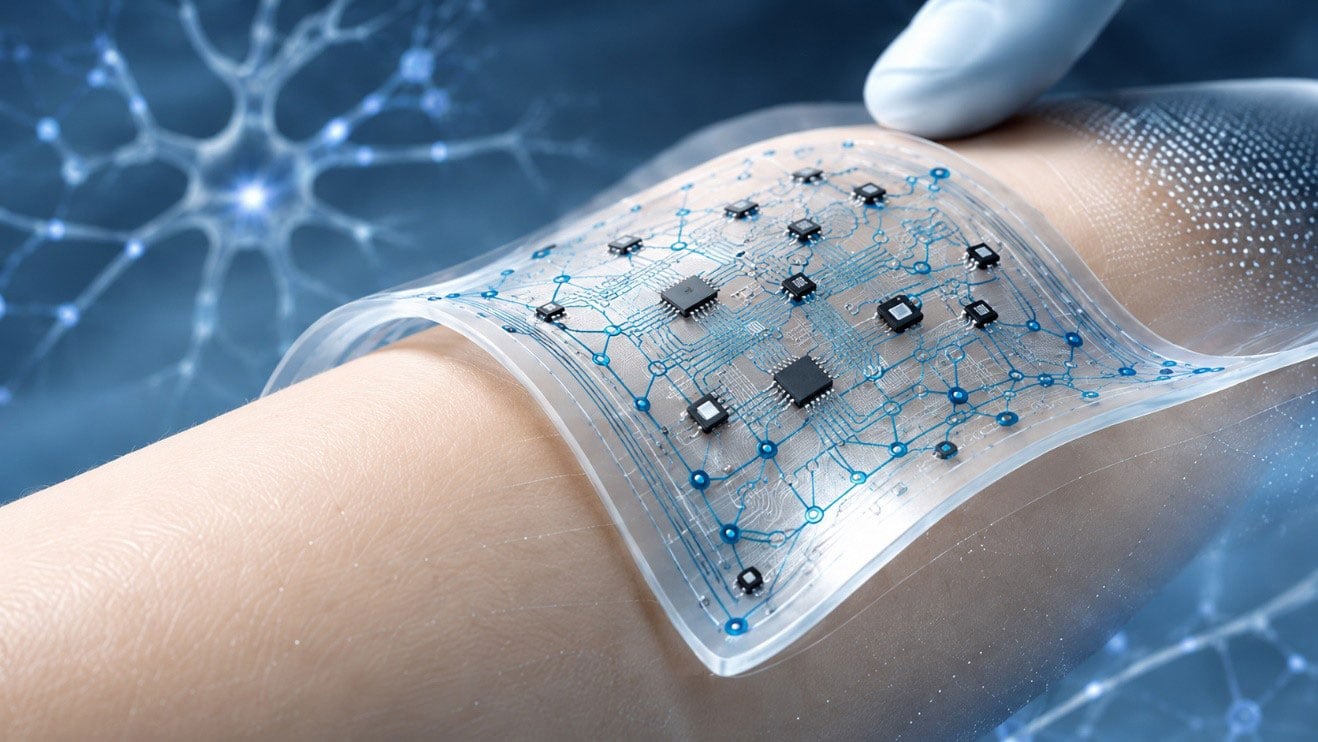
Researchers are replacing rigid silicon-based AI hardware with stretchable, neuromorphic electronics that mimic how the brain processes information, opening new possibilities for long-term human-machine integration.
Modern artificial intelligence can outperform humans in tasks ranging from image recognition to medical data analysis, but there is one environment where today’s hardware still struggles: the human body.
The problem is surprisingly simple. Human tissues are soft, flexible, and constantly moving. Conventional electronics are not. Even the most advanced silicon chips remain rigid, making long-term integration with organs, muscles, and skin extremely difficult. Devices attached to a beating heart, expanding lungs, or bending joints can irritate tissue, lose contact, and eventually fail.
Researchers are now pursuing a radically different approach. Instead of forcing the body to adapt to electronics, they are redesigning electronics to behave more like the body itself.
A review published in the International Journal of Extreme Manufacturing highlights the rise of soft neuromorphic electronics, a new class of devices that combine sensing, memory, and computing in materials that can stretch, bend, and conform to living tissue. The technology draws inspiration from the brain, not only in how it processes information but also in how it physically interacts with its environment.
Electronics Inspired by the Brain
Unlike traditional circuits that rely exclusively on electrons moving through metal pathways, these systems use soft materials such as flexible polymers and gel-like ionogels that transport both electrons and ions.
This mechanism, known as organic mixed ionic-electronic conduction, more closely resembles the electrochemical signaling used by the nervous system. The active materials can absorb and release ions from their surroundings, continuously altering their internal electrical state.
As a result, a single soft transistor can mimic synaptic plasticity, the biological process that allows brain cells to strengthen or weaken connections over time. In effect, the hardware itself can exhibit behaviors similar to the learning mechanisms found in the brain.
Stretchable and Energy Efficient
Recent advances in materials science have pushed these devices to impressive levels of flexibility. Some components can stretch to 140% of their original length, exceeding the natural stretchability of human skin and allowing them to function across highly mobile areas of the body.
The devices also operate with extremely low power requirements. By relying on efficient electrochemical processes rather than large electrical currents, they can perform complex tasks, including heart rhythm classification, at voltages below 0.5 volts.
Such low operating voltages help minimize heat generation and electrical stress, two critical considerations for electronics designed to remain in continuous contact with living tissue.
The technology could also reshape wearable device manufacturing. Rather than mounting rigid sensors onto flexible substrates, engineers could print integrated soft computing networks that combine sensing, memory, and processing within a single stretchable material. This approach could enable electronic skin and soft robotic limbs capable of interpreting touch and movement locally instead of constantly sending data to an external computer.
Moving Beyond the Laboratory
Despite the progress, significant technical hurdles remain before soft neuromorphic electronics can be used clinically.
One of the biggest challenges is memory retention. Many current soft memory devices lose stored information quickly after a signal ends, limiting their usefulness for long-term data storage.
To address this issue, researchers are focusing on island-bridge architectures. These designs place permanent memory components on tiny rigid islands that are protected from mechanical strain, while highly stretchable coiled connections link the components together.
Researchers believe that combining these architectures with chemically stable, non-toxic materials could provide a practical path toward durable neuromorphic devices capable of long-term integration with the human body.
Reference: “Stretchable neuromorphic electronics for future human-integrated intelligence” by Tianda Fu, Ruizhe Yang, Max Weires, Junyi Yin, Yifan Liao and Yifan Guo, 23 March 2026, International Journal of Extreme Manufacturing.
DOI: 10.1088/2631-7990/ae5004
Never miss a breakthrough: Join the SciTechDaily newsletter.
Follow us on Google and Google News.
1 Comment
Scientists told me that wearing a mask and avoiding people would save me from COVID, and that the world would burn up in 2010 if I kept driving my car.