
Close Menu
    Facebook X (Twitter) Instagram
    SciTechDaily
    • Biology
    • Chemistry
    • Earth
    • Health
    • Physics
    • Science
    • Space
    • Technology
    Facebook X (Twitter) Pinterest YouTube RSS
    SciTechDaily
    Home»Technology»Low-Cost, High-Accuracy GPS-Like System Developed for Flexible Medical Robots
    Technology

    Low-Cost, High-Accuracy GPS-Like System Developed for Flexible Medical Robots

    By University of California - San DiegoMay 18, 2020No Comments4 Mins Read
    Facebook Twitter Pinterest Telegram LinkedIn WhatsApp Email Reddit
    Share
    Facebook Twitter LinkedIn Pinterest Telegram Email Reddit
    Flexible Robot in Maze
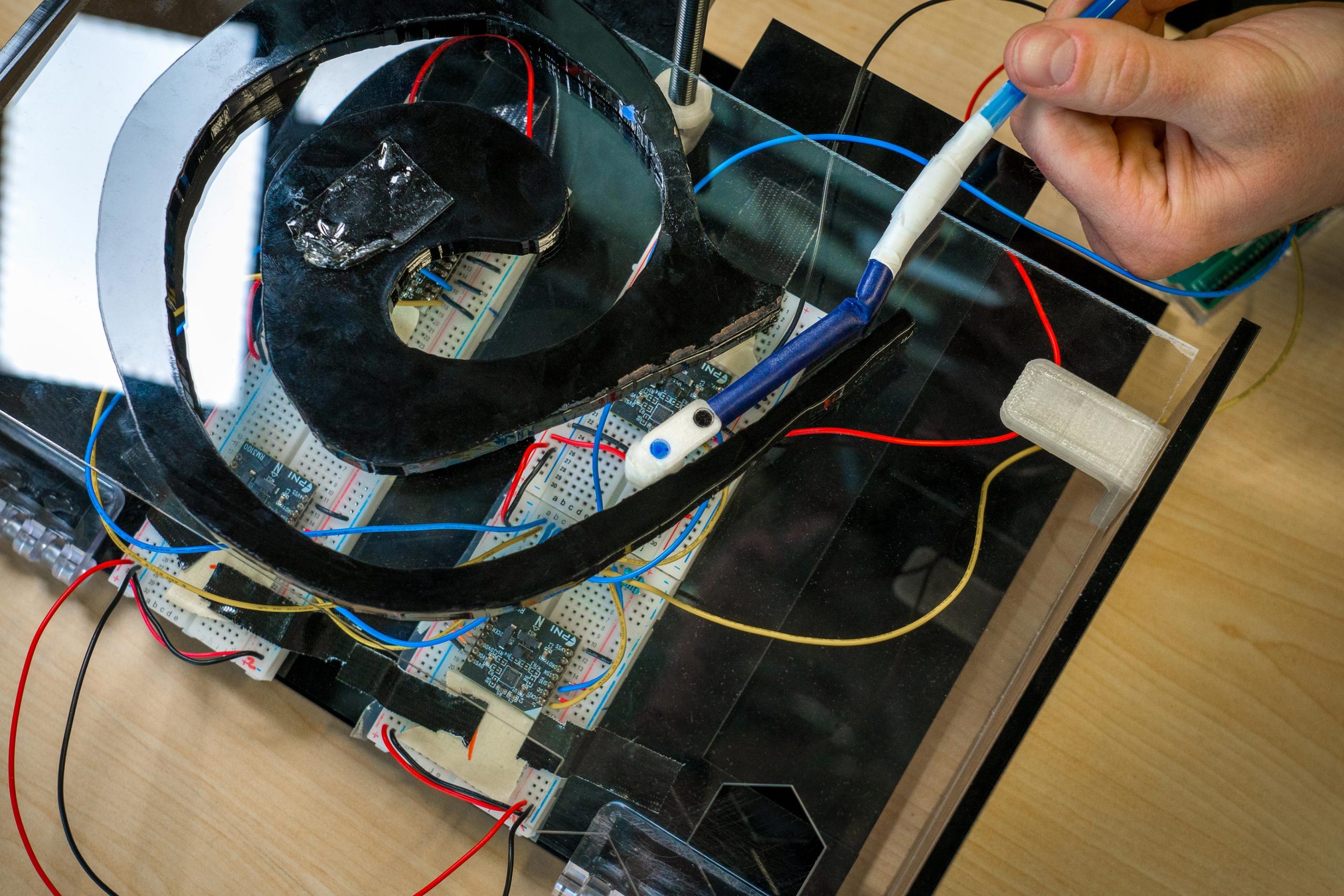
    The researchers then used existing magnet localization methods, which work very much like GPS, to develop a computer model that predicts the robot’s location. GPS satellites ping smartphones and based on how long it takes for the signal to arrive, the GPS receiver in the smartphone can determine where the cell phone is. Similarly, researchers know how strong the magnetic field should be around the magnet embedded in the robot. They rely on four sensors that are carefully spaced around the area where the robot operates to measure the magnetic field strength. Based on how strong the field is, they are able to determine where the tip of the robot is. Credit: David Baillot/University of California San Diego

    Roboticists at the University of California San Diego have developed an affordable, easy to use system to track the location of flexible surgical robots inside the human body. The system performs as well as current state of the art methods, but is much less expensive. Many current methods also require exposure to radiation, while this system does not.

    The system was developed by Tania Morimoto, a professor of mechanical engineering at the Jacobs School of Engineering at UC San Diego, and mechanical engineering Ph.D. student Connor Watson. Their findings are published in the April 2020 issue of IEEE Robotics and Automation Letters.

    “Continuum medical robots work really well in highly constrained environments inside the body,” Morimoto said. “They’re inherently safer and more compliant than rigid tools. But it becomes a lot harder to track their location and their shape inside the body. And so if we are able to track them more easily that would be a great benefit both to patients and surgeons.”

    The researchers embedded a magnet in the tip of a flexible robot that can be used in delicate places inside the body, such as arterial passages in the brain. “We worked with a growing robot, which is a robot made of a very thin nylon that we invert, almost like a sock, and pressurize with a fluid which causes the robot to grow,” Watson said.  Because the robot is soft and moves by growing, it has very little impact on its surroundings, making it ideal for use in medical settings.

    The researchers then used existing magnet localization methods, which work very much like GPS, to develop a computer model that predicts the robot’s location. GPS satellites ping smartphones and based on how long it takes for the signal to arrive, the GPS receiver in the smartphone can determine where the cell phone is. Similarly, researchers know how strong the magnetic field should be around the magnet embedded in the robot. They rely on four sensors that are carefully spaced around the area where the robot operates to measure the magnetic field strength. Based on how strong the field is, they are able to determine where the tip of the robot is.

    The whole system, including the robot, magnets, and magnet localization setup, costs around $100.

    Morimoto and Watson went a step further. They then trained a neural network to learn the difference between what the sensors were reading and what the model said the sensors should be reading. As a result, they improved localization accuracy to track the tip of the robot.

    “Ideally we are hoping that our localization tools can help improve these kinds of growing robot technologies. We want to push this research forward so that we can test our system in a clinical setting and eventually translate it into clinical use,” Morimoto said.

    Reference: “Permanent Magnet-Based Localization for Growing Robots in Medical Applications” by Connor Watson and Tania Morimoto, 10 February 2020, IEEE Robotics and Automation Letters.
    DOI: 10.1109/LRA.2020.2972890

    Never miss a breakthrough: Join the SciTechDaily newsletter.
    Follow us on Google and Google News.

    Biomedical Engineering Biotechnology Robotics Surgery UCSD
    Share. Facebook Twitter Pinterest LinkedIn Email Reddit

    Related Articles

    Scientists Create Microscopic Algae Robots With Incredible Swimming Abilities

    Engineers Develop the First Fully Integrated Wearable Ultrasound System for Deep-Tissue Monitoring

    Appetite-Control Capsule: Ingestible Electroceutical Tames Hunger Hormones

    Compact Wearable “Lab on the Skin” Continuously Monitors Glucose, Alcohol, and Lactate

    Wearable, All-in-One Health Monitor: New Skin Patch Continuously Tracks Cardiovascular Signals and Biochemical Levels

    New Tool for Surgeons: 3D Bioprinted Heart

    New Magnetic Spray Transforms Objects Into Insect-Scale Robots for Biomedical Applications

    LEGO-Inspired 3D-Printed Bricks Help Broken Bones Heal Faster

    Soft, Flexible Artificial Skin Produces a Realistic Sense of Touch [Video]

    Leave A Reply Cancel Reply

    • Facebook
    • Twitter
    • Pinterest
    • YouTube

    Don't Miss a Discovery

    Subscribe for the Latest in Science & Tech!

    Trending News

    Your Blood Pressure Reading Could Be Wrong Because of One Simple Mistake

    Astronomers Stunned by Ancient Galaxy With No Spin

    Physicists May Be on the Verge of Discovering “New Physics” at CERN

    Scientists Solve 320-Million-Year Mystery of Reptile Skin Armor

    Scientists Say This Daily Walking Habit May Be the Secret to Keeping Weight Off After Dieting

    New Therapy Rewires the Brain To Restore Joy in Depression Patients

    Giant Squid Detected off Western Australia in Stunning Deep-Sea Discovery

    Popular Sugar-Free Sweetener Linked to Liver Disease, Study Warns

    Follow SciTechDaily
    • Facebook
    • Twitter
    • YouTube
    • Pinterest
    • Newsletter
    • RSS
    SciTech News
    • Biology News
    • Chemistry News
    • Earth News
    • Health News
    • Physics News
    • Science News
    • Space News
    • Technology News
    Recent Posts
    • The Hidden Types of Dementia Most People Have Never Heard Of
    • Scientists Discover Why Alcohol Prevents the Liver From Healing, Even After You Quit
    • Scientists Solve a 60-Year-Old Fat Cell Mystery — and It Changes What We Know About Obesity
    • A Crucial Atlantic Current Is Weakening and Weather Could Change Worldwide
    • Scientists Stunned As Volcano Removes Methane From the Air
    Copyright © 1998 - 2026 SciTechDaily. All Rights Reserved.
    • Science News
    • About
    • Contact
    • Editorial Board
    • Privacy Policy
    • Terms of Use

    Type above and press Enter to search. Press Esc to cancel.