

Close Menu
    Facebook X (Twitter) Instagram
    SciTechDaily
    • Biology
    • Chemistry
    • Earth
    • Health
    • Physics
    • Science
    • Space
    • Technology
    Facebook X (Twitter) Pinterest YouTube RSS
    SciTechDaily
    Home»Biology»Unlocking the Neuroscience of How Experiencing Traumatic Stress Leads to Aggression
    Biology

    Unlocking the Neuroscience of How Experiencing Traumatic Stress Leads to Aggression

    By Society for NeuroscienceMay 18, 2020No Comments2 Mins Read
    Facebook Twitter Pinterest Telegram LinkedIn WhatsApp Email Reddit
    Share
    Facebook Twitter LinkedIn Pinterest Telegram Email Reddit
    Frustrated Agressive Man
    Traumatic stress can cause aggression by strengthening certain brain pathways. Deep brain stimulation may help reduce aggression associated with post-traumatic stress disorder by targeting these pathways.

    Strengthened amygdala pathways increase aggression, may be targets for PTSD treatment.

    Traumatic stress can cause aggression by strengthening two brain pathways involved in emotion, according to research recently published in JNeurosci. Targeting those pathways via deep brain stimulation may stymie aggression associated with post-traumatic stress disorder.

    The consequences of traumatic stress linger long after the stress ends. People suffering from post-traumatic stress disorder often display heightened aggression, caused by unknown changes in the amygdala. An almond-shaped structure nestled deep inside the brain, the amygdala plays an essential role in emotion, social behaviors, and aggression.
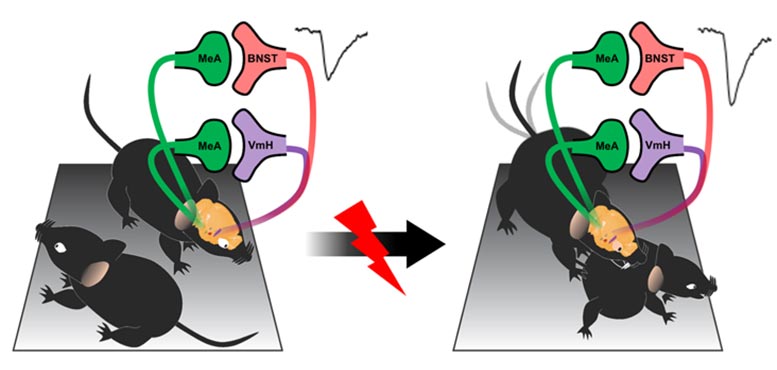
    Traumatic Stress Leads to Aggression
    Attacking another animal or experiencing traumatic stress strengthens amygdala pathways and leads to aggressive behavior. Credit: Nordman et al., JNeurosci 2020

    Nordman et al. examined how different amygdala circuits changed in male mice after traumatic stress. Two connections strengthened, resulting in more attacks on other mice: the circuitry connecting the amygdala to the ventromedial hypothalamus and the bed nucleus of the stria terminalis. The former modulates the frequency of attacks, while the latter controls the length of attacks. The research team then used low frequencies of light to stop the pathways from strengthening, preventing an increase in aggressive behavior. Deep brain stimulation may elicit the same effect in humans.

    Reference: “Potentiation of Divergent Medial Amygdala Pathways Drives Experience-Dependent Aggression Escalation” by Jacob Nordman, Xiaoyu Ma, Qinhua Gu, Michael Potegal, He Li, Alexxai V. Kravitz and Zheng Li, 18 May 2020, JNeurosci.
    DOI: 10.1523/JNEUROSCI.0370-20.2020

    Never miss a breakthrough: Join the SciTechDaily newsletter.
    Follow us on Google and Google News.

    Brain Neuroscience PTSD Society for Neuroscience Stress
    Share. Facebook Twitter Pinterest LinkedIn Email Reddit

    Related Articles

    Neurobiologists Have Discovered How Stress Turns Into Fear – And a Method To Block It

    Scientists Uncover Brain Mechanism That May Explain Why Sleep Helps You Learn

    Adult-Born Neurons Grow More Than Their Counterparts From Infancy – May Even Have Unique Functions

    Feeling Disconnected? Loneliness Alters Your Brain’s Social Network

    A Child’s Unique Brain Activity Reveals Their Memory Ability

    Researchers Discover How Stress Restructures the Brain

    Functional Magnetic Resonance Imaging Shows How the Brain Repurposes Unused Regions

    Traumatic Memories Manipulated in Sleeping Mice

    Scientists Discover Link Between TBI and PTSD

    Leave A Reply Cancel Reply

    • Facebook
    • Twitter
    • Pinterest
    • YouTube

    Don't Miss a Discovery

    Subscribe for the Latest in Science & Tech!

    Trending News

    Artificial Sweeteners May Harm Future Generations, Study Suggests

    Splashdown! NASA Artemis II Returns From Record-Breaking Moon Mission

    What If Consciousness Exists Beyond Your Brain

    Scientists Finally Crack the 100-Million-Year Evolutionary Mystery of Squid and Cuttlefish

    Beyond “Safe Levels”: Study Challenges What We Know About Pesticides and Cancer

    Researchers Have Found a Dietary Compound That Increases Longevity

    Scientists Baffled by Bizarre “Living Fossil” From 275 Million Years Ago

    Your IQ at 23 Could Predict Your Wealth at 27, Study Finds

    Follow SciTechDaily
    • Facebook
    • Twitter
    • YouTube
    • Pinterest
    • Newsletter
    • RSS
    SciTech News
    • Biology News
    • Chemistry News
    • Earth News
    • Health News
    • Physics News
    • Science News
    • Space News
    • Technology News
    Recent Posts
    • Researchers Expose Hidden Chemistry of “Ore-Forming” Elements in Biology
    • Geologists Reveal the Americas Collided Earlier Than We Thought
    • 20x Difference: Study Reveals True Source of Airborne Microplastics
    • Scientists Uncover Hidden Force Powering Yellowstone’s Supervolcano
    • This Metal Melts in Your Hand – and Scientists Just Discovered Something Strange
    Copyright © 1998 - 2026 SciTechDaily. All Rights Reserved.
    • Science News
    • About
    • Contact
    • Editorial Board
    • Privacy Policy
    • Terms of Use

    Type above and press Enter to search. Press Esc to cancel.