
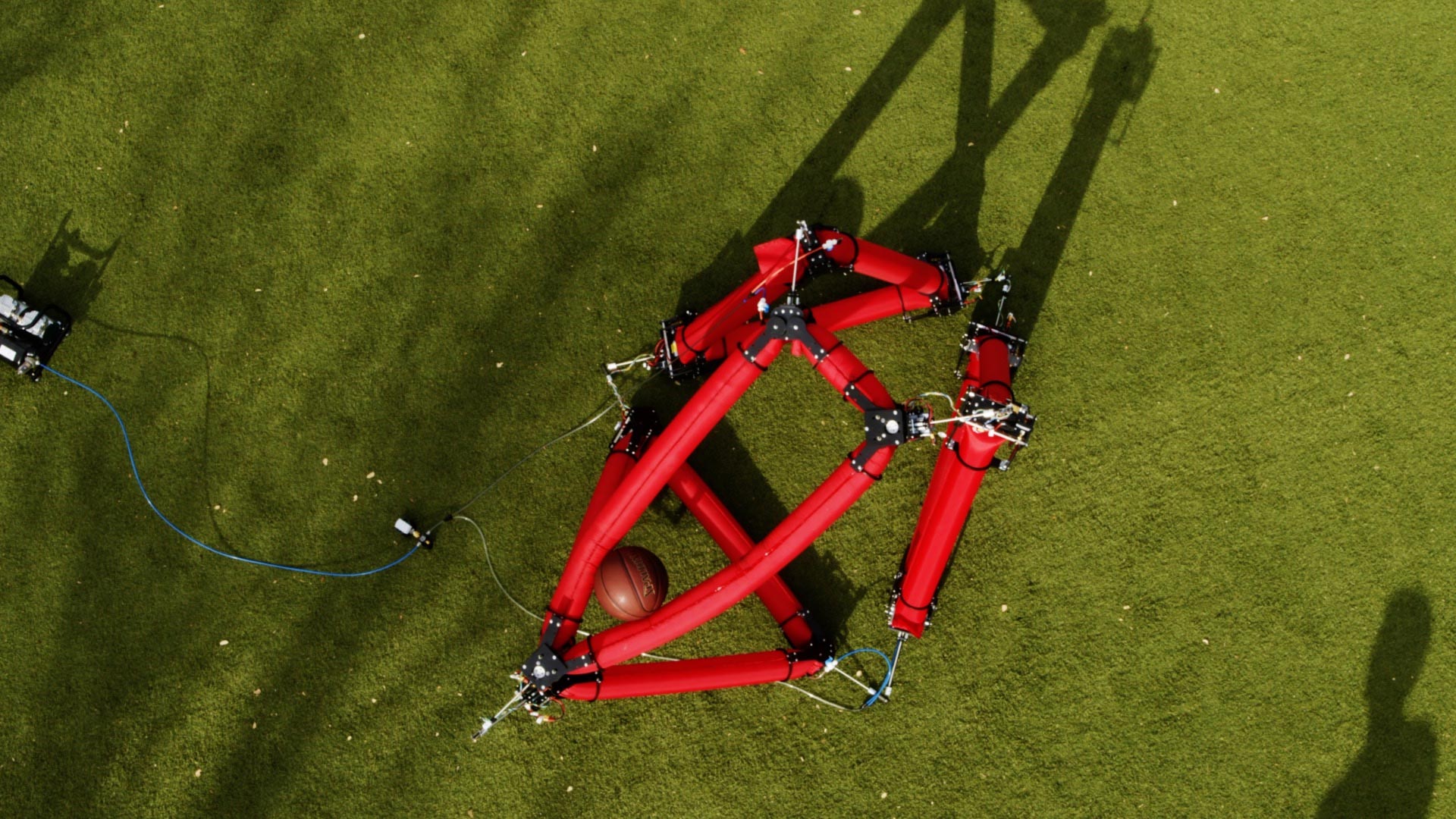
A new type of robot combines traditional and soft robotics, making it safe but sturdy. Once inflated, it can change shape and move without being attached to a source of energy or air.
Advances in soft robotics could someday allow robots to work alongside humans, helping them lift heavy objects or carrying them out of danger. As a step toward that future, Stanford University researchers have developed a new kind of soft robot that, by borrowing features from traditional robotics, is safe while still retaining the ability to move and change shape.
“A significant limitation of most soft robots is that they have to be attached to a bulky air compressor or plugged into a wall, which prevents them from moving,” said Nathan Usevitch, a graduate student in mechanical engineering at Stanford. “So, we wondered: What if we kept the same amount of air within the robot all the time?”
From that starting point, the researchers ended up with a human-scale soft robot that can change its shape, allowing it to grab and handle objects and roll in controllable directions. Their invention is described in a paper published on March 18, 2020, in Science Robotics.
“The casual description of this robot that I give to people is Baymax from the movie Big Hero 6 mixed with Transformers. In other words, a soft, human-safe robot mixed with robots that can dramatically change their shape,” said Usevitch.
A combination of many robots
The simplest version of this squishy robot is an inflated tube that runs through three small machines that pinch it into a triangle shape. One machine holds the two ends of the tube together; the other two drive along the tube, changing the overall shape of the robot by moving its corners. The researchers call it an “isoperimetric robot” because, although the shape changes dramatically, the total length of the edges – and the amount of air inside – remains the same.
The isoperimetric robot is a descendant of three types of robots: soft robots, truss robots, and collective robots. Soft robots are lightweight and compliant, truss robots have geometric forms that can change shape and collective robots are small robots that work together, making them particularly strong in the face of single-part failures.
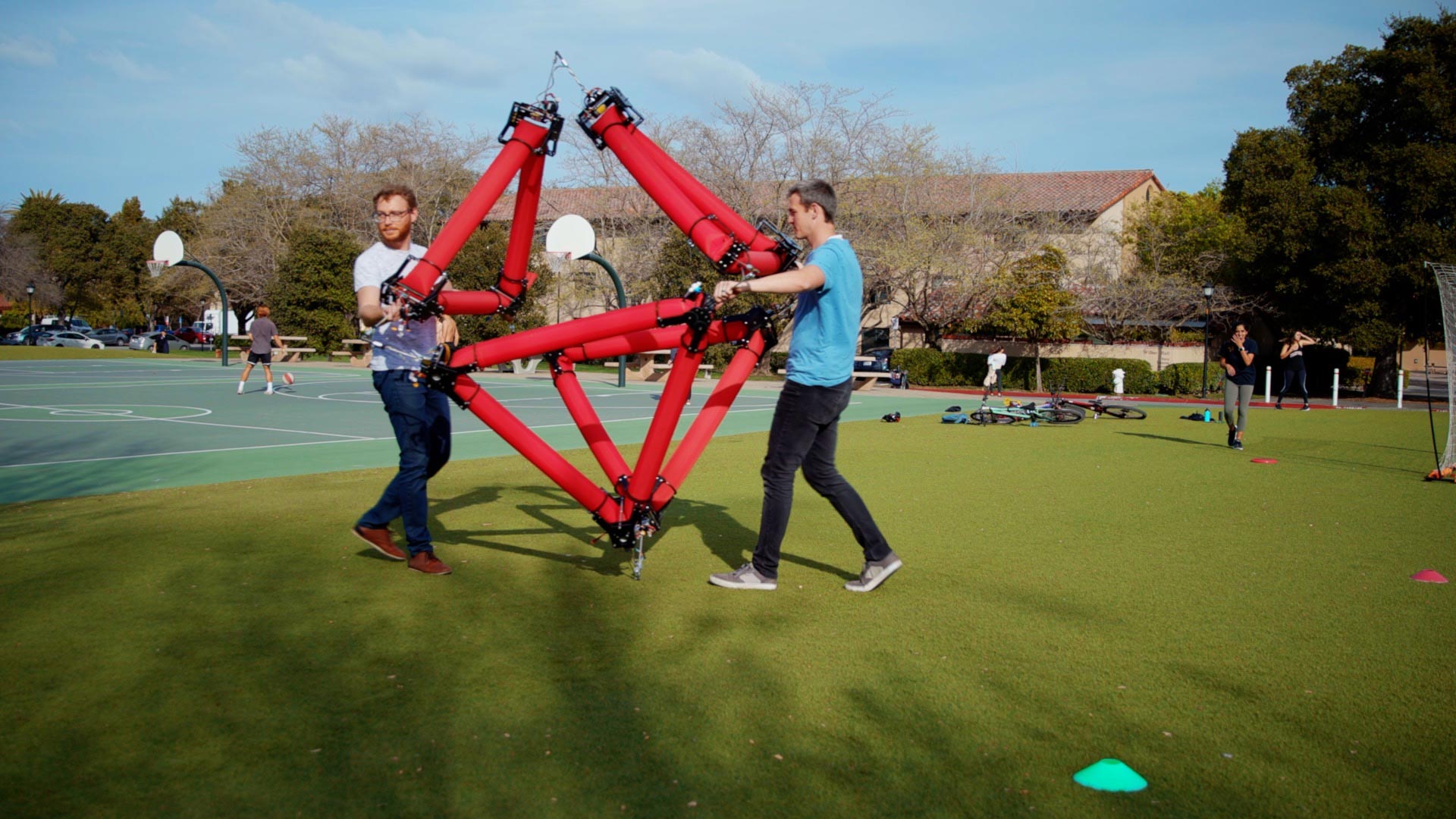
“We’re basically manipulating a soft structure with traditional motors,” said Sean Follmer, assistant professor of mechanical engineering and co-senior author of the paper. “It makes for a really interesting class of robots that combines many of the benefits of soft robots with all of the knowledge we have about more classic robots.”
To make a more complex version of the robot, the researchers simply attach several triangles together. By coordinating the movements of the different motors, they can cause the robot to perform different behaviors, such as picking up a ball by engulfing it on three sides or altering the robot’s center of mass to make it roll.
“What’s exciting to me is that the robot is actually a collective of individual robotic rollers, which work together to move the robot and change its shape,” said Mac Schwager, assistant professor of aeronautics and astronautics and co-author of the paper. “This helps make it an adaptable and robust system.”
“A key understanding we developed was that to create motion with a large, soft pneumatic robot, you don’t actually need to pump air in and out,” said Elliot Hawkes, assistant professor of mechanical engineering at the University of California, Santa Barbara and co-senior author of the paper. “You can use the air you already have and just move it around with these simple motors; this method is more efficient and lets our robot move much more quickly.”

From outer space to your living room
The field of soft robotics is relatively young, which means people are still figuring out the best applications for these new creations. Their safe-but-sturdy softness may make them useful in homes and workplaces, where traditional robots could cause injury. Squishy robots are also appealing as tools for disaster response.
Other exciting possibilities for the isoperimetric robot could lie off-planet. “This robot could be really useful for space exploration – especially because it can be transported in a small package and then operates untethered after it inflates,” said Zachary Hammond, a graduate student in mechanical engineering at Stanford and co-lead author of the paper, with Usevitch. “On another planet, it could use its shape-changing ability to traverse complicated environments, squeezing through tight spaces and spreading over obstacles.”
For now, the researchers are experimenting with different shapes for their supple robot and considering plopping it in water to see if it can swim. They are also exploring even more new soft robot types, each with its own features and benefits.
“This research highlights the power of thinking about how to design and build robots in new ways,” said Allison Okamura, professor of mechanical engineering and co-author of the paper. “The creativity of robot design is expanding with this type of system and that’s something we’d really like to encourage in the robotics field.”
Reference: “An untethered isoperimetric soft robot” by Nathan S. Usevitch, Zachary M. Hammond, Mac Schwager, Allison M. Okamura, Elliot W. Hawkes and Sean Follmer, 18 March 2020, Science Robotics.
DOI: 10.1126/scirobotics.aaz0492
Follmer and Okamura are both members of Stanford Bio-X. Okamura is also a member of the Wu Tsai Neurosciences Institute.
This research was funded by the National Science Foundation and the Defense Advanced Research Projects Agency.
Never miss a breakthrough: Join the SciTechDaily newsletter.
Follow us on Google and Google News.