
Neanderthals and Denisovans interbred with the ancestors of modern humans, leaving recognizable traces in our DNA. Evidence now suggests that modern humans also interbred with two much older, unidentified ancestral groups.
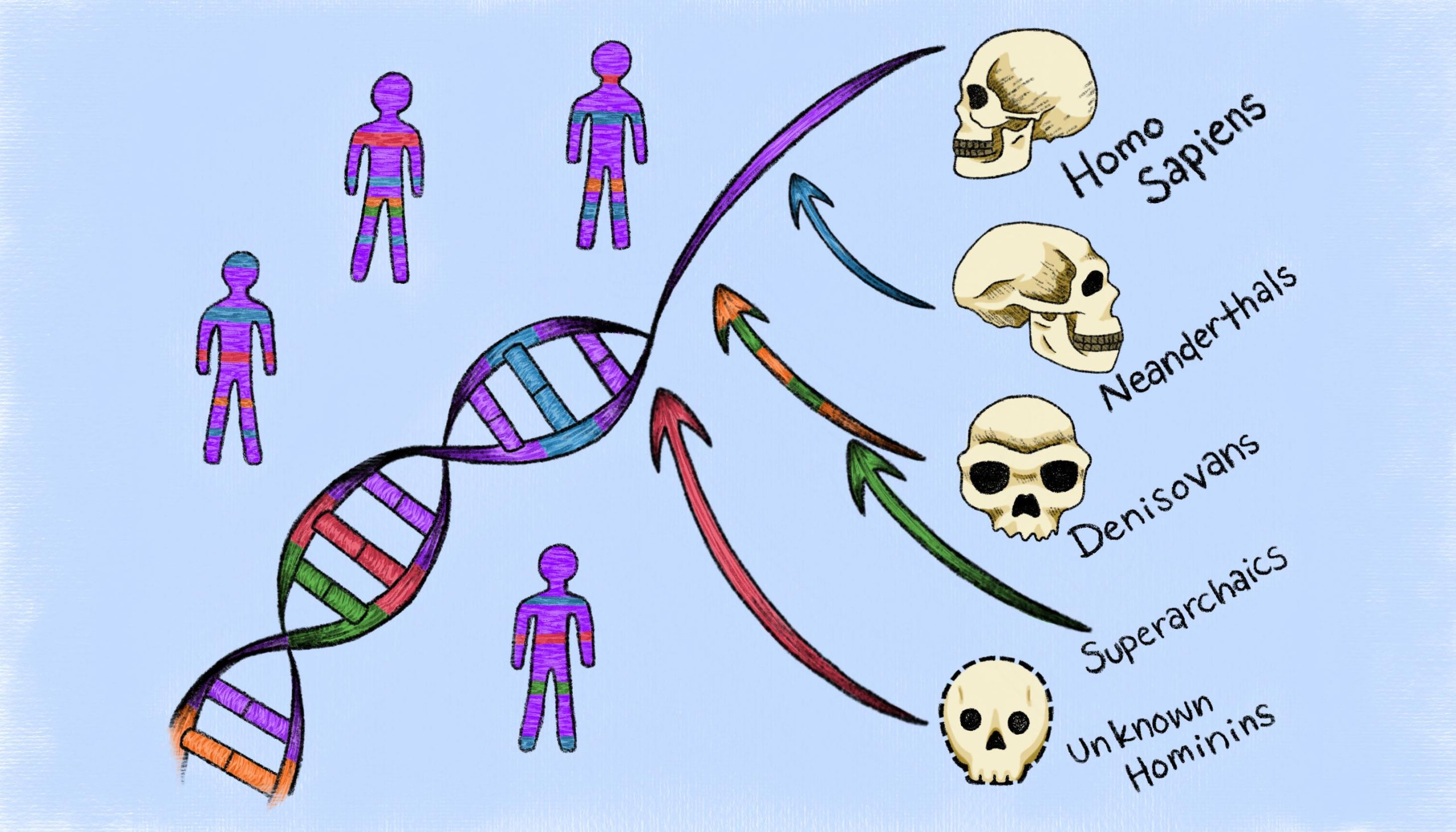
Hidden within the genomes of people alive today are fragments of DNA from two unidentified human ancestors. Researchers at UC Berkeley traced these genetic regions to ancient episodes of interbreeding involving modern humans and at least four archaic human groups.
Earlier studies had suggested that modern humans mixed with hominins beyond the now-extinct Neanderthals and Denisovans. The new analysis goes further by locating the DNA inherited from these unknown populations and estimating when the interbreeding occurred. To uncover those relationships, the researchers developed a method that reconstructs ancient genealogies from hundreds of present-day human genomes.
Two unknown lineages entered our DNA
One unidentified population, described as a ghost ancestor, interbred with modern humans in Africa before 50,000 years ago. This happened before the most recent migration of Homo sapiens from Africa into Europe and Asia.
DNA from this lineage accounts for around 1% of the modern human genome, roughly comparable to the amount inherited from Neanderthals. The ghost lineage separated from the ancestors of modern humans around 800,000 years ago, near the time when Neanderthals and Denisovans diverged, although its interbreeding with modern humans occurred earlier.
“Previous publications suggested that there might be ghost ancestry — ancestry from unknown archaic lineages in modern humans — but they hadn’t concluded whether this unknown ancestry is present only in Africans or not, and when this introgression event happened,” said Berkeley graduate student Yulin Zhang, one of two first authors of the study. “We were actually able to find and map genomic locations in modern humans that are from this ghost lineage and show that this ghost ancestry is in all modern humans, not only in Africans.”
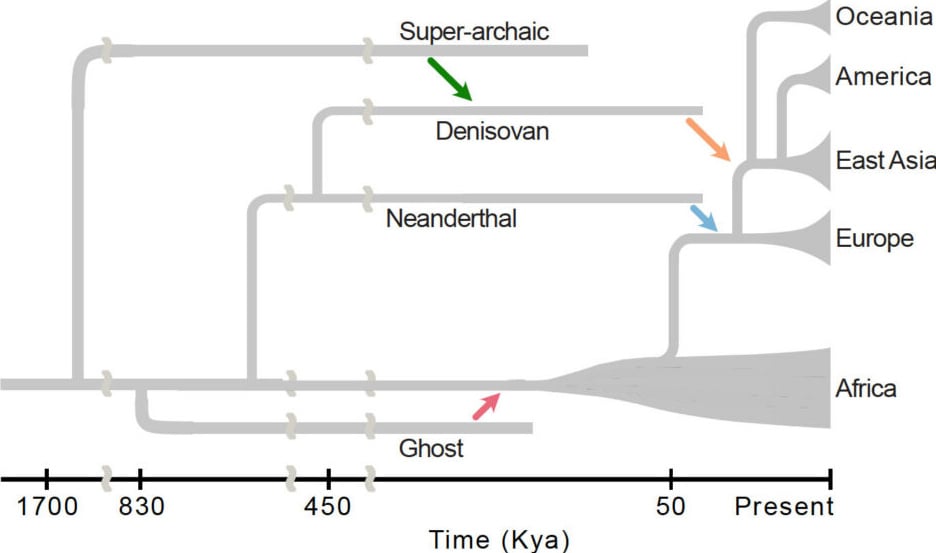
The second unidentified population, called a super-archaic ancestor, belonged to a hominin lineage dating back 1.8 million years. It interbred with Denisovans in Eurasia, and Denisovans later passed some of that super-archaic DNA to modern humans through interbreeding with Homo sapiens.
“The super-archaic finding is particularly exciting because it reveals genetic contributions from a human lineage that lived over a million years ago, despite the absence of any sequenced DNA from that population,” said Arjun Biddanda, a postdoctoral researcher at Johns Hopkins University and a co-first author of the study
The results reinforce a growing view of human evolution in which early modern humans repeatedly encountered related hominin populations across Africa and Eurasia. These groups were genetically similar enough to produce offspring together throughout much of the past million years.
“With ancient DNA from Neanderthals and Denisovans and with these new genealogical methods, we are learning that mixture among human populations has been very pervasive across time, and that this is also likely to be true at ancient time scales,” said Priya Moorjani, a Berkeley associate professor of molecular and cell biology. “We often think of human evolution as a branching tree, but new genomic data and analytical methods reveal a much more interconnected history — more like a complex web of populations connected by repeated episodes of migration and mixing.”
The identities of the ghost and super-archaic ancestors remain uncertain. However, their estimated divergence dates overlap with Middle Pleistocene Homo groups living in Africa about 800,000 years ago and Homo erectus populations in Eurasia around 1.8 million years ago.
Zhang, Biddanda, Moorjani and their colleagues published their findings July 30 in the journal Science.
Known fossils revealed only part
Modern humans leaving Africa approximately 50,000 years ago encountered and interbred with Neanderthals and Denisovans in Eurasia. Both older lineages eventually disappeared, but parts of their genomes survived in their modern human descendants.
Researchers uncovered that history by extracting and sequencing ancient DNA preserved in Neanderthal and Denisovan fossils. Yet the human genome also contained signs of interbreeding that appeared to be much older.
Identifying the source of those signals was difficult because no DNA has been recovered from the other extinct hominins that might have contributed them.
TRACE reconstructs ancestry without fossils
Moorjani’s group created TRACE (TRacking Archaic Contributions via ARG Estimation), a method that searches for archaic DNA using complete genomes from living people rather than genetic material from ancient fossils.
The researchers analyzed genomes from populations around the world and reconstructed an ancestral recombination graph (ARG), which charts how segments of DNA connect through shared ancestry across time.
“Genealogies preserve a record of our evolutionary past,” said Moorjani. “TRACE reconstructs those histories across the genome. By identifying regions whose ancestry extends unusually far back in time, we can uncover genetic contributions from extinct human populations, even in the absence of ancient DNA.”
As an initial test, TRACE identified some exceptionally old regions that matched the sequenced Neanderthal genome. Neanderthal ancestry accounts for about 1% of the modern human genome.
When the researchers focused on people from Asia and Oceania, the populations with substantial amounts of Denisovan ancestry, the method also correctly located known regions of Denisovan introgression.
Many other ancient DNA segments matched neither Neanderthals nor Denisovans. The researchers concluded that these regions came from two separate lineages that entered the human family at different times.
Ghost ancestry appeared in both African and non-African populations. That widespread distribution indicates that the interbreeding occurred before modern humans made their final major departure from Africa and expanded around the world.
“We discovered that about 2% of the modern human genome is from archaic hominins,” Zhang said. “In the case of the ghost lineage, modern-day Africans and non-African populations both inherited similar amounts of ghost ancestry. Each individual has about 0.5 to 1% of their genome inherited from this ghost lineage.”
To recover evidence of the second lineage, the researchers examined genomes from people in Oceania, where Denisovan ancestry can reach as much as 4%.
The super-archaic signal appeared inside regions inherited from Denisovans, suggesting that Denisovans first acquired this DNA and later passed it to modern humans. Denisovan genomes contain between 3% and 5% super-archaic ancestry, but only a small portion of that DNA reached people living today, Moorjani said.
“TRACE allowed us to contextualize how the ancestry segments from these previously uncharacterized hominins are distributed throughout the human genome,” Biddanda said. “We found that these contributions are widespread throughout the genome, and ghost ancestry is detected even in regions previously thought to be intolerant of Neanderthal and Denisovan ancestry.”
Ancient mixing may shape immunity
Moorjani said many of the inherited archaic segments are concentrated in genomic regions associated with immune and metabolic functions.
“This pattern is not entirely surprising,” she said. “Adaptation to new pathogens and food sources has been one of the strongest selective pressures in human evolution. Interbreeding with other human groups introduced new genetic variation, providing additional raw material for natural selection. Beneficial variants could then be retained and spread over many generations.”
As global genome databases become more representative of human diversity, Moorjani hopes TRACE will uncover weaker signals from still more unknown lineages.
Additional Denisovan genomes would also improve the analysis, since only one has been published. Recently sequenced proteins from Homo erectus fossils may even help researchers determine the identity of the super-archaic ancestor.
“I think these new computational methods that allow us to reconstruct genealogical relationships are really the next frontier in this field because they are allowing us to uncover hidden episodes from our past without requiring ancient DNA,” she added.
Moorjani noted that TRACE should also work with other species, “allowing us to also uncover really different patterns across the tree of life.”
Reference: “Recovering signatures of archaic hominin introgression using ancestral recombination graphs” by Yulin Zhang, Arjun Biddanda, Sarah A. Johnson, Colm O’Dushlaine and Priya Moorjani, 30 July 2026, Science.
DOI: 10.1126/science.aef8874
The work was funded by the National Science Foundation.
Never miss a breakthrough: Join the SciTechDaily newsletter.
Follow us on Google and Google News.
1 Comment
Im 1 4% neanderthal