
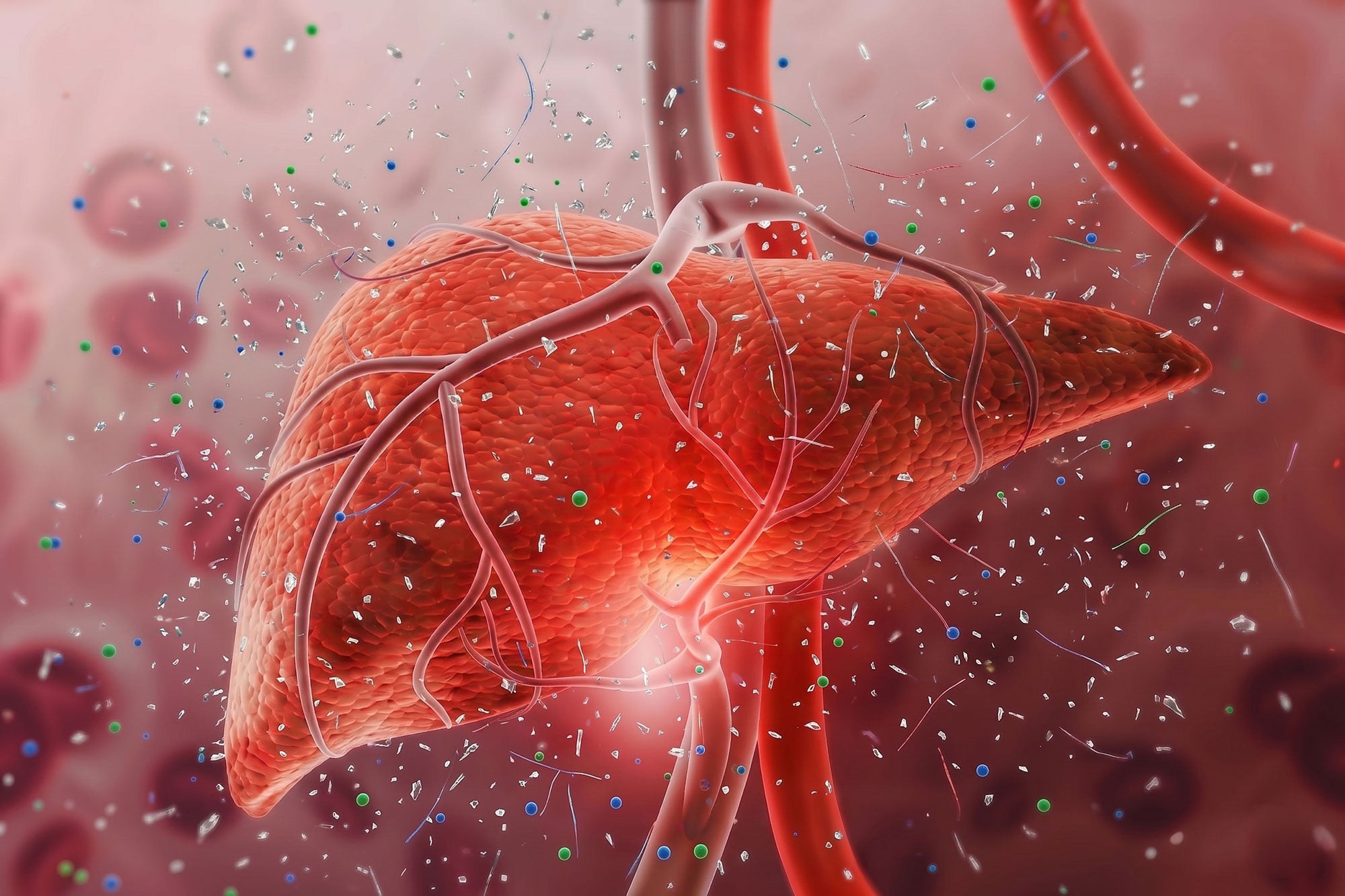
Researchers were surprised to find that polyethylene, one of the world’s most widely used plastics, contributes to liver disease because it has long been considered one of the more biologically inert microplastics.
Tiny fragments of plastic now appear in oceans, drinking water and human tissues. Although exposure has become difficult to avoid, researchers are still working to determine what these particles may do inside the body.
Evidence from the Texas A&M College of Veterinary Medicine and Biomedical Sciences (VMBS) now suggests that polyethylene, one of the most widely produced plastics, may contribute to fatty liver disease. The effects appeared more severe when exposure was combined with an unhealthy diet.
Polyethylene accounts for approximately one third of global plastic production but has received less scientific attention than several other microplastics. It is commonly found in food packaging, plastic wrap, storage containers and the linings of beverage cups.
Researchers examined whether exposure to this everyday material could affect the liver and investigated the biological processes that might explain any damage.
“No studies have really looked into polyethylene’s effect on liver health, and it’s the most widely produced plastic,” said Dr. Adi Joshi, associate professor in VMBS’ Department of Veterinary Physiology and Pharmacology. “What we now know is that these microplastics, especially polyethylene, affect our liver’s natural defense and repair mechanisms.”
Polyethylene worsens diet-related liver damage
Joshi and his colleagues focused on fatty liver disease, a condition in which excessive fat accumulates inside liver cells. According to the American Liver Foundation, it affects approximately 25% of people worldwide.
The researchers found that polyethylene exposure alone increased signs associated with the disease. Those signs became more pronounced when polyethylene was paired with a diet containing high levels of fat, fructose and cholesterol.
The results indicate that diet and environmental exposure may interact in ways that speed the progression of liver damage.

“Those who have a more Western-style diet, including foods like burgers and sodas, may have a greater chance of progressing to fatty liver disease if they are also exposed to polyethylene,” Joshi said.
This result was unexpected because polyethylene has generally been viewed as one of the more biologically inert forms of microplastic.
Instead of remaining harmless inside the body, the material appeared capable of affecting the liver both independently and alongside dietary risk factors. The researchers next sought to identify the molecular changes behind those effects.
Gene mapping pinpoints damaged liver regions
To investigate where the damage occurred, the Texas A&M researchers collaborated with scientists at the University of Oklahoma and used spatial transcriptomics.
The technology measures gene activity while preserving the location of individual cells within intact tissue. This allowed the researchers to connect changes in gene expression with specific damaged areas of the liver.
The analysis identified PPAR-alpha, a protein involved in regulating fat production in the liver, as an important part of the organ’s response to polyethylene exposure.
The researchers also identified ANXA2, a gene involved in repairing tissue, as another possible contributor to the disease process.
Joshi said identifying these molecular pathways provides a possible explanation for how polyethylene affects liver health. The findings could also help researchers investigate new treatment strategies.
Later disease stages remain untested
The results provide an initial view of polyethylene’s effects on the liver, but several questions remain unanswered.
The researchers plan to examine whether exposure contributes to more advanced forms of liver disease, including fibrosis, which involves the buildup of scar tissue.
They will also continue searching for other molecular pathways involved in the response to microplastics. Another goal is to determine whether altering the PPAR-alpha pathway could reduce the harmful liver effects associated with polyethylene.
“This is the pioneering study showing that polyethylene can contribute to fatty liver disease and the use of spatial transcriptomics has determined exactly where the damage has happened within the liver,” Joshi said. “The other microplastics might also be harmful to the liver, and we definitely need to look into other classes of microplastics.”
As research into the long-term health effects of microplastics continues, Joshi hopes the findings will encourage closer examination of how routine environmental exposures may interact with diet and influence chronic disease.
Reference: “Spatial transcriptome mapping identifies Ppara-Anxa2 cross-talk in microplastic-induced hepatotoxicity” by Woncheol Jung, Hassan Abushukair, Nikhil Y. Patil, Felix Ampadu, Maryam Firouzi, Iulia Rus, Jinhyuk Choi, Sree Deepthi Muthukrishnan, Surendra Shukla, Stefano Tarantini, Anna Csiszar, Kamiya Mehla, Dongin Kim, Je-Hyun Yoon, Dowoon Kim, Juyang Kim, Jaehak Jung, Oxana Klementieva, Yatrik M. Shah, Eiji Yoshihara, Pankaj K. Singh, Aditya D. Joshi and Tae Gyu Oh, 17 June 2026, Science Advances.
DOI: 10.1126/sciadv.aec8681
This work was supported in part by start-up funding provided to Principal Investigator T.G.O. by the Department of Oncology Science, OUHC. Research reported in this publication was supported by the National Institutes of Health under award numbers as follows: R01DK122028 and in part by P30ES029067 (A.D.J.), R01CA148828 (Y.M.S.), R01CA210439, R01CA163649, and R01CA270234 (P.K.S.).
Never miss a breakthrough: Join the SciTechDaily newsletter.
Follow us on Google and Google News.