
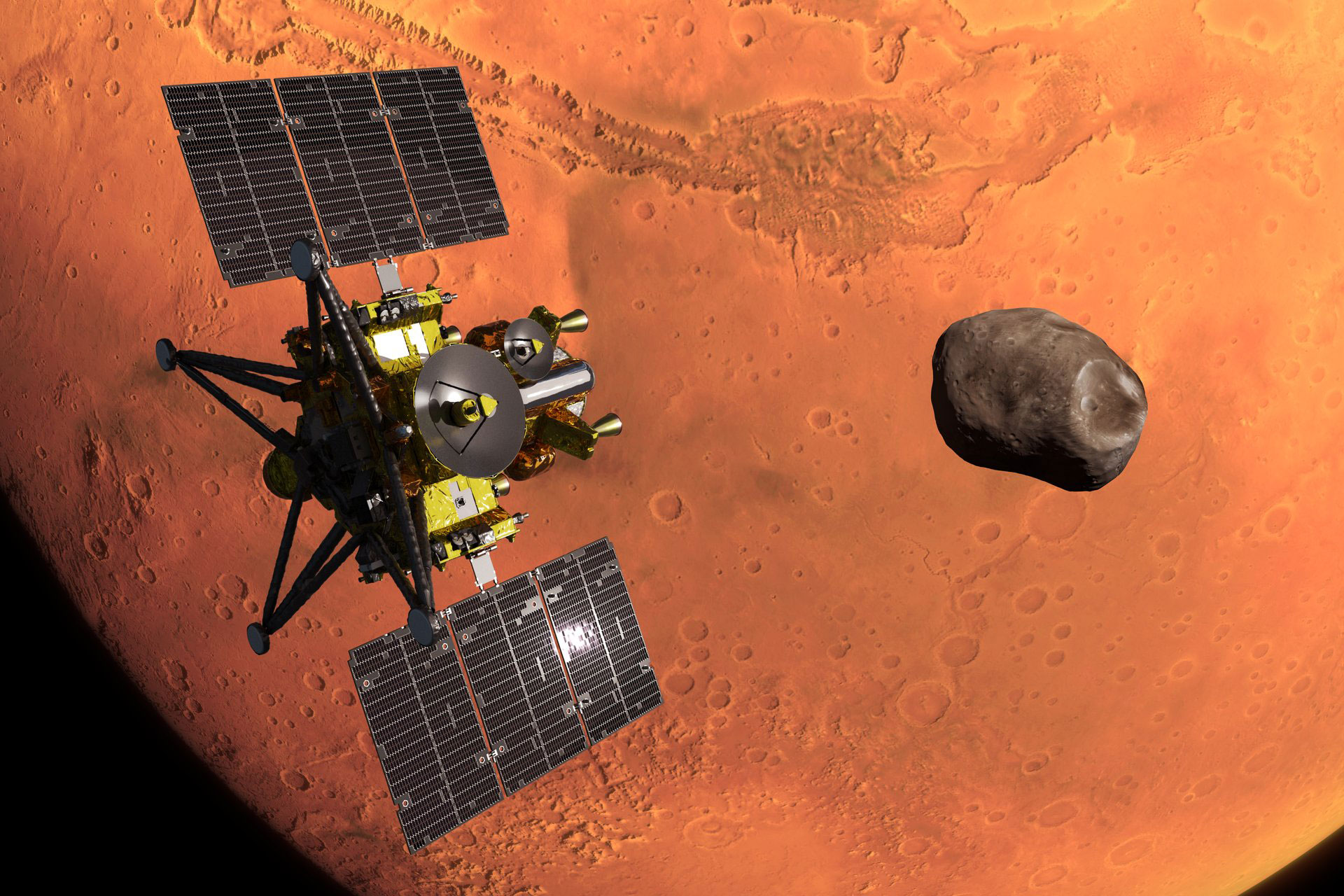
Phobos’ hidden interior may hold the key to how Mars gained its strange inner moon.
Phobos has circled Mars for billions of years, but scientists still do not know exactly how the small inner moon came to be. One possibility is that Mars captured it as an asteroid. Another is that Phobos formed from debris blasted into space after a massive object struck the Martian surface. The answer may depend on something researchers still cannot see clearly: what lies inside Phobos.
That hidden interior remains a “known unknown” for planetary scientists. A recent presentation at the European Geosciences Union general assembly in Vienna explored the problem by modeling tiny changes in Phobos’ geophysical observables, with a focus on the area around Stickney Crater.
Stickney Crater, which is about 9 kilometers across, could hold clues to the moon’s history. If Phobos formed after a giant impact on Mars, the collision that created Stickney may have happened roughly 4.2 billion years ago. If Phobos is instead a captured asteroid, the Stickney forming impact may be much younger, closer to 2.6 billion years old.
In a 2026 paper in The Monthly Notices of the Royal Astronomical Society (MNRAS), Haser and co-author Thomas Andert note that current estimates point to a porous interior that may contain water ice. They argue that detailed mapping of Phobos’ gravitational field could be critical for testing these ideas, especially if the Stickney impact created a localized region of compacted, denser material inside the moon.
The Stickney event is one of the most important events in Phobos’ history, and understanding it better might help to resolve its origin, Benjamin Haser, a doctoral student in planetary science at Germany’s Universität der Bundeswehr München, told me in Vienna.
Not An Ordinary Rock
Phobos is small and irregular, but it is not just a simple ‘rock in orbit,’ says Haser.
Even so, with a mean diameter of only 22.2km and a Mars orbital period of only 7 hours and 39 minutes, Phobos is tiny.
Two theories of Phobos’ origin have emerged.
The first theory suggests a giant impact onto Mars, causing the fragments to bounce back into orbit, creating a debris disc which finally results in the two moons Deimos and Phobos, Haser and Andert write in their MNRAS paper. In contrast, spectroscopic properties and asteroid capture models suggest that both moons originated from asteroids and were captured by Mars’s gravity field, the authors write.
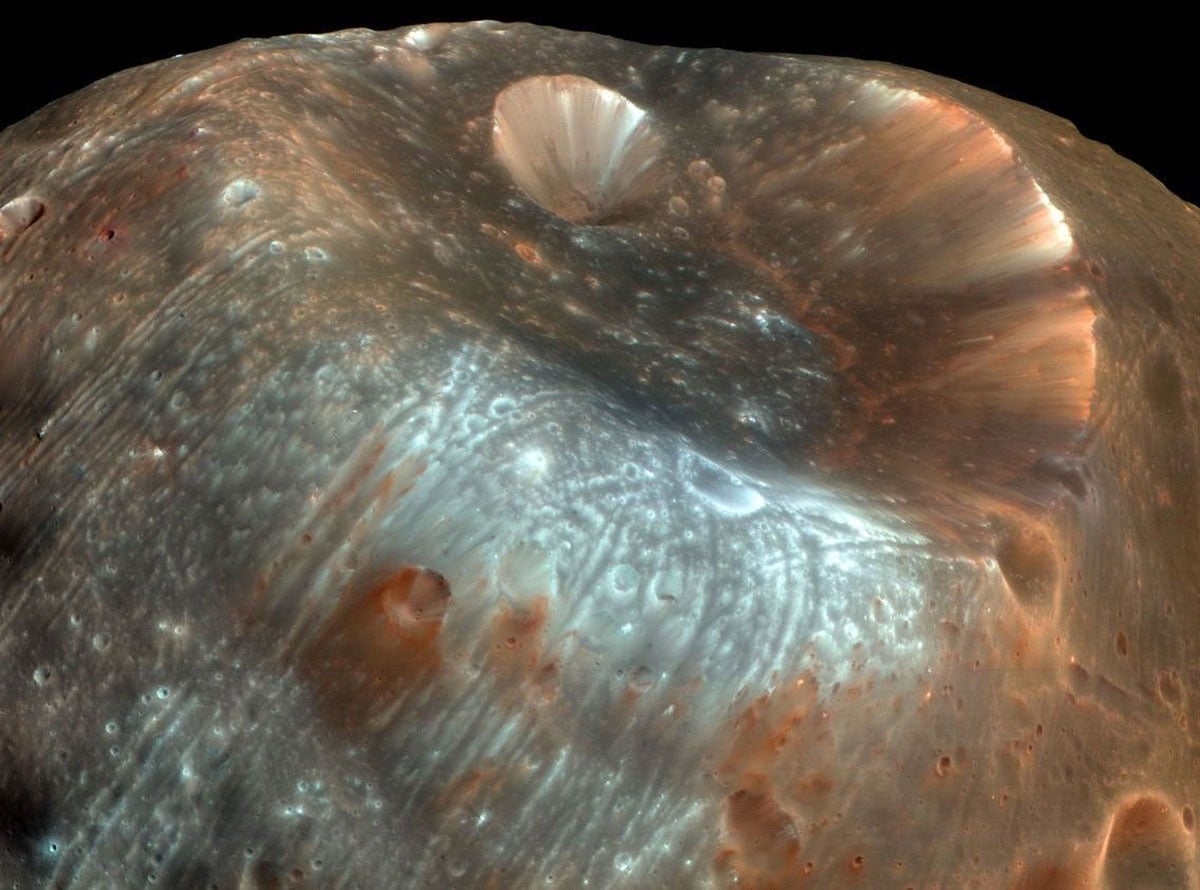
Determining and understanding Phobos’s gravitational field is a fundamental step toward constraining its interior and, consequently, its origin, Haser noted in his EGU 26 paper. Current estimates suggest a porous interior with possible water-ice content and a denser mass concentration in its equatorial region, he noted.
A Planetary Sponge?
You would assume that such an impact would have shattered Phobos, unless it has a very low homogeneous density, like a sponge that can absorb that kind of impact, says Haser. And at that impact region, there must be a very high temperature that melted and compressed the stone beneath it, he says.
A Rubble Pile?
Haser says Phobos aligns well with the captured asteroid scenario. Its irregular shape looks very much like a rubble pile asteroid, he says.
But Haser notes that it’s difficult to connect Phobos’ present-day gravity field, shape, density, spectral characteristics, and orbital evolution into one consistent geophysical picture. At the same time, its shape, and proximity to Mars make the interpretation of its gravity field and internal structure quite challenging, he says.
In the paper, we investigate how a compressed mass beneath Stickney crater affects the tiny moon’s gravitational signal, moments of inertia, and libration amplitude (essentially how Phobos wobbles and oscillates), says Haser.
A Unique Orbit
Phobos’ orbit is dynamically very special; it is very close to Mars, slowly spiraling inward, and will eventually be disrupted or impact Mars, says Haser. This means that Phobos is not only a record of the past, but also an actively evolving geophysical system, he says.
The upcoming Japanese Martian Moons Exploration (MMX) Phobos sample return mission, targeted to launch in late 2026, will attempt a quasi-stable orbit around the tiny moon. This is a difficult task because, as Haser points out, there truly is no stable orbit around Phobos.
Phobos’ gravity field is strongly overshadowed by the Mars’ gravity field, says Haser.
Even so, the MMX’s main spacecraft will use two sampling mechanisms to collect material from Phobos’ surface. One core sampler will collect matter down to 2 cm, while a pneumatic sampler (being contributed by NASA) will use pressurized gas to “loft material into a sample container,” says the Japanese Space Agency (JAXA).
All samples will subsequently be sent back to Earth by mid-2031 via a sample return capsule constructed to withstand re-entry into our atmosphere.
As for what Haser finds most puzzling about Phobos?
The main puzzle, says Haser, is not just what is Phobos made of, but what kind of interior structure can explain all its characteristics simultaneously. Understanding this is essential to distinguish between formation scenarios such as capture, formation from impact-generated debris, or a more complex mixed origin, he says.
Reference: “Stickney’s impact on Phobos geophysical observables” by Benjamin Haser and Thomas Andert, 21 April 2026, Monthly Notices of the Royal Astronomical Society.
DOI: 10.1093/mnras/stag753
Adapted from an article originally published in UniverseToday.
Never miss a breakthrough: Join the SciTechDaily newsletter.
Follow us on Google and Google News.