
Close Menu
    Facebook X (Twitter) Instagram
    SciTechDaily
    • Biology
    • Chemistry
    • Earth
    • Health
    • Physics
    • Science
    • Space
    • Technology
    Facebook X (Twitter) Pinterest YouTube RSS
    SciTechDaily
    Home»Space»NASA’s Mars Odyssey Views Phobos in a Different Light
    Space

    NASA’s Mars Odyssey Views Phobos in a Different Light

    By Guy Webster, Jet Propulsion LaboratoryOctober 5, 2017No Comments4 Mins Read
    Facebook Twitter Pinterest Telegram LinkedIn WhatsApp Email Reddit
    Share
    Facebook Twitter LinkedIn Pinterest Telegram Email Reddit
    THEMIS Camera Shows Mars' Moon Phobos in a Different Light
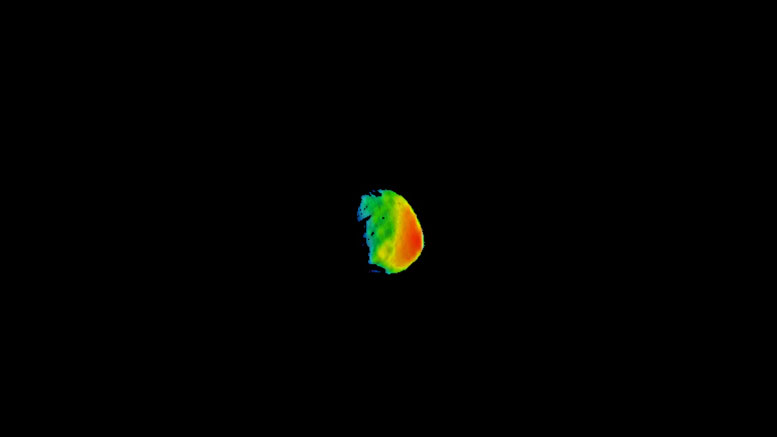
    This image combines two products from the first pointing at the Martian moon Phobos by the THEMIS camera on NASA’s Mars Odyssey orbiter, on September 29, 2017. Surface-temperature information from observation in thermal-infrared wavelengths is overlaid on a more detailed image from a visible-light observation. Credit: NASA/JPL-Caltech/ASU

    NASA’s Mars Odyssey has gained its first look at the Martian moon Phobos, pursuing a deeper understanding by examining it in infrared wavelengths.

    The Thermal Emission Imaging System (THEMIS) camera on NASA’s Mars Odyssey orbiter observed Phobos on September 29, 2017. Researchers have combined visible-wavelength and infrared data to produce an image color-coded for surface temperatures of this moon, which has been considered for a potential future human-mission outpost.

    “Part of the observed face of Phobos was in pre-dawn darkness, part in morning daylight,” said THEMIS Deputy Principal Investigator Victoria Hamilton of the Southwest Research Institute, headquartered in San Antonio.

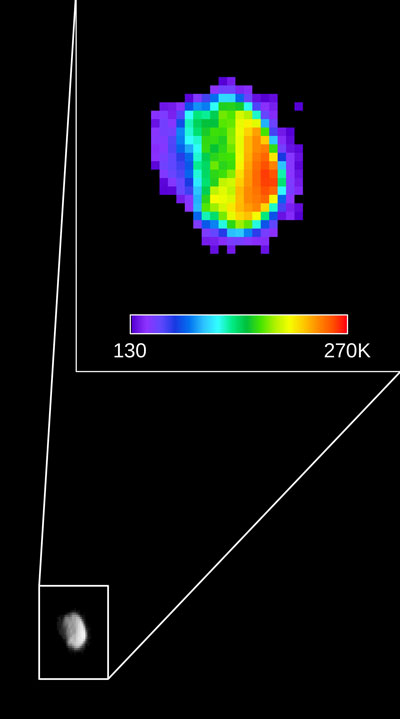
    Looking across the image from left to right presents a sequence of times of day on the Martian moon, from before dawn, to sunrise, to increasing amounts of time after dawn. This provides information about how quickly the ground warms, which is related to the texture of the surface. As barefoot beach walks can confirm, sand warms or cools quicker than rocks or pavement.

    THEMIS Camera Shows Mars' Moon Phobos in a Different Light
    This series of images was taken in visible-wavelength light as the THEMIS camera on NASA’s Mars Odyssey scanned across the Martian moon Phobos on September 29, 2017. The apparent motion is due to progression of the camera’s pointing during 18 seconds of observing, not from motion of Phobos. Credit: NASA/JPL-Caltech/ASU

    “Including a predawn area in the observation is useful because all the heating from the previous day’s sunshine has reached its minimum there,” Hamilton said. “As you go from predawn area to morning area you get to watch the heating behavior. If it heats up very quickly, it’s likely not very rocky but dusty instead.”

    Phobos has an oblong shape with an average diameter of about 14 miles (22 kilometers). Cameras on other Mars orbiters have previously taken higher-resolution images of Phobos, but none with the infrared information available from THEMIS. Observations in multiple bands of thermal-infrared wavelengths can yield information about the mineral composition of the surface, as well as the surface texture.
    Astronomers View Phobos in a Different Light
    Colors in this image of the Martian moon Phobos indicate a range of surface temperatures detected by observing the moon on September 29, 2017, with the Thermal Emission Imaging System (THEMIS) camera on NASA’s Mars Odyssey orbiter. Credit: NASA/JPL-Caltech/ASU

    One major question about Phobos and Mars’ even smaller moon, Deimos, is whether they are captured asteroids or bits of Mars knocked into the sky by impacts. Compositional information from THEMIS might help pin down their origin.

    Since Odyssey began orbiting the Red Planet in 2001, THEMIS has provided compositional and thermal-properties information from all over Mars, but never before imaged either Martian moon. The September 29 observation was completed to validate that the spacecraft could safely do so, as the start of a possible series of observations of Phobos and Deimos in coming months.

    In normal operating mode, Odyssey keeps the THEMIS camera pointed straight down as the spacecraft orbits Mars. In 2014, the spacecraft team at Lockheed Martin Space Systems, Denver; and NASA’s Jet Propulsion Laboratory, Pasadena, California; and the THEMIS team at Arizona State University, Tempe, developed procedures to rotate the spacecraft for upward-looking imaging of a comet passing near Mars. The teams have adapted those procedures for imaging the Martian moons.

    “We now have the capability of rotating the spacecraft for THEMIS observations,” said Odyssey Project Scientist Jeffrey Plaut of JPL. “There is heightened interest in Phobos because of the possibility that future astronauts could perhaps use it as an outpost.”

    With the first observation now in hand, plans are advancing for additional opportunities at different illumination phases of Phobos and Deimos.

    “We want to get observations under all types of lighting — fully daylit, a small crescent, during eclipse,” Hamilton said. “We hope this is the first of several observations that will help us understand Phobos and Deimos.”

    Never miss a breakthrough: Join the SciTechDaily newsletter.
    Follow us on Google and Google News.

    Astronomy Mars Mars Odyssey Orbiter Phobos Planetary Science
    Share. Facebook Twitter Pinterest LinkedIn Email Reddit

    Related Articles

    Mars Orbiter Reveals Why Martian Full Moon Looks Like Candy

    Martian Moon Phobos May Have Formed From Impact With Home Planet

    New Mars Model Details the Violent Birth of Phobos and Deimos

    Mars Odyssey Observes Martian Moons Phobos and Deimos

    Electrically Charged Particles Could Impact Future Missions to Martian Moons

    NASA Spacecraft Map Gravity on Mars, Give Best View Yet Inside Mars

    NASA’s MAVEN Spacecraft Observes Mars Moon Phobos

    Mars’ Moon Phobos Shows Signs of Structural Failure

    A Connection Between Volatiles in the Subsurface of Mars and the Impact Process

    Leave A Reply Cancel Reply

    • Facebook
    • Twitter
    • Pinterest
    • YouTube

    Don't Miss a Discovery

    Subscribe for the Latest in Science & Tech!

    Trending News

    Millions Take These IBS Drugs, But a New Study Finds Serious Risks

    Scientists Unlock Hidden Secrets of 2,300-Year-Old Mummies Using Cutting-Edge CT Scanner

    Bread Might Be Making You Gain Weight Even Without Eating More Calories

    Scientists Discover Massive Magma Reservoir Beneath Tuscany

    Europe’s Most Active Volcano Just Got Stranger – Here’s Why Scientists Are Rethinking It

    Alzheimer’s Symptoms May Start Outside the Brain, Study Finds

    Millions Take This Popular Supplement – Scientists Discover a Concerning Link to Heart Failure

    The Universe Is Expanding Too Fast and Scientists Can’t Explain Why

    Follow SciTechDaily
    • Facebook
    • Twitter
    • YouTube
    • Pinterest
    • Newsletter
    • RSS
    SciTech News
    • Biology News
    • Chemistry News
    • Earth News
    • Health News
    • Physics News
    • Science News
    • Space News
    • Technology News
    Recent Posts
    • Scientists Say a Hidden Structure May Exist Inside Earth’s Core
    • Doctors Surprised by the Power of a Simple Drug Against Colon Cancer
    • Why Popular Diabetes Drugs Like Ozempic Don’t Work for Everyone: The “Genetic Glitch”
    • Scientists Create Improved Insulin Cells That Reverse Diabetes in Mice
    • Scientists Stunned After Finding Plant Thought Extinct for 60 Years
    Copyright © 1998 - 2026 SciTechDaily. All Rights Reserved.
    • Science News
    • About
    • Contact
    • Editorial Board
    • Privacy Policy
    • Terms of Use

    Type above and press Enter to search. Press Esc to cancel.