
Martian ions have been embedding in Phobos’ near side for billions of years. A sample return from the moon could unlock clues about Mars’ lost atmosphere.
The Martian moon Phobos orbits through a stream of charged atoms and molecules that flow off the Red Planet’s atmosphere, new research shows.
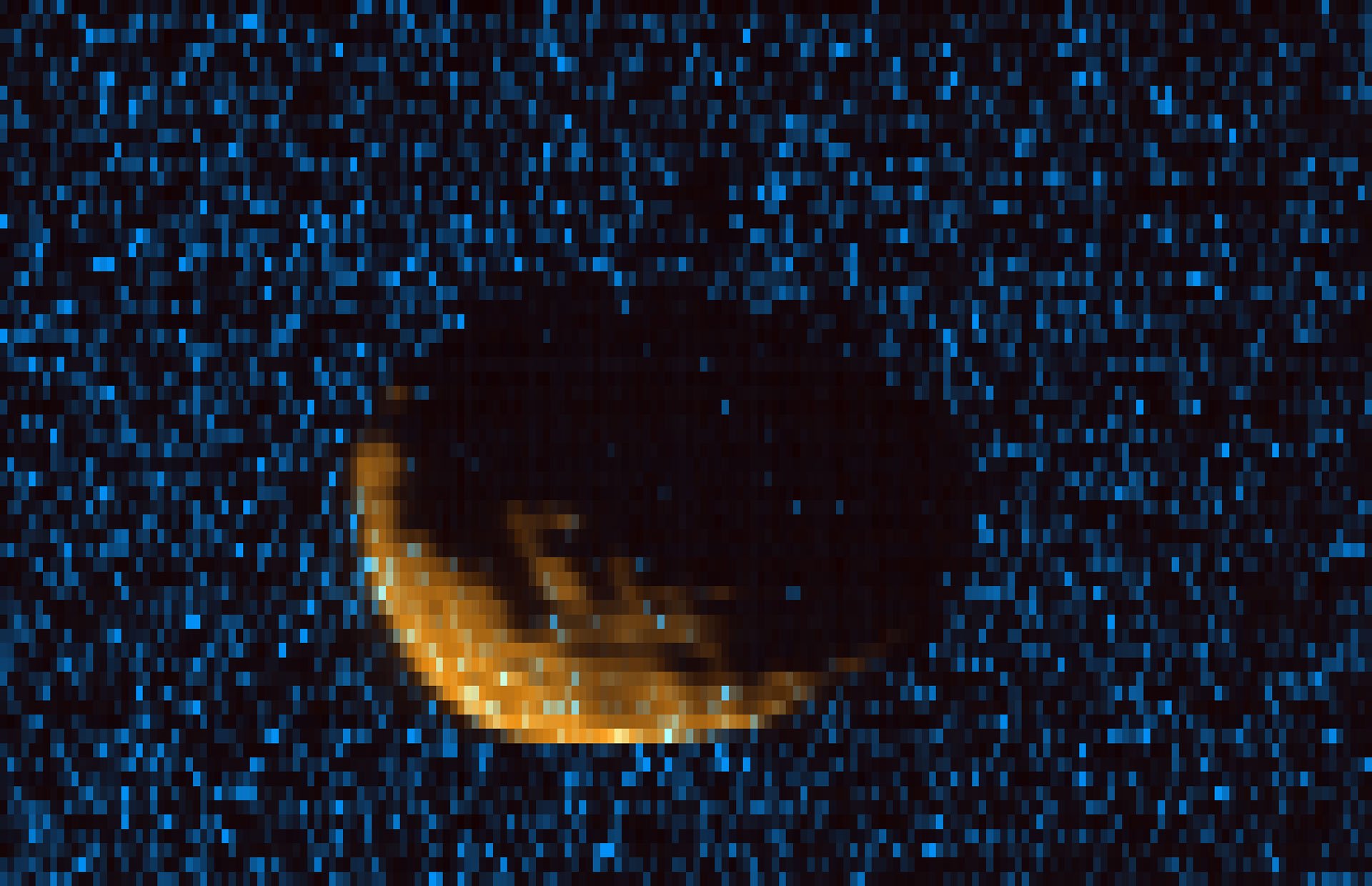
Many of these charged particles, or ions, of oxygen, carbon, nitrogen, and argon, have been escaping Mars for billions of years as the planet has been shedding its atmosphere. Some ions, scientists predict, have been smashing into the surface of Phobos and could be preserved in its uppermost layer, according to a paper published on February 1, 2021, in the journal Nature Geoscience.
This means that if soil from Phobos were analyzed in labs on Earth, it could reveal key information about the evolution of the Martian atmosphere, researchers say. Mars once had an atmosphere thick enough to support liquid water on its surface; today, it’s less than 1% as dense as Earth’s.
“We knew that Mars lost its atmosphere to space, and now we know that some of it ended up on Phobos,” said Quentin Nénon, a researcher at the Space Sciences Laboratory at the University of California, Berkeley, and the study’s lead author.
MAVEN’s Mission and New Discoveries
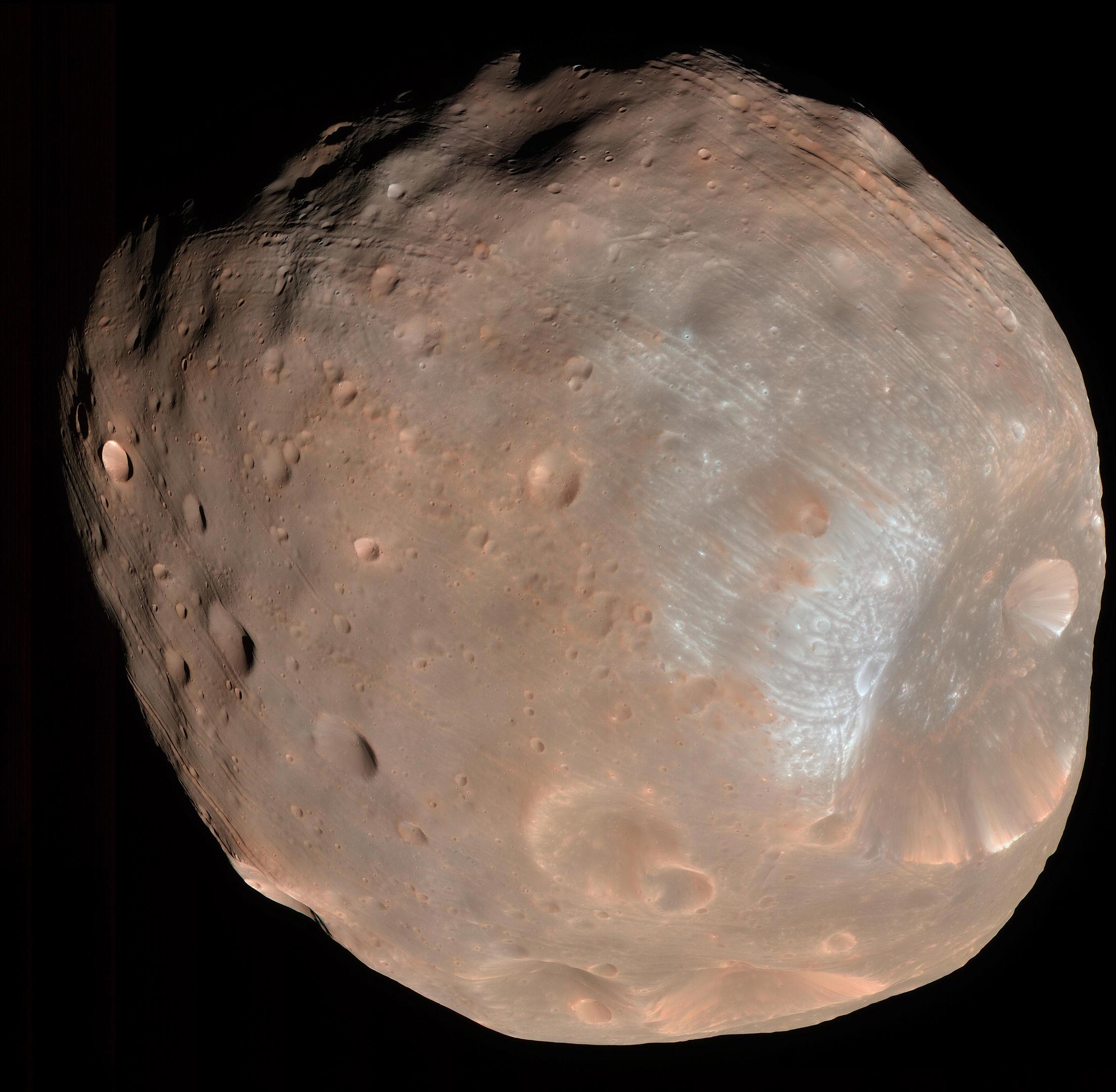
Phobos is one of two moons of Mars (the other is called Deimos). It orbits intimately close to the Red Planet, about 60 times closer than the Moon orbits Earth, as measured from approximately surface to surface. Misshapen, pockmarked by craters, and 100 times smaller in diameter than Earth’s moon, Phobos is the source of great controversy among scientists. The mystery is where Phobos and Deimos come from. Are they asteroids that were captured by Martian gravity, or natural satellites of Mars that were spawned by the same cloud that created the planet? It’s also possible that they formed from the debris that spewed when Mars collided with something, similar to how our Moon is thought to have formed after Earth collided with a rocky object.
In order to help settle the debate, Japan Aerospace Exploration Agency is preparing to send the Martian Moons Exploration (MMX) probe to Phobos in 2024 to collect the first samples from its surface and deliver them to Earth. But those samples, Nénon noted, could reveal a lot more than the origin of Phobos if MMX were to land on the near side of the moon, or the side that always faces Mars.
Phobos as a Martian Archive
Phobos is tidally locked to Mars, like Earth’s moon is locked to Earth, thus always showing the planet only one side. As a result, the rocks on the near side of Phobos have been bathed for millennia in Martian atoms and molecules. Nénon’s research shows that the uppermost surface layer of Phobos’ near side has been subjected to 20 to 100 times more wayward Martian ions than its far side.
“With a sample from the near side,” Nénon said, “we could see an archive of the past atmosphere of Mars in the shallow layers of grain, while deeper in the grain we could see the primitive composition of Phobos.”
Nénon’s team analyzed data from NASA’s Mars Atmosphere and Volatile EvolutioN, or MAVEN, spacecraft to reach this conclusion. MAVEN has been collecting data from the orbit of Mars for more than six years to help scientists figure out how Mars lost its atmosphere and to provide other important scientific insights on the evolution of the planet’s climate. Since the spacecraft crossed the orbit of Phobos about five times each Earth day as it circled Mars during its primary mission, Nénon, and his colleagues figured they could use MAVEN measurements to learn something about Phobos, especially since it is the target of the forthcoming MMX mission.
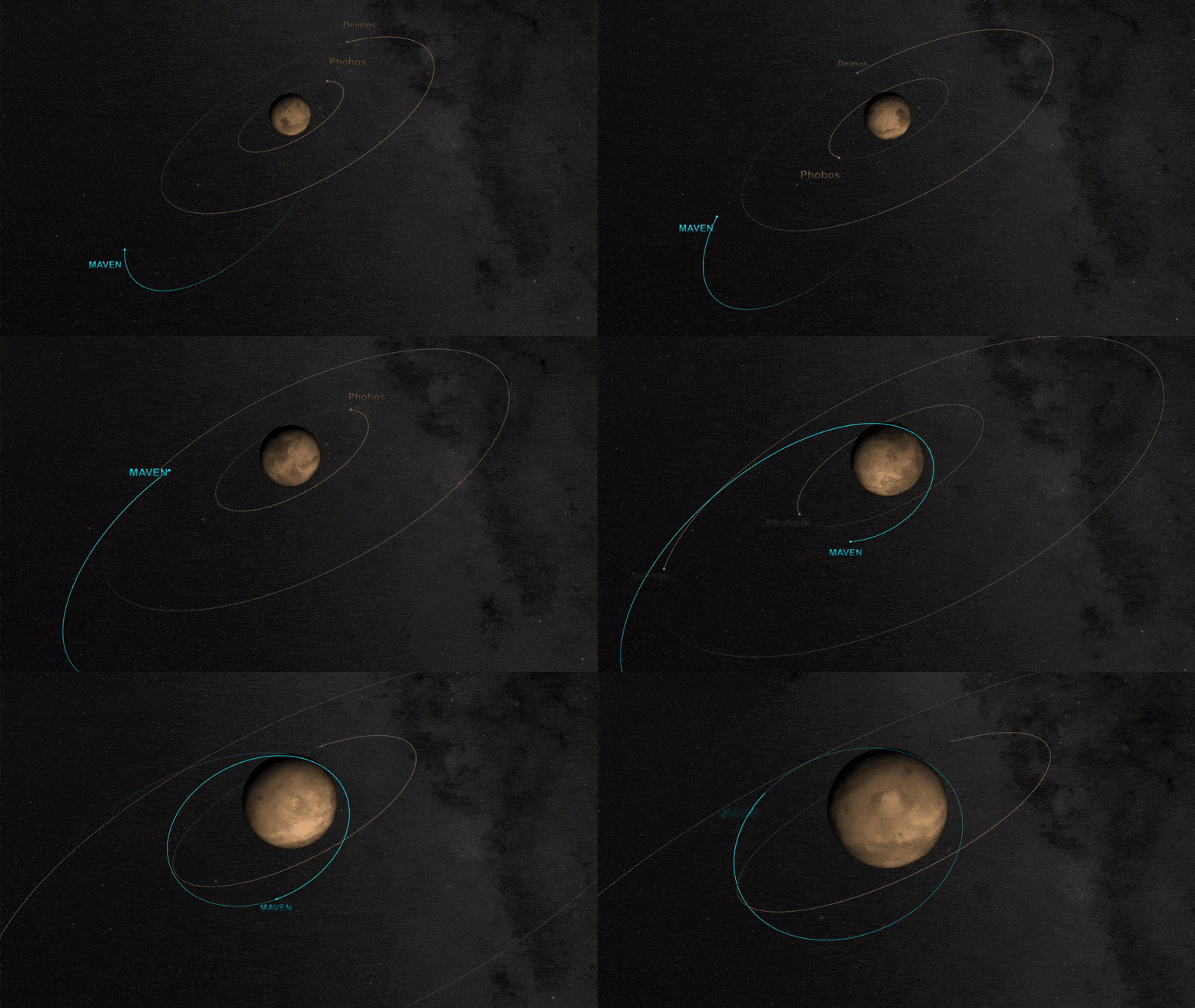
This visualization shows the MAVEN spacecraft’s orbit change during its primary mission as it progressed from the initial, highly elliptical entry orbit to a somewhat less elliptical orbit, and finally to the science orbit. Credit: NASA’s Scientific Visualization Studio
They relied on MAVEN’s Suprathermal and Thermal Ion Composition instrument, or STATIC, to measure the Martian ions in Phobos’ orbit. STATIC measures the kinetic energy and velocity of incoming particles. This allows scientists to compute their mass. Based on the different masses of ions measured, STATIC determined which particles came from Mars rather than from the Sun. The Sun also emits atmosphere-busting ions, though predominantly ones with much lower mass. Scientists then estimated how many ions could make it to the surface of Phobos and how deeply they would be implanted (no more than several hundred nanometers, which is about 250 times shallower than the width of a human hair).
“What Quentin has done is take investigations we’ve done at the Moon and other moons of the solar system and applied the same methods to Phobos for the first time,” said Andrew Poppe, associate research scientist at the Space Sciences Laboratory and co-author of the Phobos paper.
Historical Record in Moondust
Indeed, studying moons to learn more about their parent planets is common practice. Earth’s moon, for instance, with no atmosphere, wind, or water to strip its surface of ancient clues, is considered by scientists to be the best-preserved archive we have of the early solar system.
“What we’ve seen in Apollo samples is that the Moon has been patiently recording individual atoms coming from the Sun and from Earth,” Poppe said. “It’s a really cool historical record.”
Scientists hope that more samples from the Moon’s surface will inform us about Earth’s ancient atmosphere or early magnetic field. Poppe, whose Berkeley colleagues designed and built the STATIC instrument, said he wondered whether the surface of Phobos would be able to reveal information about early Mars, when the planet appears to have been warm and wet.
So when he found himself, several years ago, with no internet service at the lab, “I was forced to talk to my colleagues over coffee because we had nothing better to do,” Poppe said. He asked them if Phobos could be subjected to Martian ions like Earth’s moon is often subjected to particles coming from Earth. “Do you guys see any evidence of this?” he asked.
Nobody had looked into this, so Poppe did some computer modeling which indicated that he was onto something. When Nénon joined Space Sciences Laboratory in 2019, he offered to pore through MAVEN data to find out if Poppe’s model was right. It turns out it was. “So hopefully this finding will have an impact on the scientific activities of the MMX mission,” Nénon said.
Reference: “Implantation of Martian atmospheric ions within the regolith of Phobos” by Q. Nénon, A. R. Poppe, A. Rahmati and J. P. McFadden, 1 February 2021, Nature Geoscience.
DOI: 10.1038/s41561-020-00682-0
This research was partially funded by the MAVEN mission. MAVEN’s principal investigator is based at the University of Colorado Boulder’s Laboratory for Atmospheric and Space Physics, and NASA Goddard manages the MAVEN project.
This research was also partially funded by teams affiliated with NASA’s Solar System Exploration Research Virtual Institute, including the Lunar Environment and Dynamics for Exploration Research project, led by NASA Goddard planetary scientist Rosemary M. Killen, and the Dynamic Response of the Environments at Asteroids, the Moon, and moons of Mars, led by Goddard planetary scientist William M. Farrell.
Never miss a breakthrough: Join the SciTechDaily newsletter.
Follow us on Google and Google News.