
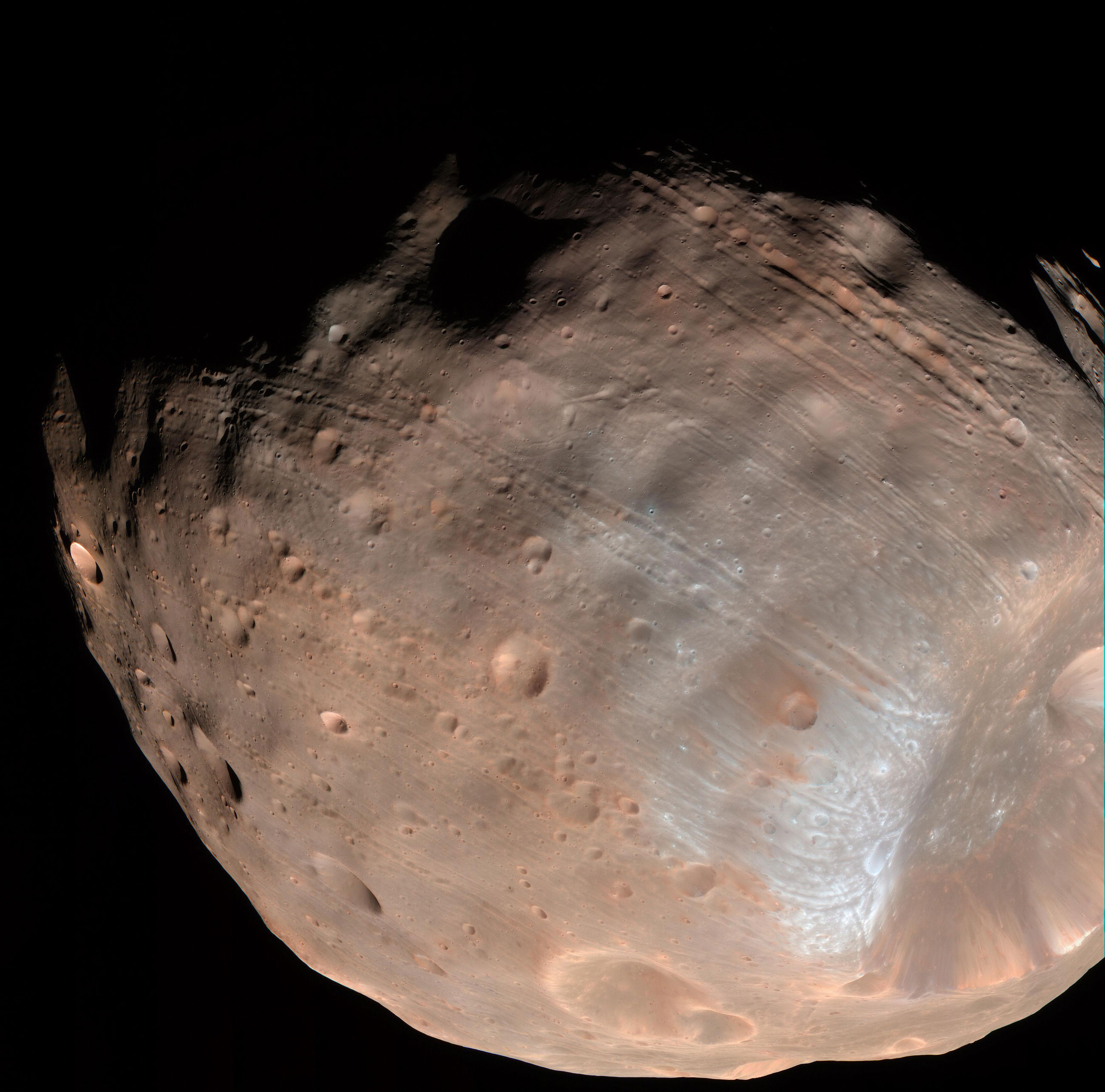
New research presented at the 47th Annual Meeting of the Division of Planetary Sciences reveals that the long, shallow grooves lining the surface of Phobos are likely early signs of the structural failure that will ultimately destroy this moon of Mars.
Orbiting a mere 3,700 miles (6,000 kilometers) above the surface of Mars, Phobos is closer to its planet than any other moon in the solar system. Mars’ gravity is drawing in Phobos, the larger of its two moons, by about 6.6 feet (2 meters) every hundred years. Scientists expect the moon to be pulled apart in 30 to 50 million years.
“We think that Phobos has already started to fail, and the first sign of this failure is the production of these grooves,” said Terry Hurford of NASA’s Goddard Space Flight Center in Greenbelt, Maryland.
The findings by Hurford and his colleagues are being presented on November 10, 2015, at the Annual Meeting of the Division of Planetary Sciences of the American Astronomical Society at National Harbor, Maryland.
Phobos’ grooves were long thought to be fractures caused by the impact that formed the Stickney crater. That collision was so powerful, it came close to shattering Phobos. However, scientists eventually determined that the grooves don’t radiate outward from the crater itself but from a focal point nearby.
More recently, researchers have proposed that the grooves may instead be produced by many smaller impacts of material ejected from Mars. But new modeling by Hurford and colleagues supports the view that the grooves are more like “stretch marks” that occur when Phobos gets deformed by tidal forces.
The gravitational pull between Mars and Phobos produces these tidal forces. Earth and our moon pull on each other in the same way, producing tides in the oceans and making both planet and moon slightly egg-shaped rather than perfectly round.
The same explanation was proposed for the grooves decades ago after the Viking spacecraft sent images of Phobos to Earth. At the time, however, Phobos was thought to be more or less solid all the way through. When the tidal forces were calculated, the stresses were too weak to fracture a solid moon of that size.
The recent thinking, however, is that the interior of Phobos could be a rubble pile, barely holding together, surrounded by a layer of powdery regolith about 330 feet (100 meters) thick.
“The funny thing about the result is that it shows Phobos has a kind of mildly cohesive outer fabric,” said Erik Asphaug of the School of Earth and Space Exploration at Arizona State University in Tempe and a co-investigator on the study. “This makes sense when you think about powdery materials in microgravity, but it’s quite non-intuitive.”
An interior like this can distort easily because it has very little strength and forces the outer layer to readjust. The researchers think the outer layer of Phobos behaves elastically and builds stress, but it’s weak enough that these stresses can cause it to fail.
All of this means the tidal forces acting on Phobos can produce more than enough stress to fracture the surface. Stress fractures predicted by this model line up very well with the grooves seen in images of Phobos. This explanation also fits with the observation that some grooves are younger than others, which would be the case if the process that creates them is ongoing.
The same fate may await Neptune’s moon Triton, which is also slowly falling inward and has a similarly fractured surface. The work also has implications for extrasolar planets, according to researchers.
“We can’t image those distant planets to see what’s going on, but this work can help us understand those systems, because any kind of planet falling into its host star could get torn apart in the same way,” said Hurford.
Never miss a breakthrough: Join the SciTechDaily newsletter.
Follow us on Google and Google News.
3 Comments
This conclusion assumes the large crater was caused by a single large object. That object however could have been a large object accompanied by hundreds of others, in other words, that object was itself in the process of breaking up when it hit Phobos. I think the streaks were caused by these hundreds of smaller objects striking Phobos at a glancing angle. Also, Phobos may have been more spherical then, than the egg shape it is now.
There are several deep impacts that occurred after the lines were created that indicate that the line features are local to the surface, and do not travel into the sub-structure. This would give credence to the theory that these were projectiles from the massive collision that bounced along the surface.
It is plausible to believe that any satellite falling on the planet by its gravity should be torn apart. Even in the case of meteors which are also solids in a miniature way, we find the asteroids being torn to pieces as it enters gravity. A big solid will not go to pieces but crack itself to one or two pieces intact. Thank You.