
Close Menu
    Facebook X (Twitter) Instagram
    SciTechDaily
    • Biology
    • Chemistry
    • Earth
    • Health
    • Physics
    • Science
    • Space
    • Technology
    Facebook X (Twitter) Pinterest YouTube RSS
    SciTechDaily
    Home»Space»First Images and Videos From the Double Venus Flyby
    Space

    First Images and Videos From the Double Venus Flyby

    By Nancy AtkinsonAugust 22, 2021No Comments4 Mins Read
    Facebook Twitter Pinterest Telegram LinkedIn WhatsApp Email Reddit
    Share
    Facebook Twitter LinkedIn Pinterest Telegram Email Reddit
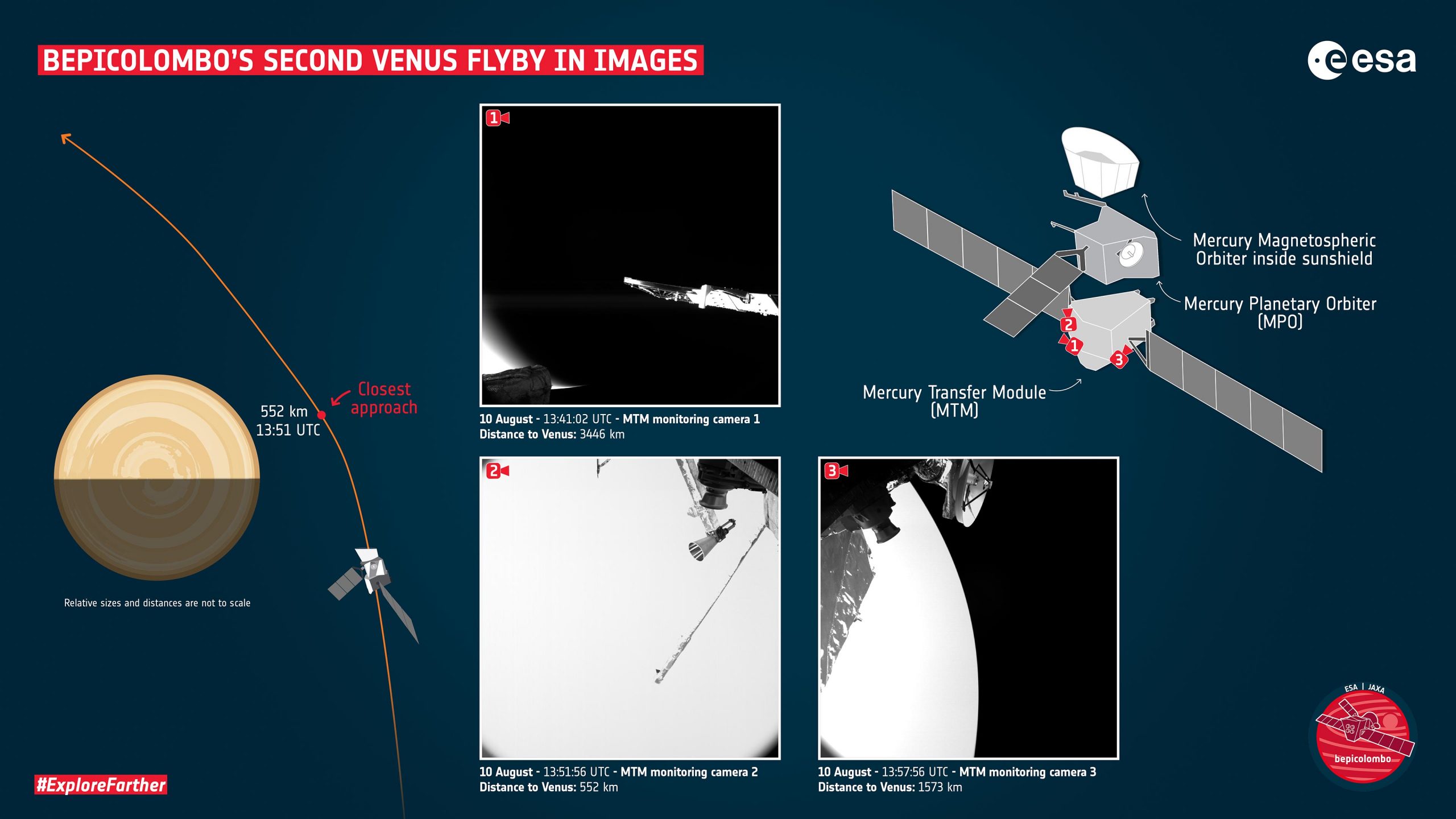
    BepiColombo’s Second Venus Flyby in Images
    The ESA/JAXA BepiColombo mission completed its second flyby of Venus on 19 August 2021, coming within 552 km of the planet at 13:51:54 UTC for a gravity assist manoeuvre. All three monitoring cameras (MCAM) onboard the Mercury Transfer Module were activated during dedicated imaging slots from shortly before closest approach through to the days after. Examples are shown in this infographic. Credit: ESA/BepiColombo/MTM, CC BY-SA 3.0 IGO

    Two spacecraft made historic flybys of Venus this month, and both sent back sci-fi-type views of the mysterious, cloud-shrouded planet.

    The Solar Orbiter and BepiColombo spacecraft both used Venus for gravity assists within 33 hours of each other, capturing unique imagery and data during their encounters.

    Solar Orbiter, a joint mission between ESA and NASA to study the Sun, sailed past Venus on August 9 at a distance of 7995 km (4967 miles). Then BepiColombo, a collaborative venture between ESA and JAXA to Mercury, skimmed past at just 552 km (343 miles) from the planet’s surface on August 10.

    The lower-right image in the collage above was taken when BepiColumbo was 1,573 km from Venus.

    Here’s a video of Solar Orbiter’s view, from the SoloHI imager:

    The camera observed the nightside of Venus in the days before closest approach. SoloHI will be used to take images of the solar wind – the stream of charged particles constantly released from the Sun – by capturing the light scattered by electrons in the wind. In the days leading up to the Venus flyby, the telescope caught views of the bright glare of the planet’s dayside. The footage shows Venus moving across the field of view from the left, while the Sun is off camera to the upper right. The planet’s nightside, the part hidden from the Sun, appears as a dark semicircle surrounded by a bright crescent of light, ESA scientists explained.
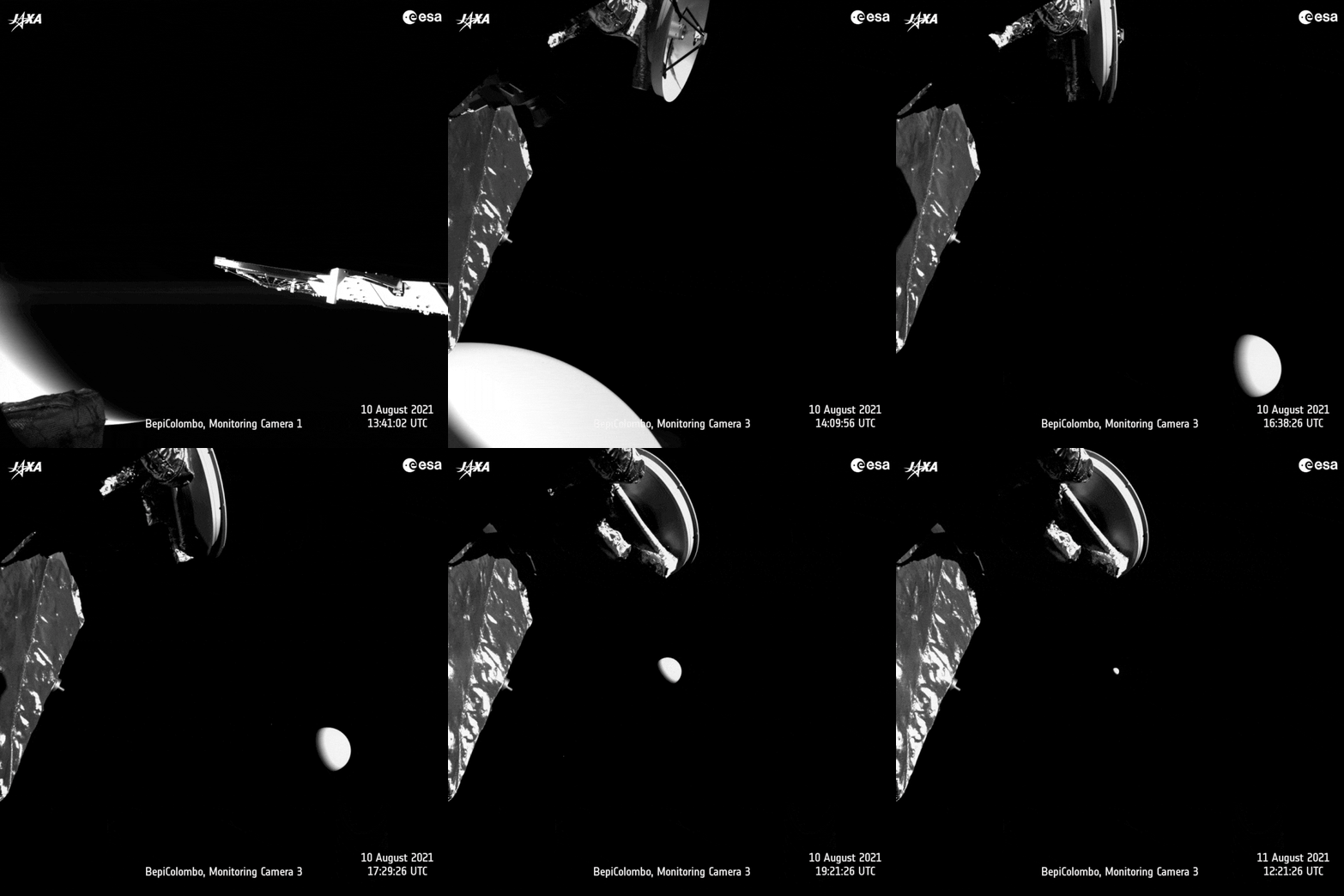
    Flying by Venus
    Sequence of 89 images taken by the monitoring cameras on board the European-Japanese BepiColombo mission to Mercury, as the spacecraft made a close approach of Venus on 10 August 2021. It was the second of two Venus gravity assist flybys needed to set course with Mercury. Credit: ESA/BepiColombo/MTM, CC BY-SA 3.0 IGO

    Both flybys helped the two spacecraft reach their next destinations. BepiColombo is scheduled to reach the innermost planet of the Solar System in October 2025. The spacecraft needs flybys of Earth, Venus and then several flybys of Mercury itself, together with the spacecraft’s solar electric propulsion system, to help steer into Mercury orbit against the immense gravitational pull of the Sun.

    BepiColombo is actually made of two attached orbiters: the Mercury Planetary Orbiter and the Mercury Magnetospheric Orbiter. The Planetary Orbiter will map the planet in great detail, and the Magnetospheric Orbiter will study, obviously, its magnetosphere.

    This video of BepiColombo’s Venus flyby includes sonification of data recorded by the Italian Spring Accelerometer (ISA) aboard the Mercury Planetary Orbiter spacecraft. The accelerometer data was converted to frequency to be made audible to the human ear. The resulting sound is quite interesting, with the sound reflecting variations in spacecraft accelerations due to the planet’s gravity acting on the spacecraft structure, as well as effects due to rapid temperature changes, and the change in reaction wheel velocity as they work hard to compensate for these effects. The audio has been matched to the timing that the images seen in this movie were captured, in the moments after closest approach.
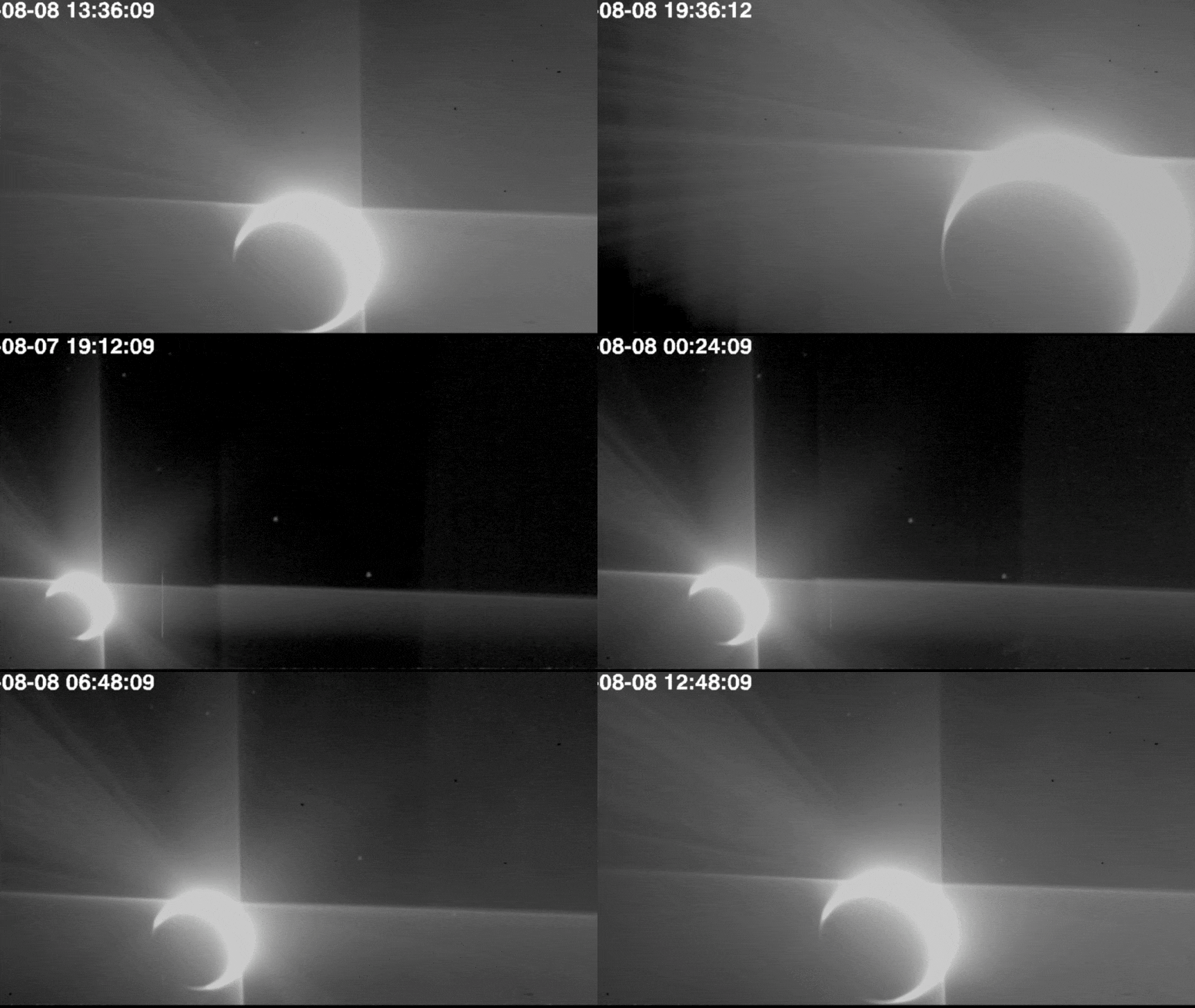
    Solar Orbiter Captures Venus’ Glare
    Footage of Venus captured by the Solar Orbiter Heliospheric Imager aboard ESA/NASA’s Solar Orbiter. Credit: ESA/NASA/NRL/SoloHI/Phillip Hess

    Solar Orbiter will make a final close Earth flyby on November 27 of this year, coming within 460 km (285 miles) before further Venus slingshots will tilt its inclination, helping the spacecraft get in the right position to get the first-ever views of the Sun’s poles, a crucial part of the mission to help us understand the Sun’s 11 year activity cycle. The beginning of the primary mission also begins in November. It will take the closest-ever images of the Sun as it comes within 42 million km, and measure the composition of the solar wind.

    Adapted from an article originally published on Universe Today.

    Related:

    • Experience the Sights and Sounds of an Extraordinary Venus Flyby
    • Solar Orbiter Captures Venus’ Glare During Close Pass of Our Solar System’s Hottest Planet

    Never miss a breakthrough: Join the SciTechDaily newsletter.
    Follow us on Google and Google News.

    BepiColombo European Space Agency NASA Solar Orbiter Venus
    Share. Facebook Twitter Pinterest LinkedIn Email Reddit

    Related Articles

    Solar Orbiter Captures Venus’ Glare During Close Pass of Our Solar System’s Hottest Planet

    Double Venus Flyby! Solar Orbiter and BepiColombo Set To Make Space History

    Watch NASA/ESA Solar Orbiter Mission First Image Release – Closer to Sun That Any Spacecraft in History

    Solar Orbiter Launch Highlights [Video]

    Solar Orbiter Blasts Off, Taking Solar Science to New Heights

    Spectacular Solar Orbiter Liftoff [Video]

    Watch Live: Solar Orbiter Launch From Cape Canaveral

    Watch Atlas V Rocket Launch Solar Orbiter Into Space Live

    Solar Orbiter Will Encounter Intense Heat and Radiation – Here’s How It’s Protected

    Leave A Reply Cancel Reply

    • Facebook
    • Twitter
    • Pinterest
    • YouTube

    Don't Miss a Discovery

    Subscribe for the Latest in Science & Tech!

    Trending News

    Why Popular Diabetes Drugs Like Ozempic Don’t Work for Everyone: The “Genetic Glitch”

    Scientists Stunned After Finding Plant Thought Extinct for 60 Years

    Scientists Discover Tiny New Spider That Hunts Prey 6x Its Size

    Natural Component From Licorice Shows Promise for Treating Inflammatory Bowel Disease

    Scientists Warn: Popular Sweetener Linked to Dangerous Metabolic Effects

    Monster Storms on Jupiter Unleash Lightning Beyond Anything on Earth

    Scientists Create “Liquid Gears” That Spin Without Touching

    The Simple Habit That Could Help Prevent Cancer

    Follow SciTechDaily
    • Facebook
    • Twitter
    • YouTube
    • Pinterest
    • Newsletter
    • RSS
    SciTech News
    • Biology News
    • Chemistry News
    • Earth News
    • Health News
    • Physics News
    • Science News
    • Space News
    • Technology News
    Recent Posts
    • 100,000-Year-Old Neanderthal Fossils in Poland Reveal Unexpected Genetic Connections
    • Unexpected Hormone Discovery Could Change How We Treat Arthritis
    • Scientists Supercharge “Natural Killer” Cells To Break Through Cancer’s Defenses
    • Simple “Gut Reset” May Prevent Weight Gain After Ozempic or Wegovy
    • 2.8 Days to Disaster: Scientists Warn Low Earth Orbit Could Suddenly Collapse
    Copyright © 1998 - 2026 SciTechDaily. All Rights Reserved.
    • Science News
    • About
    • Contact
    • Editorial Board
    • Privacy Policy
    • Terms of Use

    Type above and press Enter to search. Press Esc to cancel.