
Close Menu
    Facebook X (Twitter) Instagram
    SciTechDaily
    • Biology
    • Chemistry
    • Earth
    • Health
    • Physics
    • Science
    • Space
    • Technology
    Facebook X (Twitter) Pinterest YouTube RSS
    SciTechDaily
    Home»Space»Solar Orbiter Captures Venus’ Glare During Close Pass of Our Solar System’s Hottest Planet
    Space

    Solar Orbiter Captures Venus’ Glare During Close Pass of Our Solar System’s Hottest Planet

    By NASAAugust 16, 2021No Comments2 Mins Read
    Facebook Twitter Pinterest Telegram LinkedIn WhatsApp Email Reddit
    Share
    Facebook Twitter LinkedIn Pinterest Telegram Email Reddit
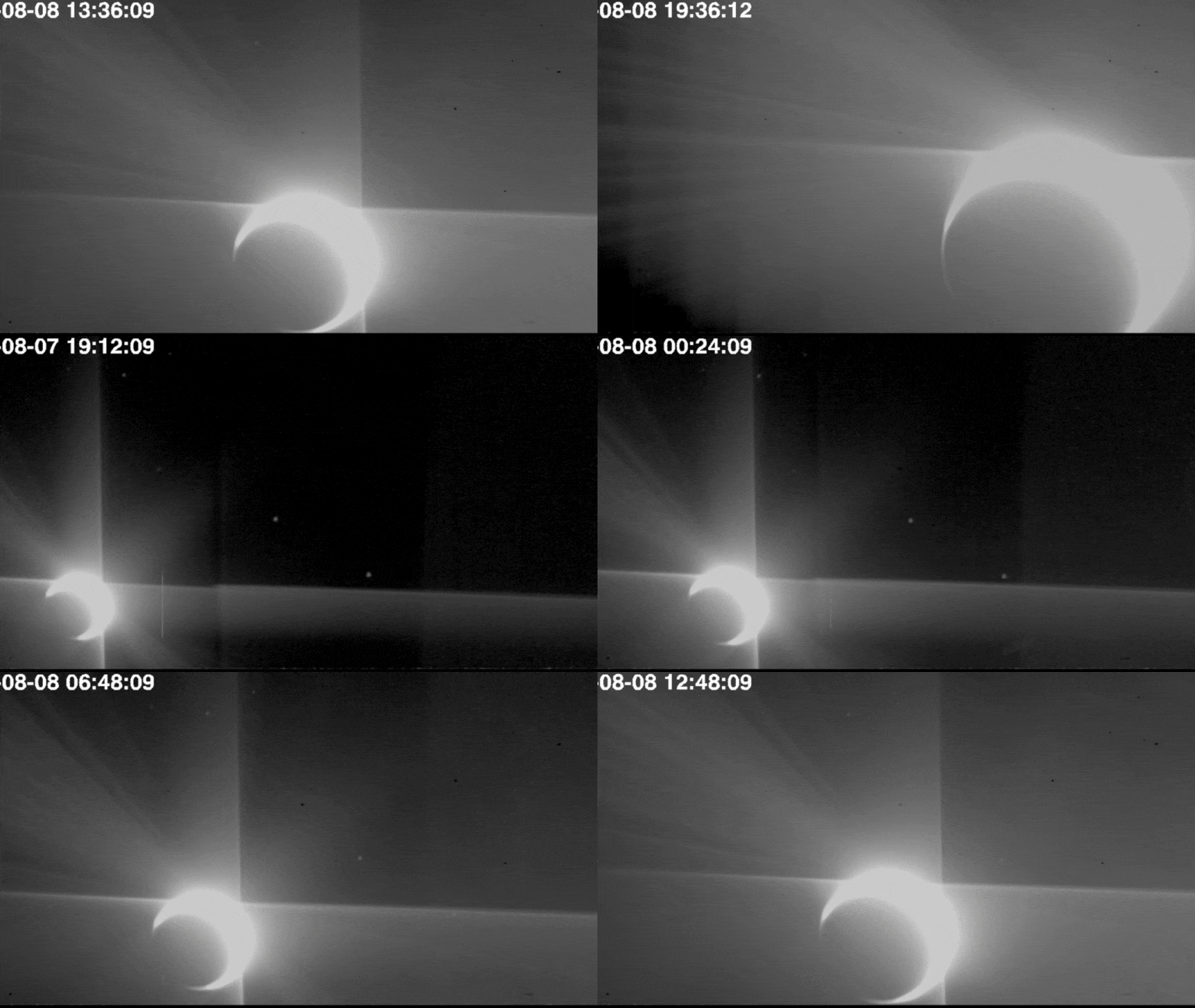
    Solar Orbiter Captures Venus’ Glare
    Footage of Venus captured by the Solar Orbiter Heliospheric Imager aboard ESA/NASA’s Solar Orbiter. Credit: ESA/NASA/NRL/SoloHI/Phillip Hess

    On August 9, 2021, ESA/NASA’s Solar Orbiter spacecraft passed within 4,967 miles (7,995 kilometers) of the surface of planet Venus. In the days leading up to the approach, the Solar Orbiter Heliospheric Imager, or SoloHI, telescope captured this gleaming view of the planet.

    The images show Venus approaching from the left while the Sun is off camera to the upper right. The planet’s nightside, the part hidden from the Sun, appears as a dark semicircle surrounded by a bright crescent of light – glare from Venus’ incredibly bright sunlit side.

    “Ideally, we would have been able to resolve some features on the nightside of the planet, but there was just too much signal from the dayside.” said Phillip Hess, astrophysicist at the Naval Research Laboratory in Washington, D.C. “Only a sliver of the dayside appears in the images, but it reflects enough sunlight to cause the bright crescent and the diffracted rays that seem to come from the surface.”

    Two bright stars are also visible in the background early in the sequence, before being eclipsed by the planet. The rightmost is Omicron Tauri, and above and to the left of it is Xi Tauri, which is actually a quadruple star system. Both are part of the Taurus constellation.

    This was Solar Orbiter’s second Venus flyby, with an Earth flyby in November 2021 and six more Venus flybys planned from 2022 to 2030. The spacecraft uses Venus’ gravity to draw it closer to the Sun and tilt its orbit, swinging it up and out so as to “look down” on the Sun. From this vantage point, Solar Orbiter will eventually capture the first images of the Sun’s north and south poles.

    On August 10, just one day later, ESA and the Japan Aerospace Exploration Agency’s BepiColombo mission also flew by Venus. Learn more about the double flyby and see BepiColombo’s images in ESA’s coverage of the event.

    Never miss a breakthrough: Join the SciTechDaily newsletter.
    Follow us on Google and Google News.

    Astronomy European Space Agency NASA Solar Orbiter Venus
    Share. Facebook Twitter Pinterest LinkedIn Email Reddit

    Related Articles

    Incredible New Views of the Sun – As You’ve Never Seen It Before

    Massive Solar Eruption Captured by Solar Orbiter Spacecraft

    First Images and Videos From the Double Venus Flyby

    Solar Orbiter Snaps Closest Pictures Ever of the Sun – Reveals New “Campfires” Phenomena

    Watch NASA/ESA Solar Orbiter Mission First Image Release – Closer to Sun That Any Spacecraft in History

    Solar Orbiter Will Encounter Intense Heat and Radiation – Here’s How It’s Protected

    Three Earthlike Planets Could be Hospitable to Life

    Hubble Captures New Image of Messier 9

    Ultra-Fast Outflows are Common Features of Black-Hole-Powered Galaxies

    Leave A Reply Cancel Reply

    • Facebook
    • Twitter
    • Pinterest
    • YouTube

    Don't Miss a Discovery

    Subscribe for the Latest in Science & Tech!

    Trending News

    First-of-Its-Kind Discovery: Homer’s Iliad Found Embedded in a 1,600-Year-Old Egyptian Mummy

    Beyond Inflammation: Scientists Uncover New Cause of Persistent Rheumatoid Arthritis

    A Simple Molecule Could Unlock Safer, Easier Weight Loss

    Scientists Just Built a Quantum Battery That Charges Almost Instantly

    Researchers Unveil Groundbreaking Sustainable Solution to Vitamin B12 Deficiency

    Millions of People Have Osteopenia Without Realizing It – Here’s What You Need To Know

    Researchers Discover Boosting a Single Protein Helps the Brain Fight Alzheimer’s

    World-First Study Reveals Human Hearts Can Regenerate After a Heart Attack

    Follow SciTechDaily
    • Facebook
    • Twitter
    • YouTube
    • Pinterest
    • Newsletter
    • RSS
    SciTech News
    • Biology News
    • Chemistry News
    • Earth News
    • Health News
    • Physics News
    • Science News
    • Space News
    • Technology News
    Recent Posts
    • Breakthrough Technology Reveals New Treatment Targets for Cancer
    • Scientists Discover New Way To Make Drug-Resistant Cancer Treatable Again
    • This Simple Exercise Trick Builds Muscle With Less Effort, Study Finds
    • Middle Age Is Becoming a Breaking Point in America, Study Reveals
    • Scientists Discover How Coffee Impacts Memory, Mood, and Gut Health
    Copyright © 1998 - 2026 SciTechDaily. All Rights Reserved.
    • Science News
    • About
    • Contact
    • Editorial Board
    • Privacy Policy
    • Terms of Use

    Type above and press Enter to search. Press Esc to cancel.