
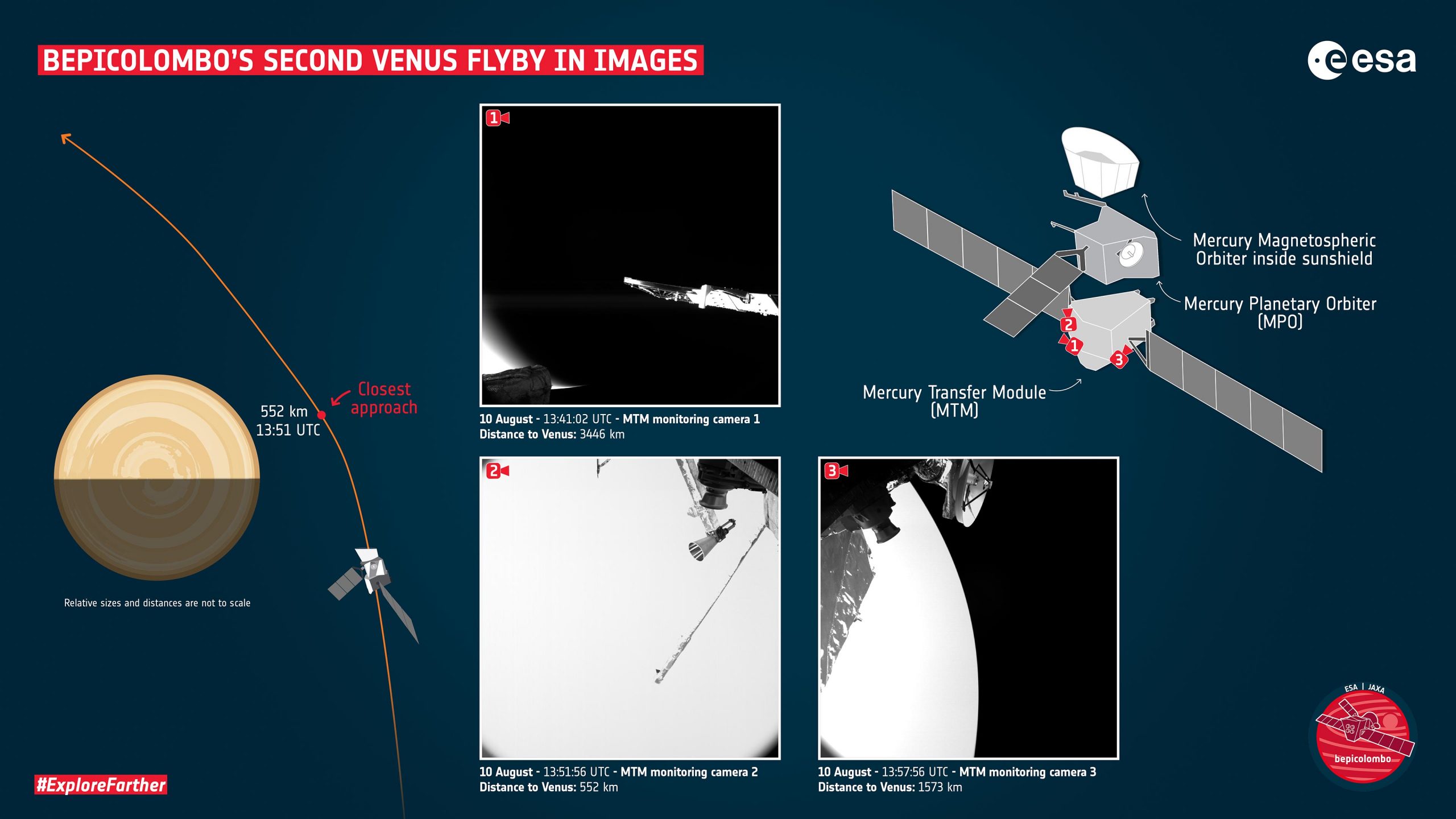
ESA’s Solar Orbiter and BepiColombo spacecraft made a historic Venus flyby earlier this week, passing by the planet within 33 hours of each other and capturing unique imagery and data during the encounter.
The ESA/NASA Solar Orbiter spacecraft flew past Venus on August 9 at a distance of 7,995 km (4,968 mi), while the ESA/JAXA BepiColombo mission skimmed past at just 552 km (343 mi) from the planet’s surface on 10 August. The flybys were needed to give the spacecraft a gravity assist to help them reach their next destinations. BepiColombo will make the first of six flybys at Mercury during the night of 1-2 October, before entering orbit in 2025. Solar Orbiter will make a close Earth flyby on 27 November, before further Venus slingshots will tilt its inclination in order to get the first-ever views of the Sun’s poles.
The Venus flybys required extremely precise deep-space navigation work, ensuring that the spacecraft was on the correct approach trajectories accurate to within just a few kilometers at a distance of 187.7 million km (116.6 million mi) from Earth.
Feeling the Heat
As expected during BepiColombo’s close flyby, the spacecraft modules felt a rapid increase of heat as it passed from the nightside to dayside of the planet. The JAXA Mercury Magnetospheric Orbiter (MMO), situated inside the sunshield, recorded an increase of 110 degrees Celsius (198 degrees Fahrenheit) on one of its eight solar panels, from -100ºC to +10ºC (-148ºF to +50ºF). Within the spacecraft itself only an increase of 2-3 degrees (3.6-5.4 degrees F) was observed, demonstrating the effectiveness of the insulation.
On the European Mercury Transfer Module, a temperature increase of 50 degrees (90 degrees F) was observed on the spacecraft radiator, while the Mercury Planetary Orbiter (MPO) recorded a change of about 20 degrees (36 degrees F).
Gravity Tug
Both Solar Orbiter and BepiColombo also felt the immense gravitational pull of the planet in the angular momentum of their reaction wheels, which are used to maintain spacecraft attitude, keeping it pointing on course.
The Italian Spring Accelerometer (ISA) onboard the BepiColombo MPO recorded the accelerations measured by the spacecraft with great sensitivity. The ISA team then translated the acceleration data into frequency to make them audible to the human ear. The resulting sound is rich with interesting effects due to the planet’s gravity acting on the spacecraft structure, the response of the spacecraft to the rapid temperature changes, and the reaction wheels that are working hard to compensate for these effects.
The accelerometer also felt the tidal effects acting on the spacecraft as it flew at different distances past Venus. The very small difference in gravitational attraction between BepiColombo’s center of mass and ISA relative to Venus could be detected, the first time an accelerometer recorded this effect on another planet. The team is analyzing this precious data and will use the measurement as a reference to fine-tune the instrument ahead of the scientific phase at Mercury.
Multipoint Science
Many of the science instruments were on during the flybys, using the opportunity to collect data on the Venusian magnetic, plasma, and particle environment around the spacecraft. Moreover, the unique aspect of the dual flyby is that the two datasets can be compared from locations not usually sampled by a planetary orbiter.
The magnetometer teams from both spacecraft report they saw the effects of the flyby in their data, allowing a rare glimpse into the solar wind interaction with a planetary atmosphere.
The BepiColombo MPO magnetometer team created a simple sonification of the variability of the total magnetic field as they flew past Venus. The audio captures low-frequency wind-like noises caused by the solar wind and its interaction with Venus. The sudden transition of the spacecraft into the very calm solar wind at the bow shock (the location where the planet’s magnetosphere meets the solar wind) is clearly recorded.
The Solar Orbiter magnetometer team also describes the magnetic field increasing in magnitude due to the compression of the field as they traveled past the flanks of the planet, and then a sharp drop as they crossed the bow shock back into the solar wind again.
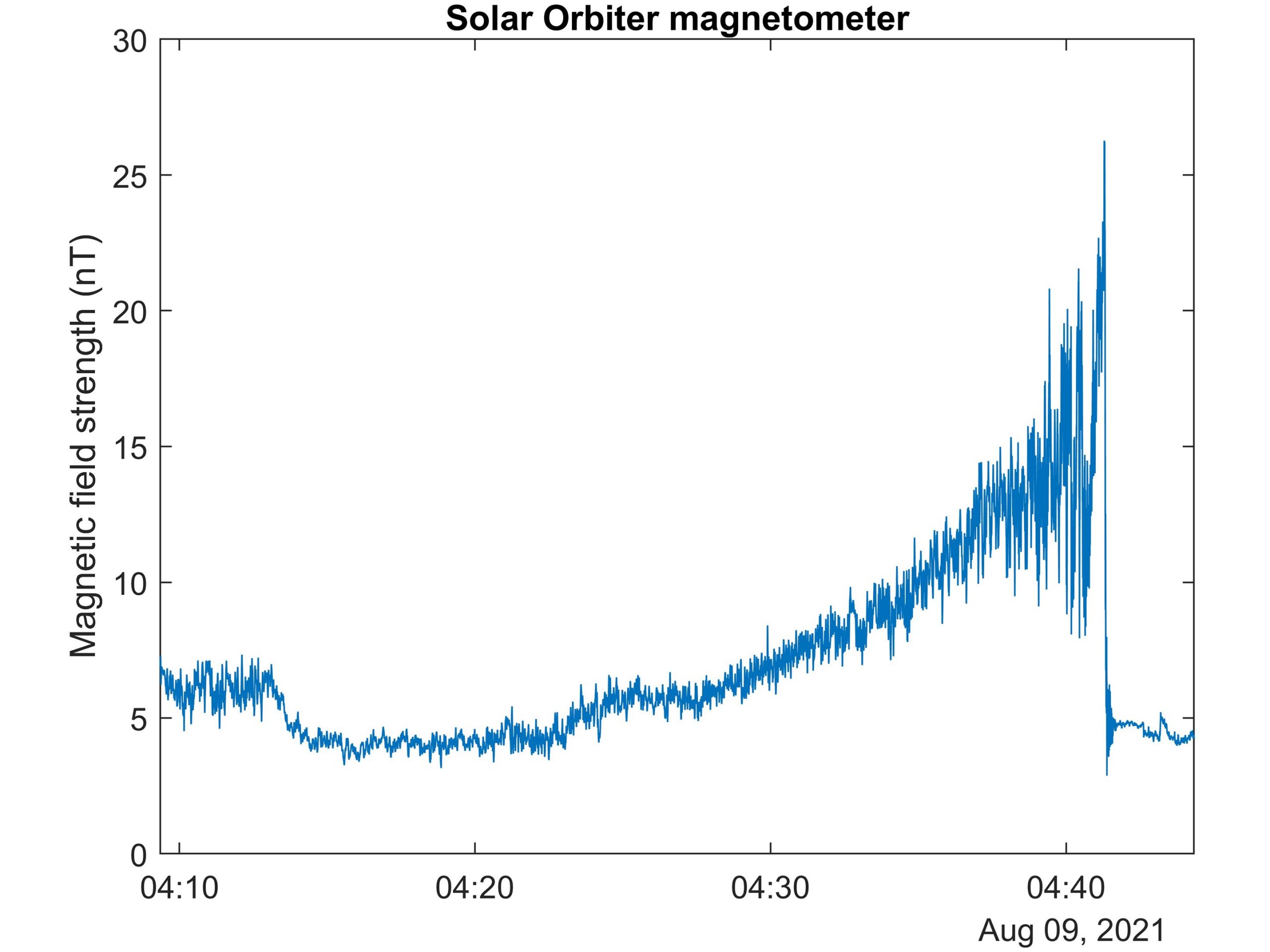
And while Solar Orbiter crossed through the tail of the magnetosphere and out of the bow shock into the solar wind, BepiColombo was ‘upstream’, so the teams will know the input magnetic field conditions throughout the encounter to see how Venus has affected the solar wind downstream. It will take many weeks to make a detailed analysis of the two datasets.
Sensors on both BepiColombo MPO and MMO were also monitoring for ions circulating in the magnetosphere and in the close vicinity of Venus. Particles follow electromagnetic fields, and are also strongly related to processes in the ionosphere and atmosphere. For example, the SERENA/PICAM ion particle detector on MPO clearly measured a peak in hydrogen ion density during the closest approach. SERENA is the Search for Exospheric Refilling and Emitted Natural Abundances instrument suite and PICAM is the Planetary Ion Camera.
With the close encounter, MPO’s MErcury Radiometer and Thermal infrared Imaging Spectrometer (MERTIS) could capture spectra of the Venus atmosphere while the planet completely filled its field of view. Such high resolution spectra of Venus have not been obtained since the Venera 15 mission in the early 1980s. A first look at the MERTIS data shows the expected band of carbon dioxide and hints of more spectral features. The detailed analysis revealing the thermal structure in the atmosphere and potentially sulfur dioxide abundance will take many weeks. Apart from the scientific value of this data, it will also help to verify the instrument calibration in preparation for the first thermal infrared observations of Mercury by a spacecraft.
Venus Photobomb
It was not possible to take high-resolution imagery of Venus with the science cameras onboard either mission, but both could use other instruments to capture black-and-white imagery.
Solar Orbiter’s SoloHI imager observed the nightside of Venus in the days before closest approach. SoloHI usually takes images of the solar wind – the stream of charged particles constantly released from the Sun – by capturing the light scattered by electrons in the wind. In the days leading up to the Venus flyby, the telescope caught the dramatic glare of the planet’s dayside. The footage shows Venus moving across the field of view from the left, while the Sun is off camera to the upper right. The planet’s nightside, the part hidden from the Sun, appears as a dark semicircle surrounded by a bright crescent of light.
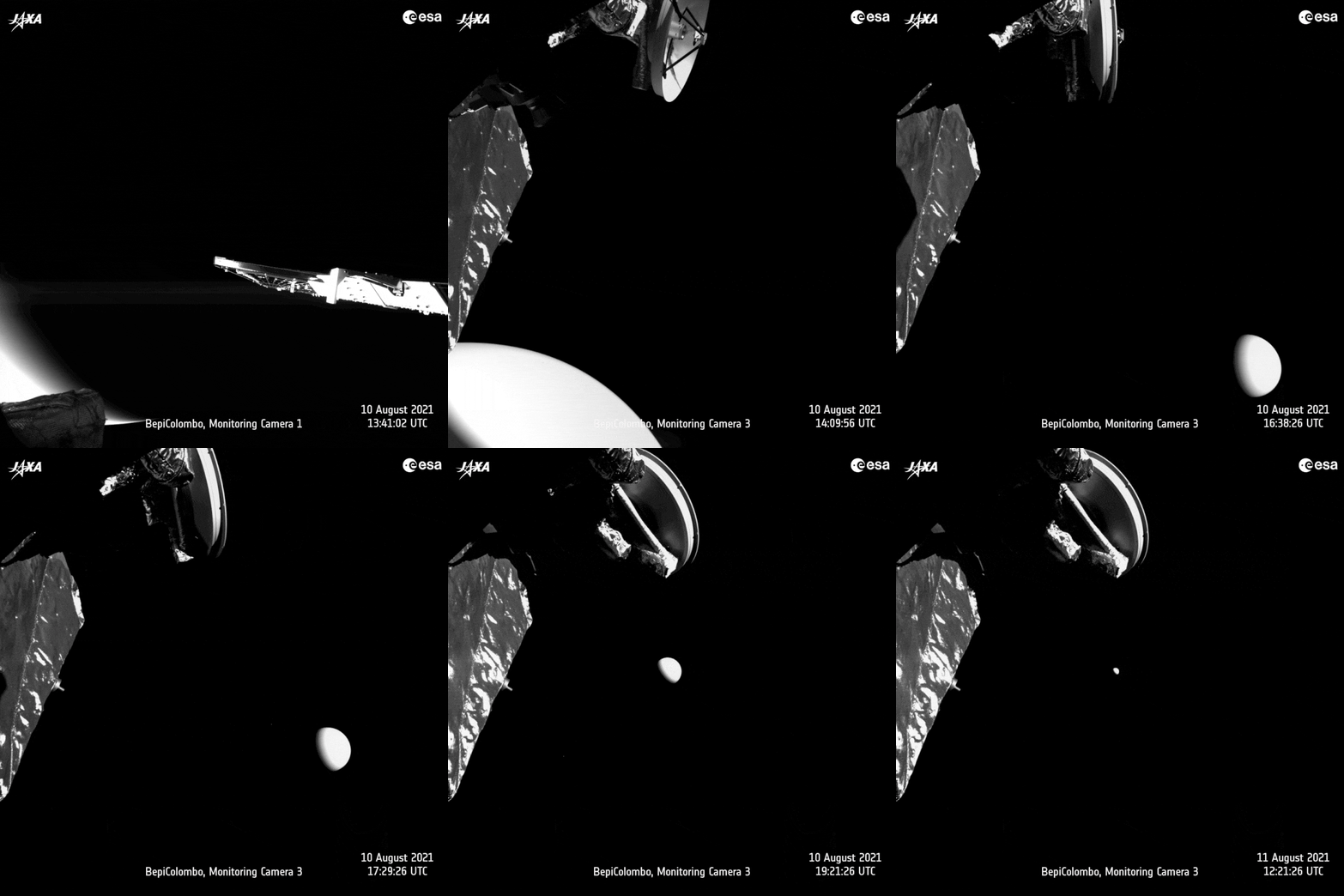
BepiColombo’s three monitoring cameras captured a series of black-and-white snapshots, starting from the approach over the nightside, through closest approach and in the days after as the planet faded from view. The full set of images from the flyby is available in the Planetary Science Archive.
Where to Next?
Solar Orbiter and BepiColombo both have one more flyby this year.
During the night of 1-2 October BepiColombo will see its destination for the first time, making its first of six flybys of Mercury at a distance of just 200 km (124 mi). The two planetary orbiters will be delivered into Mercury orbit in late 2025, tasked with studying all aspects of this mysterious inner planet from its core to surface processes, magnetic field, and exosphere, to better understand the origin and evolution of a planet close to its parent star.
On November 27, Solar Orbiter will make a final flyby of Earth at 460 km, kicking off the start of its main mission. It will continue to make regular flybys of Venus to progressively increase its orbit inclination to best observe the Sun’s uncharted polar regions, which is key to understanding the Sun’s 11-year activity cycle.
Never miss a breakthrough: Join the SciTechDaily newsletter.
Follow us on Google and Google News.