Close Menu
    Facebook X (Twitter) Instagram
    SciTechDaily
    • Biology
    • Chemistry
    • Earth
    • Health
    • Physics
    • Science
    • Space
    • Technology
    Facebook X (Twitter) Pinterest YouTube RSS
    SciTechDaily
    Home»Space»BepiColombo Captures Stunning Mercury Images During Close Gravity Assist Flyby
    Space

    BepiColombo Captures Stunning Mercury Images During Close Gravity Assist Flyby

    By European Space Agency (ESA)October 3, 20216 Comments5 Mins Read
    Facebook Twitter Pinterest Telegram LinkedIn WhatsApp Email Reddit
    Share
    Facebook Twitter LinkedIn Pinterest Telegram Email Reddit
    BepiColombo First Mercury Flyby 1
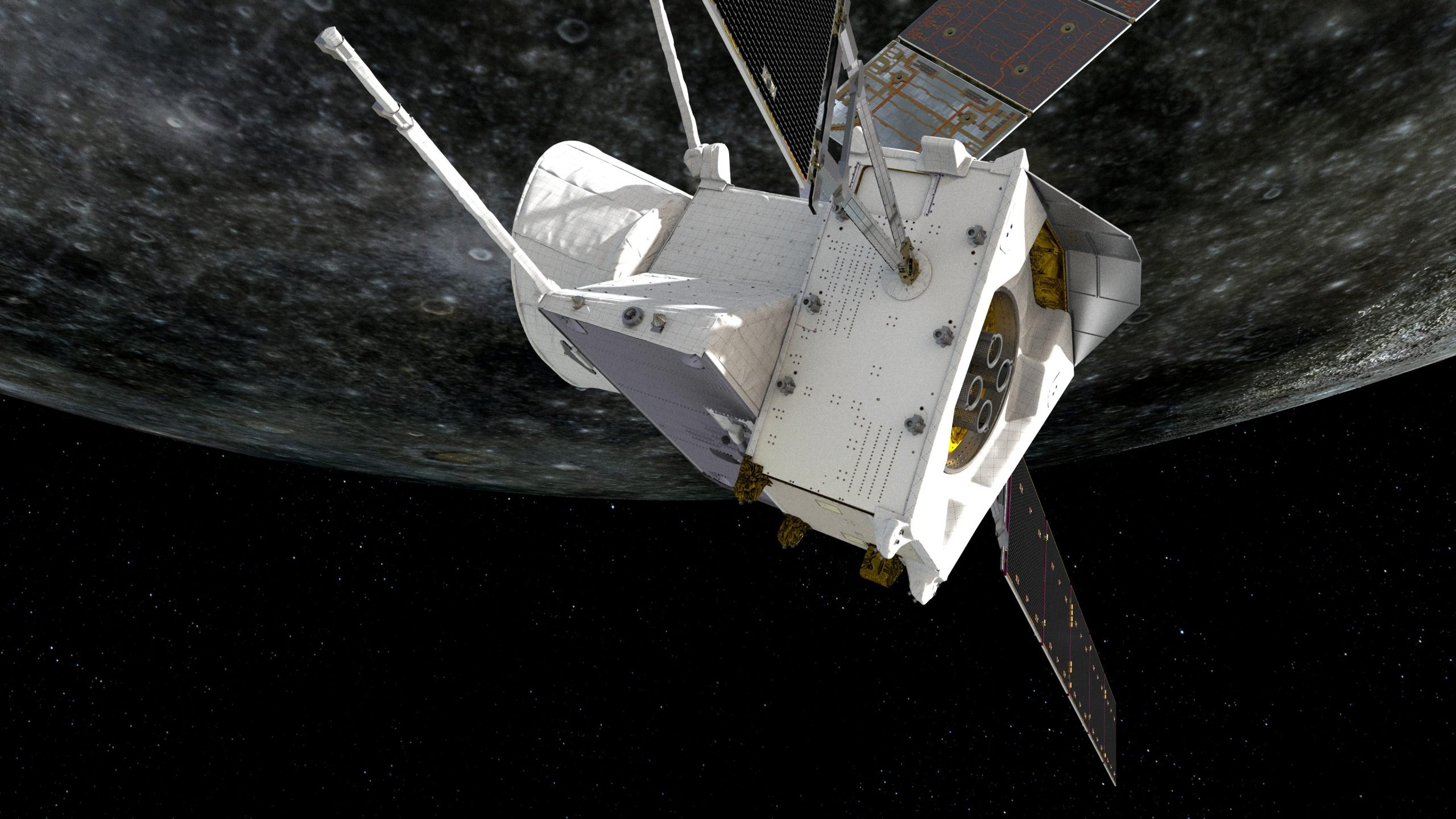
    Artist impression of BepiColombo flying by Mercury on October 1, 2021. The spacecraft makes nine gravity assist maneuvers (one of Earth, two of Venus, and six of Mercury) before entering orbit around the innermost planet of the Solar System in 2025. Credit: ESA/ATG medialab

    BepiColombo’s First Close Encounter with Mercury

    The ESA/JAXA BepiColombo mission has captured its first views of its destination planet Mercury as it swooped past in a close gravity assist flyby last night.

    The closest approach took place at 23:34 UTC on October 1, 2021, at an altitude of 199 km (124 mi) from the planet’s surface. Images from the spacecraft’s monitoring cameras, along with scientific data from a number of instruments, were collected during the encounter. The images were already downloaded over the course of Saturday morning, and a selection of first impressions are presented here.
    Hello Mercury
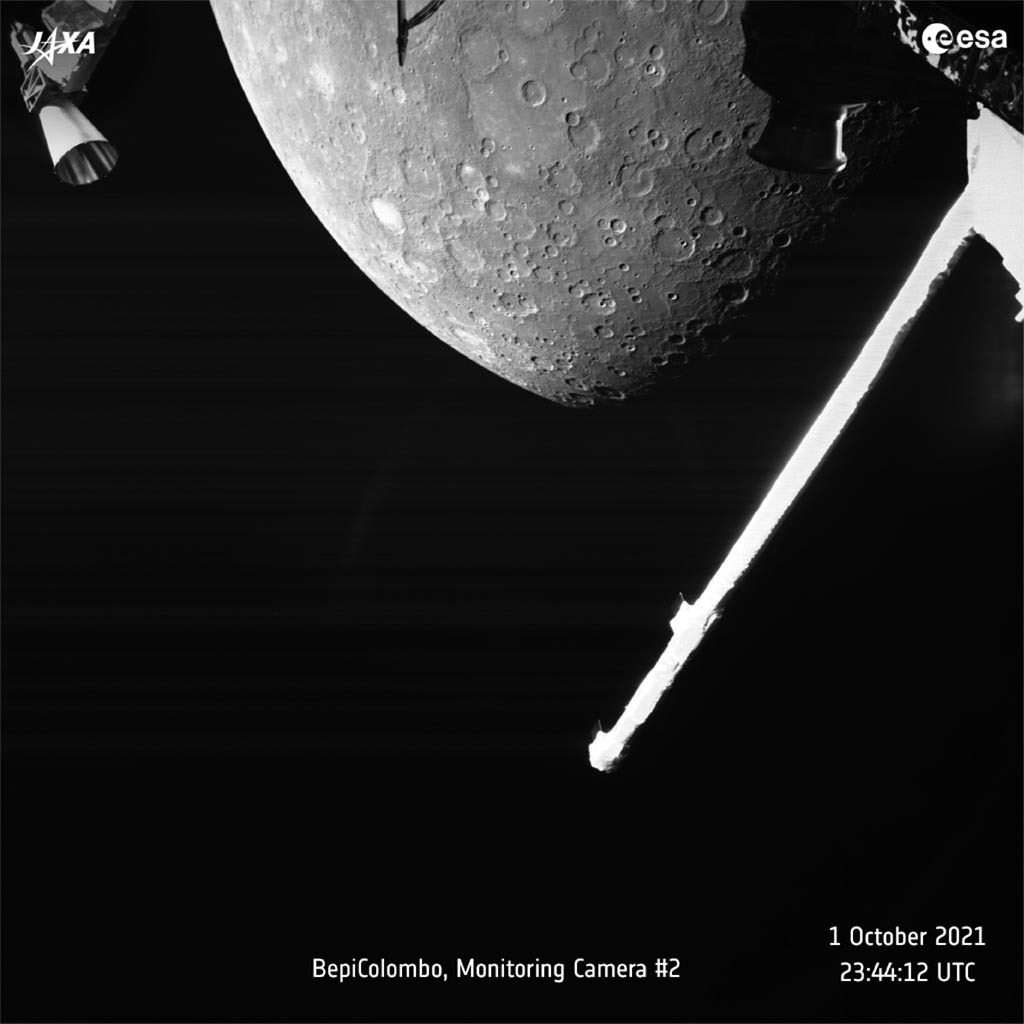
    BepiColombo captured this view of Mercury on October 1, 2021, as the spacecraft flew past the planet for a gravity assist maneuver. The image was taken at 23:44:12 UTC by the Mercury Transfer Module’s Monitoring Camera 2, when the spacecraft was about 2418 km from Mercury. Credit: ESA/BepiColombo/MTM, CC BY-SA 3.0 IGO
    Hello Mercury Annotated
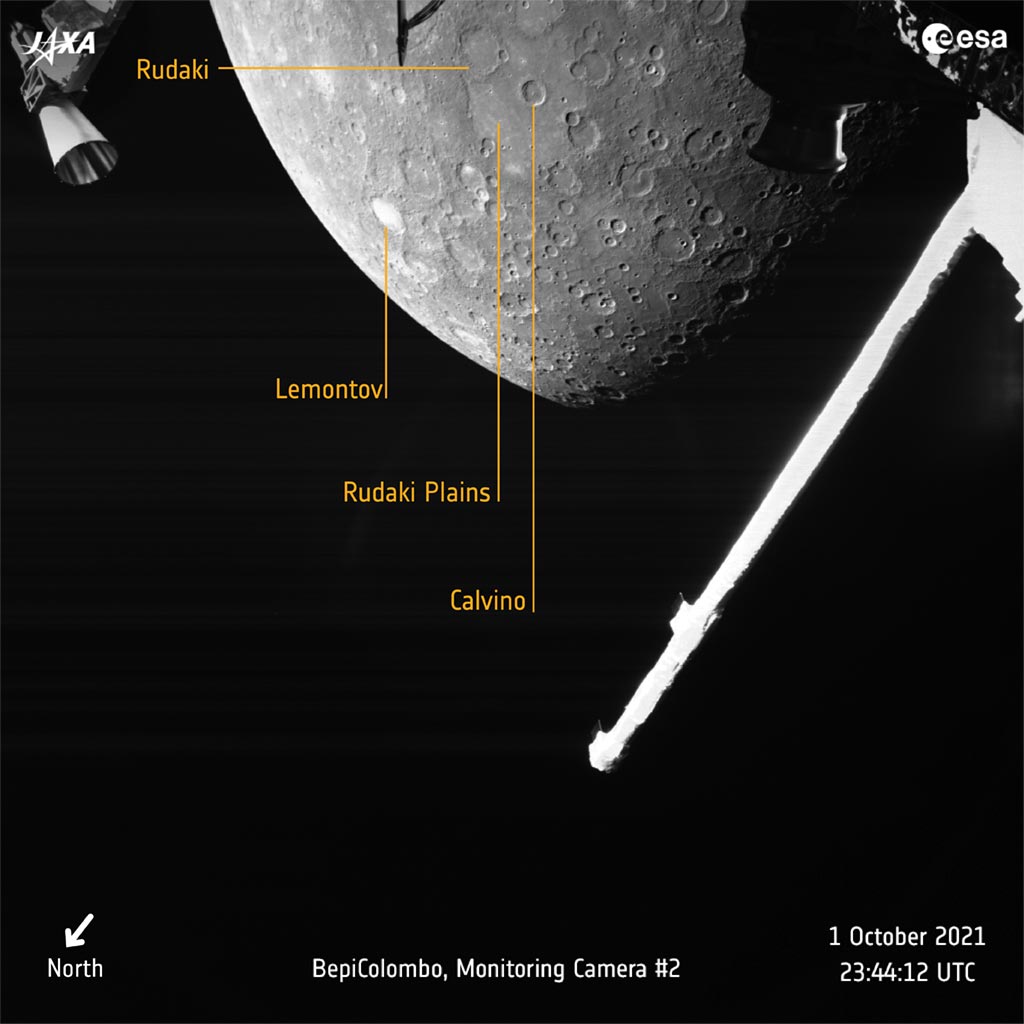
    BepiColombo captured this view of Mercury on October 1, 2021, as the spacecraft flew past the planet for a gravity assist maneuver. The image was taken at 23:44:12 UTC by the Mercury Transfer Module’s Monitoring Camera 2, when the spacecraft was about 2418 km from Mercury. Credit: ESA/BepiColombo/MTM, CC BY-SA 3.0 IGO

    “The flyby was flawless from the spacecraft point of view, and it’s incredible to finally see our target planet,” says Elsa Montagnon, Spacecraft Operations Manager for the mission.

    The monitoring cameras provide black-and-white snapshots in 1024 x 1024 pixel resolution, and are positioned on the Mercury Transfer Module such that they also capture the spacecraft’s structural elements, including its antennas and the magnetometer boom.

    Images were acquired from about five minutes after the time of close approach and up to four hours later. Because BepiColombo arrived on the planet’s nightside, conditions were not ideal to take images directly at the closest approach, thus the closest image was captured from a distance of about 1000 km (620 mi).

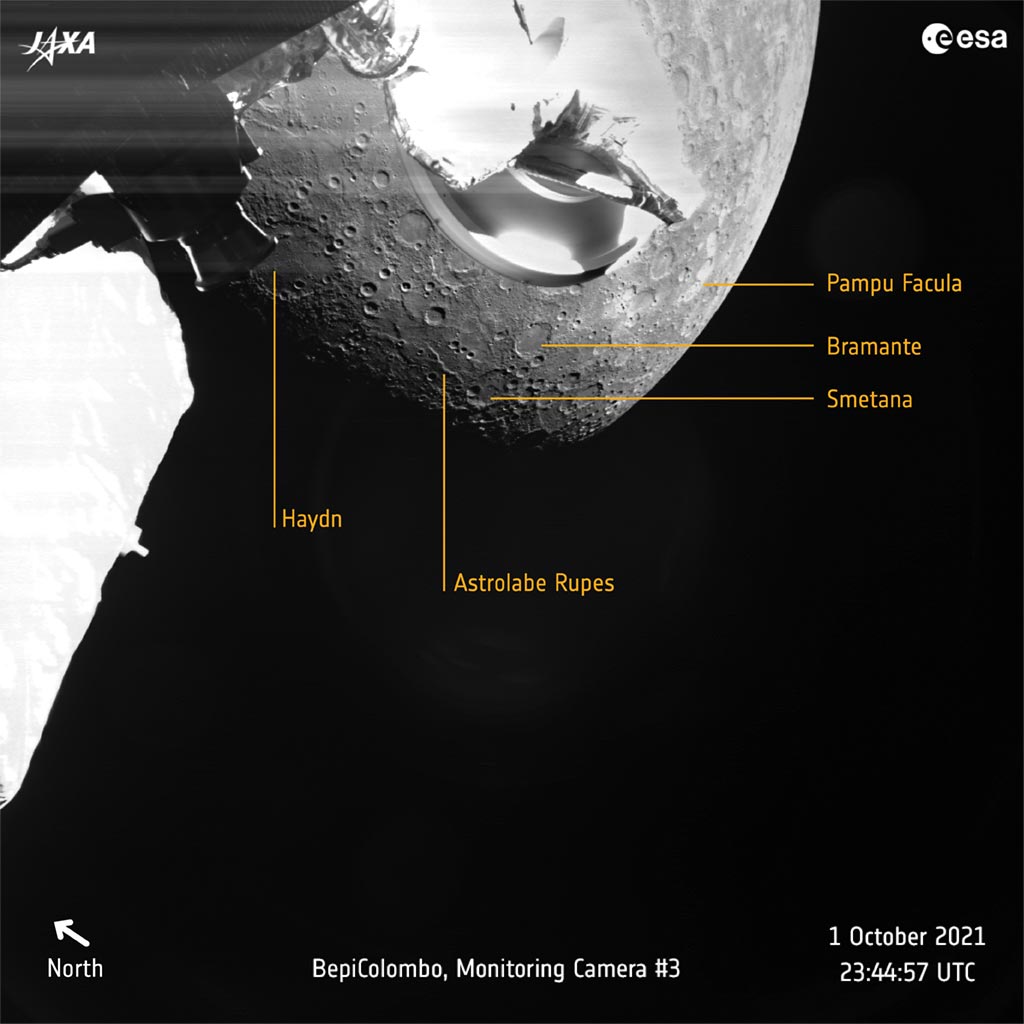
    In many of the images, it is possible to identify some large impact craters.
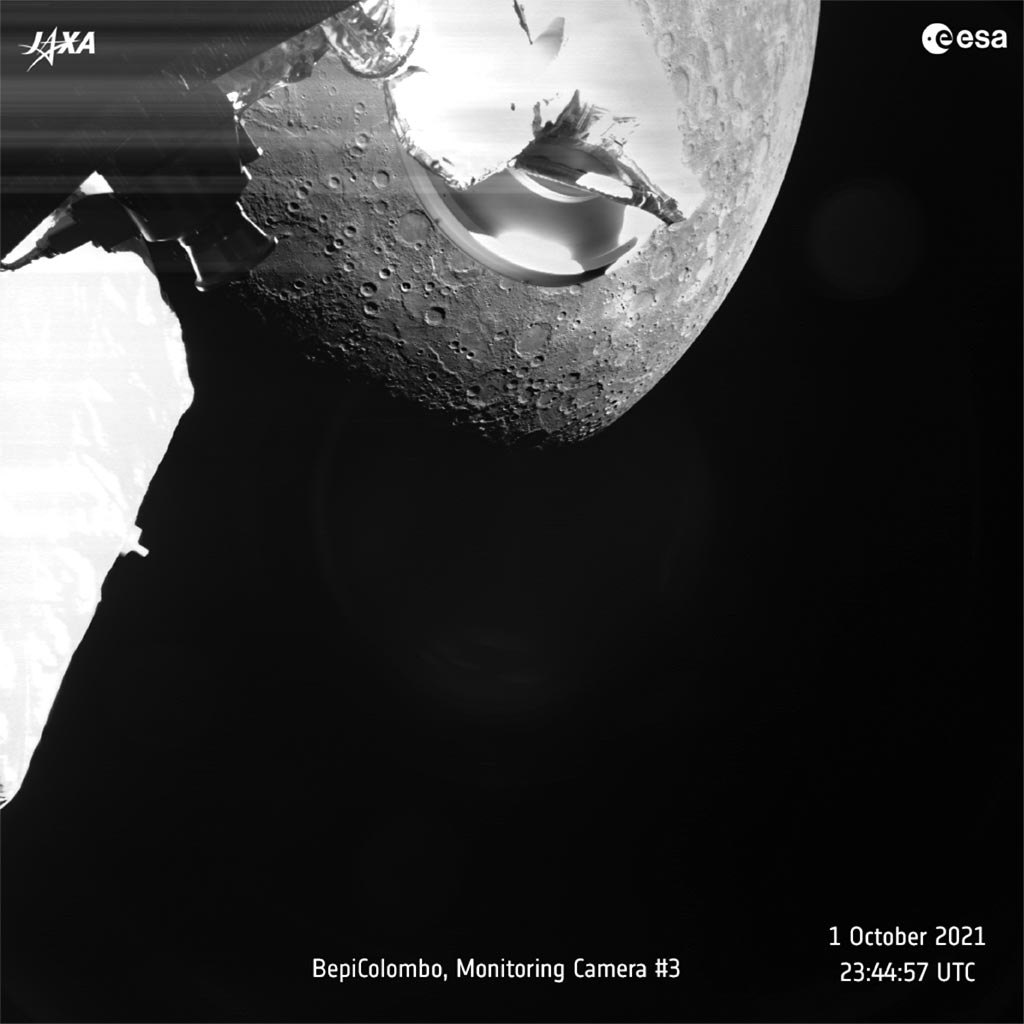
    A Taste of Mercury Geology
    BepiColombo captured this view of Mercury on October 1, 2021, as the spacecraft flew past the planet for a gravity assist maneuver. This image was taken at 23:44:57 UTC by the Mercury Transfer Module’s Monitoring Camera 3, when the spacecraft was 2687 km from Mercury. Credit: ESA/BepiColombo/MTM, CC BY-SA 3.0 IGO
    A Taste of Mercury Geology Annotated
    BepiColombo captured this view of Mercury on October 1, 2021, as the spacecraft flew past the planet for a gravity assist maneuver. This image was taken at 23:44:57 UTC by the Mercury Transfer Module’s Monitoring Camera 3, when the spacecraft was 2687 km from Mercury. Credit: ESA/BepiColombo/MTM, CC BY-SA 3.0 IGO

    “It was an incredible feeling seeing these almost-live pictures of Mercury,” says Valetina Galluzzi, co-investigator of BepiColombo’s SIMBIO-SYS imaging system that will be used once in Mercury orbit. “It really made me happy meeting the planet I have been studying since the very first years of my research career, and I am eager to work on new Mercury images in the future.”

    “It was very exciting to see BepiColombo’s first images of Mercury, and to work out what we were seeing,” says David Rothery of the UK’s Open University who leads ESA’s Mercury Surface and Composition Working Group. “It has made me even more enthusiastic to study the top quality science data that we should get when we are in orbit around Mercury, because this is a planet that we really do not yet fully understand.”

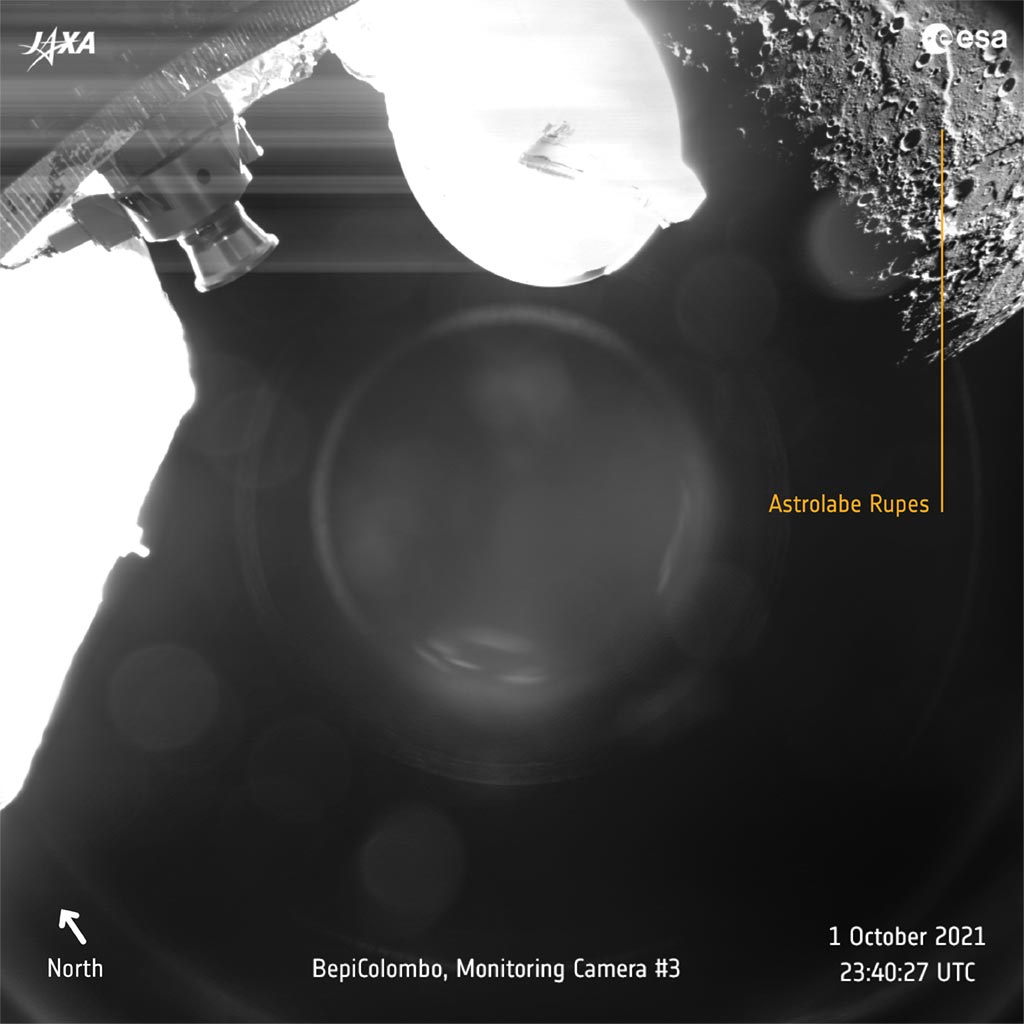
    Sunrise on Mercury
    BepiColombo captured this view of Mercury on October 1, 2021, as the spacecraft flew past the planet for a gravity assist maneuver. The image was taken at 23:40:27 UTC by the Mercury Transfer Module’s Monitoring Camera 3, when the spacecraft was 1183 km from Mercury. Credit: ESA/BepiColombo/MTM, CC BY-SA 3.0 IGO
    Sunrise on Mercury Annotated
    BepiColombo captured this view of Mercury on October 1, 2021, as the spacecraft flew past the planet for a gravity assist maneuver. The image was taken at 23:40:27 UTC by the Mercury Transfer Module’s Monitoring Camera 3, when the spacecraft was 1183 km from Mercury. Credit: ESA/BepiColombo/MTM, CC BY-SA 3.0 IGO

    Although the cratered surface looks rather like Earth’s Moon at first sight, Mercury has a much different history. Once its main science mission begins, BepiColombo’s two science orbiters – ESA’s Mercury Planetary Orbiter and JAXA’s Mercury Magnetospheric Orbiter – will study all aspects of mysterious Mercury from its core to surface processes, magnetic field, and exosphere, to better understand the origin and evolution of a planet close to its parent star. For example, it will map the surface of Mercury and analyze its composition to learn more about its formation. One theory is that it may have begun as a larger body that was then stripped of most of its rock by a giant impact. This left it with a relatively large iron core, where its magnetic field is generated, and only a thin rocky outer shell.

    Mercury has no equivalent to the ancient bright lunar highlands: its surface is dark almost everywhere, and was formed by vast outpourings of lava billions of years ago. These lava flows bear the scars of craters formed by asteroids and comets crashing onto the surface at speeds of tens of kilometers per hour. The floors of some of the older and larger craters have been flooded by younger lava flows, and there are also more than a hundred sites where volcanic explosions have ruptured the surface from below.
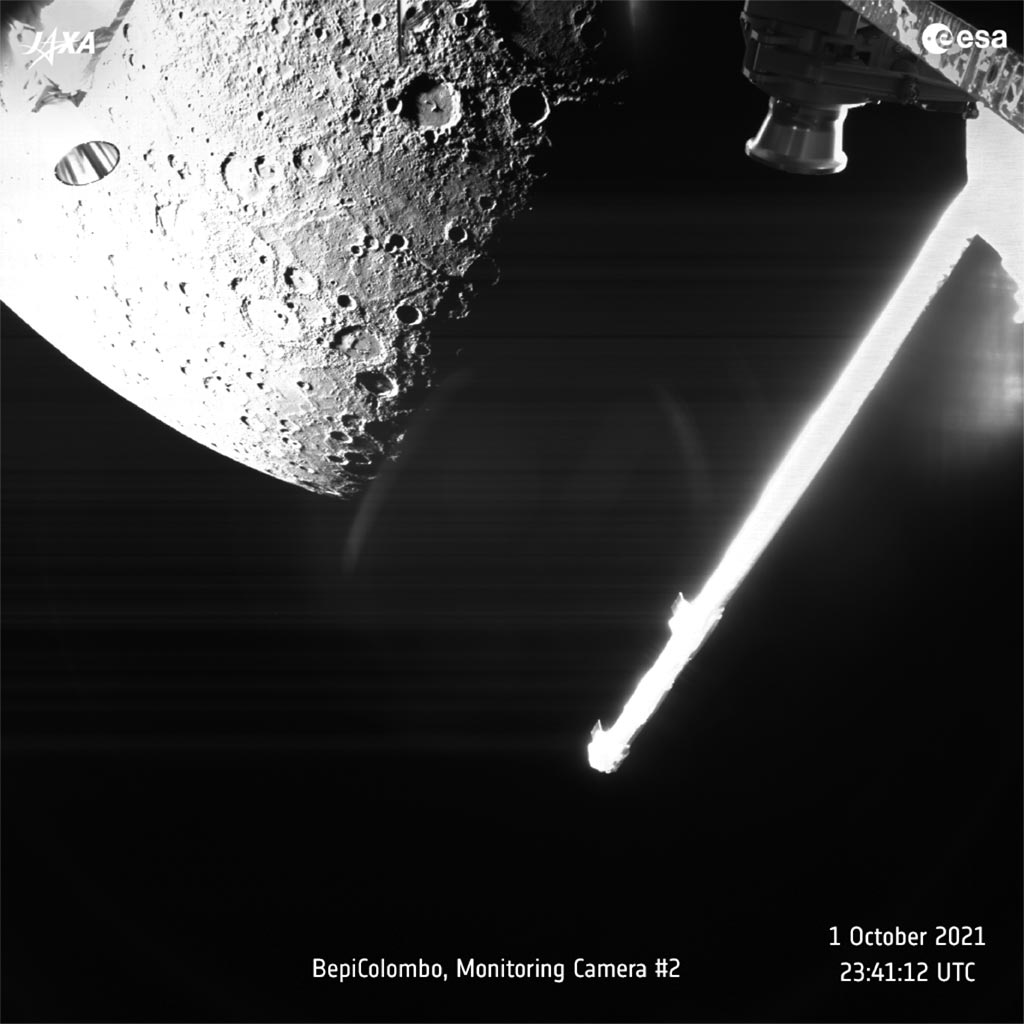
    BepiColombo Meets Mercury
    BepiColombo captured this view of Mercury on October 1, 2021, as the spacecraft flew past the planet for a gravity assist maneuver. The image was taken at 23:41:12 UTC by the Mercury Transfer Module’s Monitoring Camera 2 when the spacecraft was 1410 km from Mercury. Credit: ESA/BepiColombo/MTM, CC BY-SA 3.0 IGO
    BepiColombo Meets Mercury Annotated
    BepiColombo captured this view of Mercury on October 1, 2021, as the spacecraft flew past the planet for a gravity assist maneuver. The image was taken at 23:41:12 UTC by the Mercury Transfer Module’s Monitoring Camera 2 when the spacecraft was 1410 km from Mercury. Credit: ESA/BepiColombo/MTM, CC BY-SA 3.0 IGO

    BepiColombo will probe these themes to help us understand this mysterious planet more fully, building on the data collected by NASA’s Messenger mission. It will tackle questions such as: What are the volatile substances that turn violently into gas to power the volcanic explosions? How did Mercury retain these volatiles if most of its rock was stripped away? How long did volcanic activity persist? How quickly does Mercury’s magnetic field change?

    “In addition to the images we obtained from the monitoring cameras we also operated several science instruments on the Mercury Planetary Orbiter and Mercury Magnetospheric Orbiter,” adds Johannes Benkhoff, ESA’s BepiColombo project scientist. “I’m really looking forward to seeing these results. It was a fantastic night shift with fabulous teamwork, and with many happy faces.”

    BepiColombo’s main science mission will begin in early 2026. It is making use of nine planetary flybys in total: one at Earth, two at Venus, and six at Mercury, together with the spacecraft’s solar electric propulsion system, to help steer into Mercury orbit. Its next Mercury flyby will take place on June 23, 2022.

    Never miss a breakthrough: Join the SciTechDaily newsletter.
    Follow us on Google and Google News.

    BepiColombo European Space Agency JAXA Mercury Planets Popular
    Share. Facebook Twitter Pinterest LinkedIn Email Reddit

    Related Articles

    Stunning Close-Up Images Reveal Mercury’s Icy Craters and Volcanic Plains

    Venus Unveiled: Carbon and Oxygen Caught Escaping Into Space

    BepiColombo’s Space Odyssey: Third Mercury Flyby Reveals Geological Wonders

    BepiColombo Spacecraft Makes Second Gravity Assist of Planet Mercury – Captures Spectacular Close-Ups

    BepiColombo Spacecraft Lines Up for Second Planet Mercury Flyby

    Hear and Feel BepiColombo Spacecraft’s First Tastes of Mercury Science

    Hello Mercury! BepiColombo Spacecraft Captures Image During Gravity Assist Maneuver

    Top Five Mysteries About the Planet Mercury That BepiColombo Will Solve

    See Last Stunning Snaps of Earth as Spacecraft Completes Flyby on Journey to Mercury

    6 Comments

    1. gc on October 3, 2021 8:05 am

      s/tens of kilometers per hour/tens of kilometers per second/

      Reply
    2. GOP Goodness on October 3, 2021 5:08 pm

      This looks like the moon, looks fake like fake news

      Reply
      • Douglas Graham on January 24, 2025 2:01 pm

        Lots of airless rocky bodies in the solar system exhibit numerous impact craters just like the Earth’s Moon, and for the same reason: the early solar system was full of stuff. It still has a lot of stuff, although collisions are less frequent than in the distant past.

        Reply
    3. Spam Hater on October 3, 2021 5:09 pm

      An AD after every two paragraphs is why I hate clicking on “articles” anymore. Getting off the grid is getting more and more attractive by the minute

      Reply
    4. MuTru on October 3, 2021 9:47 pm

      “This looks like the moon, looks fake like fake news”

      Show me any pictures of the moon that have craters in this exact arrangement. Otherwise, you’re just another person who forms opinions based on ignorance rather than facts.

      Reply
    5. heywood on October 4, 2021 3:39 am

      Take a video of home, can’t do it?

      Reply
    Leave A Reply Cancel Reply

    • Facebook
    • Twitter
    • Pinterest
    • YouTube

    Don't Miss a Discovery

    Subscribe for the Latest in Science & Tech!

    Trending News

    Even Occasional Binge Drinking May Triple Liver Damage Risk

    Liftoff! NASA’s Artemis II Launch Sends Astronauts Around the Moon for First Time in 50 Years

    Scientists Discover New Way To Eliminate “Zombie Cells” Driving Aging

    This New Quantum Theory Could Change Everything We Know About the Big Bang

    This One Vitamin May Help Protect Your Brain From Dementia Years Later

    Stopping Weight-Loss Drugs Like Ozempic Can Quickly Erase Heart Benefits

    A 500-Million-Year-Old Surprise Is Forcing Scientists to Rethink Spider Evolution

    Coffee and Blood Pressure: What You Need To Know Before Your Next Cup

    Follow SciTechDaily
    • Facebook
    • Twitter
    • YouTube
    • Pinterest
    • Newsletter
    • RSS
    SciTech News
    • Biology News
    • Chemistry News
    • Earth News
    • Health News
    • Physics News
    • Science News
    • Space News
    • Technology News
    Recent Posts
    • Atomic Chains Turn Electric Fields into Measurable Quantum Signals
    • 12,000-Year-Old Native American Dice Rewrite the History of Gambling
    • Researchers Break a 150-Year-Old Math Law With a Surprising Donut Discovery
    • Are You Adding Too Much Salt? New Study Identifies Who’s Most at Risk
    • Scientists Finally Crack Decades-Old Mystery Behind Statins’ Painful Side Effects
    Copyright © 1998 - 2026 SciTechDaily. All Rights Reserved.
    • Science News
    • About
    • Contact
    • Editorial Board
    • Privacy Policy
    • Terms of Use

    Type above and press Enter to search. Press Esc to cancel.