
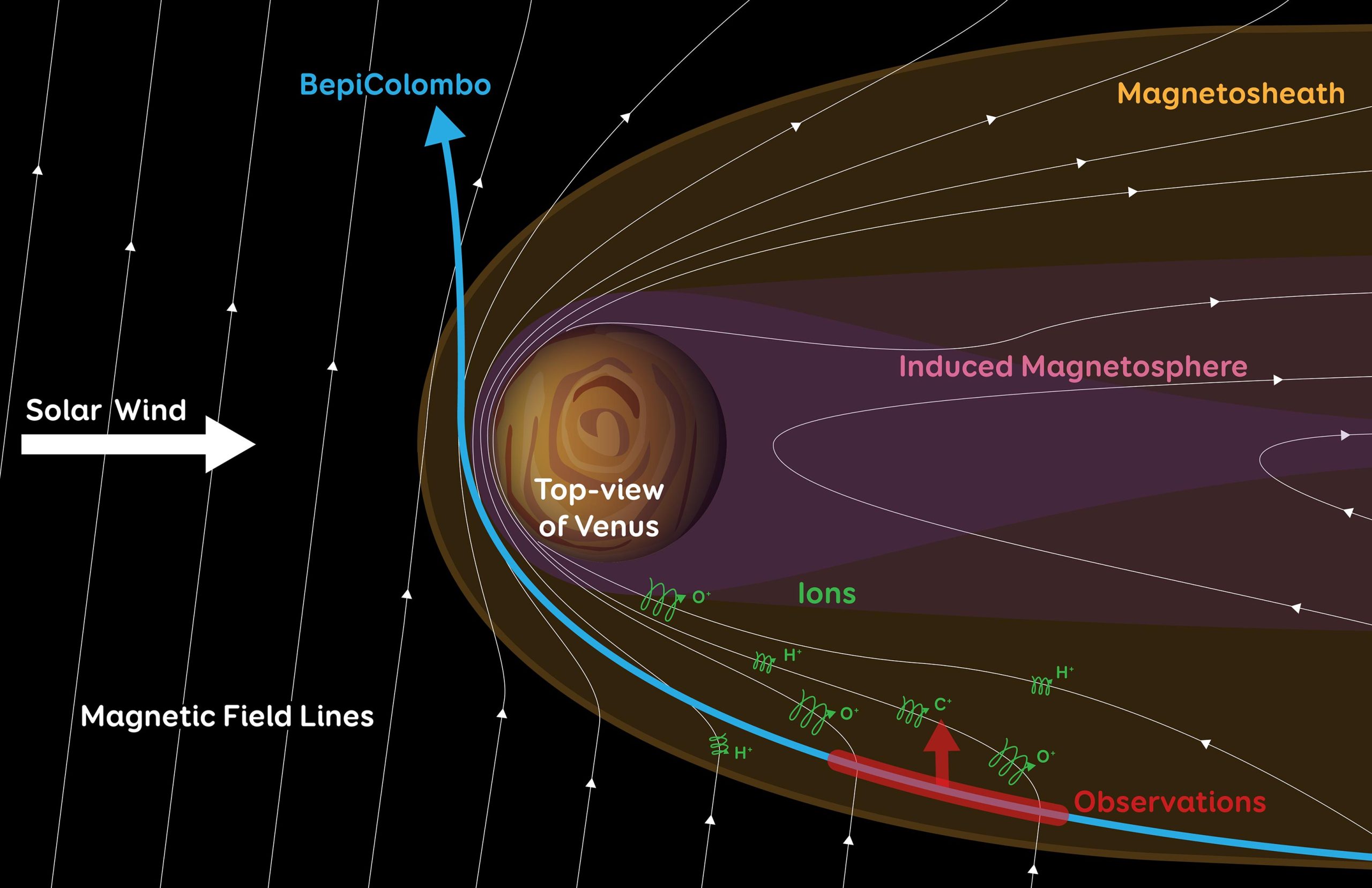
New findings from BepiColombo show escape of heavy ions from Venus, hinting at complex atmospheric dynamics.
A fleeting visit of the European Space Agency (ESA)/Japan Aerospace Exploration Agency (JAXA) BepiColombo mission to Venus has revealed surprising insights into how gases are stripped away from the upper layers of the planet’s atmosphere.
Detections in a previously unexplored region of Venus’s magnetic environment show that carbon and oxygen are being accelerated to speeds where they can escape the planet’s gravitational pull. The results have been published on April 12 in the journal Nature Astronomy.
Discovery of Ion Escape
Lina Hadid, CNRS researcher at the Plasma Physics Laboratory (LPP) and lead author of the study said: “This is the first time that positively charged carbon ions have been observed escaping from Venus’s atmosphere. These are heavy ions that are usually slow moving, so we are still trying to understand the mechanisms that are at play. It may be that an electrostatic ‘wind’ is lifting them away from the planet, or they could be accelerated through centrifugal processes.”
Unlike Earth, Venus does not generate an intrinsic magnetic field in its core. Nonetheless, a weak, comet-shaped ‘induced magnetosphere’ is created around the planet by the interaction of charged particles emitted by Sun (the solar wind) with electrically charged particles in Venus’s upper atmosphere. Draped around the magnetosphere is a region called the ‘magnetosheath’ where the solar wind is slowed and heated.
BepiColombo’s Flyby and Data Collection
On August 10, 2021, BepiColombo passed by Venus to slow down and adjust course towards its final destination of Mercury. The spacecraft swooped up the long tail of Venus’s magnetosheath and emerged through the nose of the magnetic regions closest to the Sun. Over a 90-minute period of observations, BepiColombo’s instruments measured the number and mass of charged particles it encountered, capturing information about the chemical and physical processes driving atmospheric escape in the flank of the magnetosheath.
Early in its history, Venus had many similarities to Earth, including significant amounts of liquid water. Interactions with the solar wind have stripped away the water, leaving an atmosphere composed mainly of carbon dioxide and smaller amounts of nitrogen and other trace species. Previous missions, including NASA’s Pioneer Venus Orbiter and ESA’s Venus Express have made detailed studies of the type and quantity of molecules and charged particles that are lost into space. However, the missions’ orbital paths left some areas around Venus unexplored and many questions still unanswered.
Significance of Recent Discoveries
Data for the study were obtained by BepiColombo’s Mass Spectrum Analyzer (MSA) and the Mercury Ion Analyzer (MIA) during the spacecraft’s second Venus flyby. The two sensors are part of the Mercury Plasma Particle Experiment (MPPE) instrument package, which is carried by Mio, the JAXA-led Mercury Magnetospheric Orbiter.
“Characterising the loss of heavy ions and understanding the escape mechanisms at Venus is crucial to understand how the planet’s atmosphere has evolved and how it has lost all its water,” said Dominique Delcourt, researcher at LPP and the Principal Investigator of the MSA instrument.
Europlanet’s SPIDER space weather modeling tools enabled the researchers to track how the particles propagated through the Venusian magnetosheath.
“This result shows the unique results that can come out of measurements made during planetary flybys, where the spacecraft may move through regions generally unreachable by orbiting spacecraft,” said Nicolas André, of the Institut de Recherche en Astrophysique et Planétologie (IRAP) and lead of the SPIDER service.
Future Missions and Expectations
A fleet of spacecraft will investigate Venus over the next decade, including ESA’s Envision mission, NASA’s VERITAS orbiter and DAVINCI probe, and India’s Shukrayaan orbiter. Collectively, these spacecraft will provide a comprehensive picture of the Venusian environment, from the magnetosheath, down through the atmosphere to the surface and interior.
“Recent results suggest that the atmospheric escape from Venus cannot fully explain the loss of its historical water content. This study is an important step to uncover the truth about the historical evolution of the Venusian atmosphere, and upcoming missions will help fill in many gaps,” added co-author, Moa Persson of the Swedish Institute of Space Physics.
Reference: “BepiColombo observations of cold oxygen and carbon ions in the flank of the induced magnetosphere of Venus” by L. Z. Hadid, D. Delcourt, Y. Saito, M. Fränz, S. Yokota, B. Fiethe, C. Verdeil, B. Katra, F. Leblanc, H. Fischer, M. Persson, S. Aizawa, N. André, Y. Harada, A. Fedorov, D. Fontaine, N. Krupp, H. Michalik, J-J. Berthelier, H. Krüger, G. Murakami, S. Matsuda, D. Heyner, H.-U. Auster, I. Richter, J. Z. D. Mieth, D. Schmid and D. Fischer, 12 April 2024, Nature Astronomy.
DOI: 10.1038/s41550-024-02247-2
Never miss a breakthrough: Join the SciTechDaily newsletter.
Follow us on Google and Google News.