
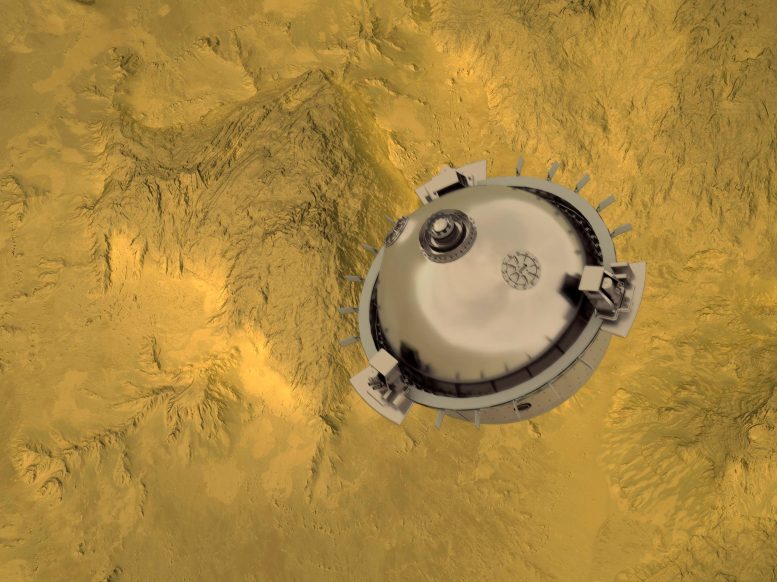
NASA’s DAVINCI mission will investigate Venus’ atmosphere, surface, and history using a deep probe and flybys to explore its past habitability and parallels to Earth.
Inspired by the Renaissance vision of Leonardo da Vinci, NASA is presently preparing its scientific return to Venus’ atmosphere and surface with a mission known as the “Deep Atmosphere of Venus Investigation of Noble gases, Chemistry, and Imaging” (DAVINCI).
The DAVINCI mission will “take the plunge” into Venus’ enigmatic history using an instrumented deep atmosphere probe spacecraft that will carry five instruments for measuring the chemistry and environments throughout the clouds and to the surface, while also conducting the first descent imaging of a mountain system on Venus known as Alpha Regio, which may represent an ancient continent. In addition, the DAVINCI mission includes two science flybys of Venus during which it will search for clues to mystery molecules in the upper cloud deck while also measuring the rock types in some of Venus’s highland regions.
All of these new and unique measurements will make the ‘exoplanet next door’ into a key place for understanding Earth and Venus-sized exoplanets that may have similar histories to our sister planet. DAVINCI will pave the way for a series of missions by NASA and ESA in the 2030s by opening the frontier as it searches for clues to whether Venus harbored oceans and how its atmosphere-climate system evolved over billions of years. DAVINCI’s science will address questions about habitability and how it could be “lost” as rocky planets evolve over time.
NASA’s DAVINCI mission will study the origin, evolution, and present state of Venus in unprecedented detail from near the top of the clouds to the planet’s surface. The mission’s goal is to help answer longstanding questions about our neighboring planet, especially whether Venus was ever wet and habitable like Earth. Named after visionary Renaissance artist and scientist Leonardo da Vinci, the DAVINCI mission Deep Atmosphere Venus Investigation of Noble gases, Chemistry, and Imaging is scheduled to launch in the late 2020s.
Video Transcript:
It’s 900 degrees hot at the surface, has powerful high-altitude winds, and is blanketed by a dense carbon dioxide atmosphere.
The planet Venus. Although the same size and density as Earth, the similarities end there.
Earth has water and life.
Venus is desolate, dry, apparently lifeless.
The DAVINCI mission, named after Leonardo da Vinci, will now take us back to Venus and address unresolved questions about this mysterious planet.
This exciting new mission will launch in June 2029.
During two gravity assist flybys, DAVINCI will study the cloud tops in ultraviolet light, tracking cloud motions and analyzing mysterious ultraviolet absorbing chemicals.
Both flybys will also examine nightside heat emanating from the surface. These geological clues will paint a global picture of surface composition and its evolution.
Seven months after our second flyby, DAVINCI will release its atmospheric descent probe, which will enter the atmosphere over the course of two days.
The probe will take about an hour to fall through the atmosphere, taking measurements down to the surface.
These measurements will include profiles of composition, winds, temperature, pressure, and acceleration.
Key gases will help us understand how Venus formed and evolved. Some of these measurements may even reveal signatures of ancient water.
The spherical probe houses the state-of-the-art instruments that will work together to address questions about the Venus atmosphere, protecting them from the extreme temperatures, high pressures, and acidic clouds in the environment.
DAVINCI’s camera peers down through a small viewing port, and once the probe passes below the clouds, it will start to collect a series of three-dimensional views that will also help us understand whether the rocks of the Alpha Regio Highland region reveal a story of an ancient continent shaped by water. And an oxygen-sensing student collaboration experiment will reveal the role of this gas in the deep atmosphere.
The discoveries that emerge from this diverse dataset, will help tell us whether Venus was once habitable and the story that we reveal will reach even beyond our solar system to analog exoplanets that will be observed with the James Webb Space Telescope.
Venus is waiting for us all and DAVINCI is ready to take us there and ignite a new Venus renaissance.
NASA’s Goddard Space Flight Center leads the DAVINCI Mission as the PI institution.
Never miss a breakthrough: Join the SciTechDaily newsletter.
Follow us on Google and Google News.
2 Comments
‘for the first time’
The Soviets did it a long time ago. Get over yourself America
“Take the Plunge.” If the thing was really there sending back data and it indicated something unexpected, that MIGHT be a mildly interesting article. We have more interesting destinations that beg for deeper explorations (not just lame fly-bys) but we continue to finance probes that take pics of rocks and dust. Europa? NOPE! More Mars and Venus, that’s what we want! For decades we’ve known Venus isn’t a place to go, it literally offers nothing to us. But once again, let’s prove Venus is a ball of rocks and dust under a vicious atmosphere. Mars, too. Wow, look at those rocks… and that dust! Haven’t seen pics like that since 1976! Enceledus shoots plumes of SALT WATER into space? Meh, we’ll just go on paying for more of those rock and dust pics. They’ll go great with all the other ones we’ve collected. Maybe they’ll see a rock shaped like something, that’ll at least give the kooks out there something to talk about for a little while. “Duh, looks like a FACE, dude!” Totally worth the money. SMH.