
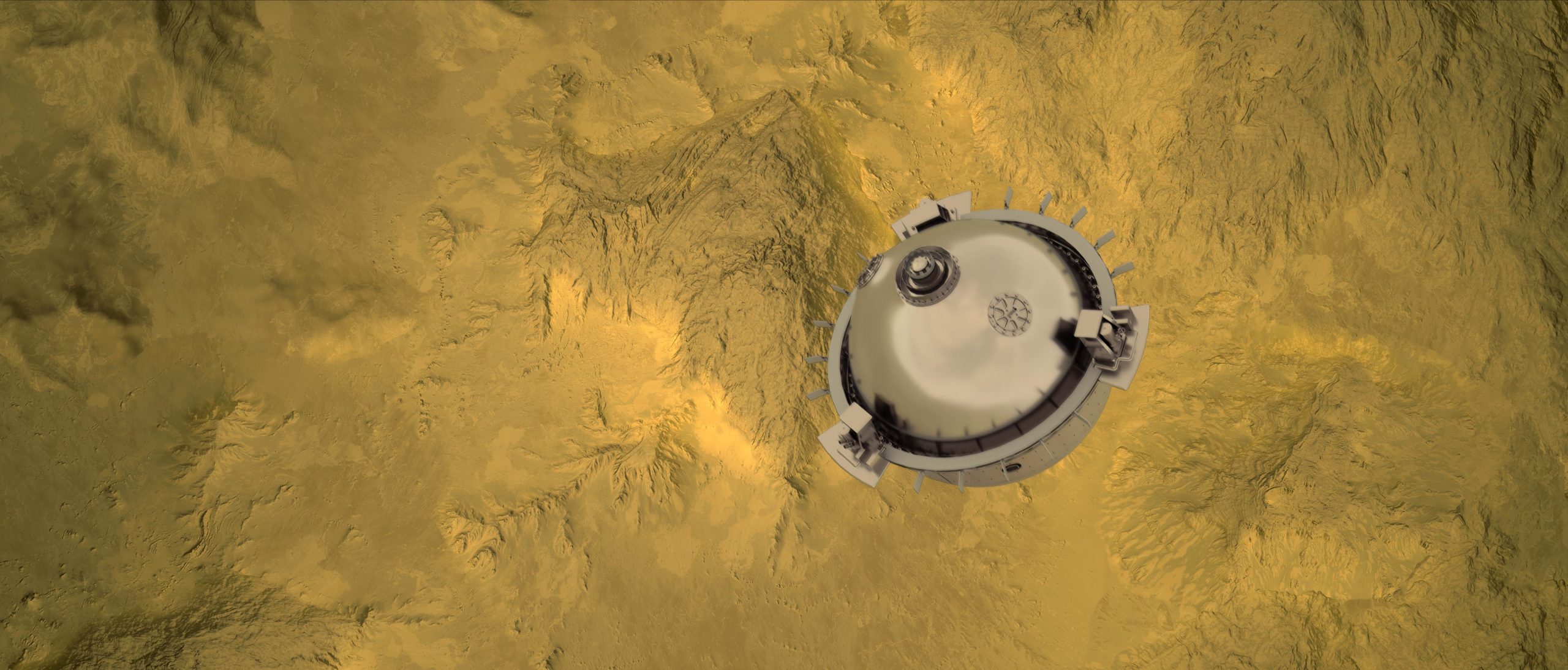
Launching in 2029, DAVINCI will send a probe into Venus’ atmosphere and highlands to study gases, climate, and geology, searching for clues to its Earth-like past.
Launching in 2029, NASA’s Deep Atmosphere Venus Investigation of Noble gases, Chemistry and Imaging (DAVINCI) mission will bring a rich suite of instruments to Venus to address long-standing questions about Earth’s sister planet. Some scientists think Venus may once have been more Earth-like in the past, with oceans and pleasant surface temperatures — DAVINCI data will help us determine if this intriguing possibility is true.
Clues to Venus’ mysterious past may be hidden in atmospheric gases or in surface rocks formed in association with ancient water in the planet’s mountainous highlands. During two flybys, the DAVINCI carrier, relay, and imaging spacecraft will collect data on the planet’s day side of unknown compounds that absorb ultraviolet light in the Venus upper atmosphere with an instrument called the Compact Ultraviolet to Visible Imaging Spectrometer (CUVIS); on the planet’s night side, the Venus Imaging System for Observational Reconnaissance (VISOR) will sense heat from Venus’ surface emerging from beneath the clouds to help us better understand the composition of diverse geological highlands regions across Venus. VISOR will also study clouds on the Venus day side in the ultraviolet, producing cloud motion movies.
Venus has a scorching surface hotter than your home oven, and a complex atmosphere 90 times thicker than Earth’s made mostly of carbon dioxide and with sulfuric acid clouds.
Two years after launch, the DAVINCI descent sphere will be dropped by the carrier spacecraft into this extreme environment to provide new direct measurements of the Venus atmosphere, and to reveal a bird’s eye view of the surface below the clouds. The descent location, the Alpha Regio “tessera,” is a mountainous highland region whose rocks may hold clues to the planet’s mysterious past. The titanium sphere is designed to withstand the harsh conditions of the Venus environment while protecting the instruments nestled inside.
The Venus Tunable Laser Spectrometer (VTLS) will measure key gases that offer clues to the planet’s past, including compounds that may hint at the possible history of past water. The Venus Mass Spectrometer (VMS) will study the atmosphere in detail, including noble gases and trace gases from 67 km (42 mi) to the near surface. The Venus Atmospheric Structure Investigation (VASI) will measure pressure, temperature, and winds throughout the descent.
VenDI to Capture 3D Views of Venus’ Surface
Peering through a transparent sapphire window at the bottom of the descent sphere, the Venus Descent Imager (VenDI) will map the 3-D topography and composition of Alpha Regio, with topographic resolution at up to sub-meter scales. Lastly, a student collaboration experiment called the Venus Oxygen Fugacity experiment (VfOx) will be mounted to the probe to measure oxygen in the deep atmosphere. Together, this set of data will help rewrite the textbooks on Venus and may even help us better understand Venus-like planets in other solar systems.
NASA has selected the DAVINCI+ (Deep Atmosphere Venus Investigation of Noble-gases, Chemistry and Imaging +) mission as part of its Discovery program, and it will be the first probe to enter the Venus atmosphere since NASA’s Pioneer Venus in 1978 and USSR’s Vega in 1985. Named for visionary Renaissance artist and scientist, Leonardo da Vinci, the DAVINCI+ mission will bring 21st-century technologies to the world next door. DAVINCI+ may reveal whether Earth’s sister planet looked more like Earth’s twin planet in a distant, possibly hospitable past with oceans and continents. Credit: NASA’s Goddard Space Flight Center
DAVINCI is a partnership between NASA’s Goddard Space Flight Center in Greenbelt, Maryland, and Lockheed Martin in Denver, Colorado, with instruments from NASA Goddard, Jet Propulsion Laboratory, Malin Space Science Systems, and key supporting hardware from Johns Hopkins Applied Physics Laboratory and the University of Michigan.
Never miss a breakthrough: Join the SciTechDaily newsletter.
Follow us on Google and Google News.
1 Comment
Cool.