
The Roman Space Telescope will revolutionize cosmic studies with wide-field imaging, revealing galaxy formation, dark matter, and the universe’s evolution on unprecedented scales.
A new simulation shows how NASA’s Nancy Grace Roman Space Telescope will turn back the cosmic clock, unveiling the evolving universe in ways that have never been possible before when it launches by May 2027. With its ability to rapidly image enormous swaths of space, Roman will help us understand how the universe transformed from a primordial sea of charged particles to the intricate network of vast cosmic structures we see today.
“The Hubble and James Webb Space Telescopes are optimized for studying astronomical objects in-depth and up close, so they’re like looking at the universe through pinholes,” said Aaron Yung, a postdoctoral fellow at NASA’s Goddard Space Flight Center in Greenbelt, Maryland, who led the study. “To solve cosmic mysteries on the biggest scales, we need a space telescope that can provide a far larger view. That’s exactly what Roman is designed to do.”
Combining Roman’s large view with Hubble’s broader wavelength coverage and Webb’s more detailed observations will offer a more comprehensive view of the universe.
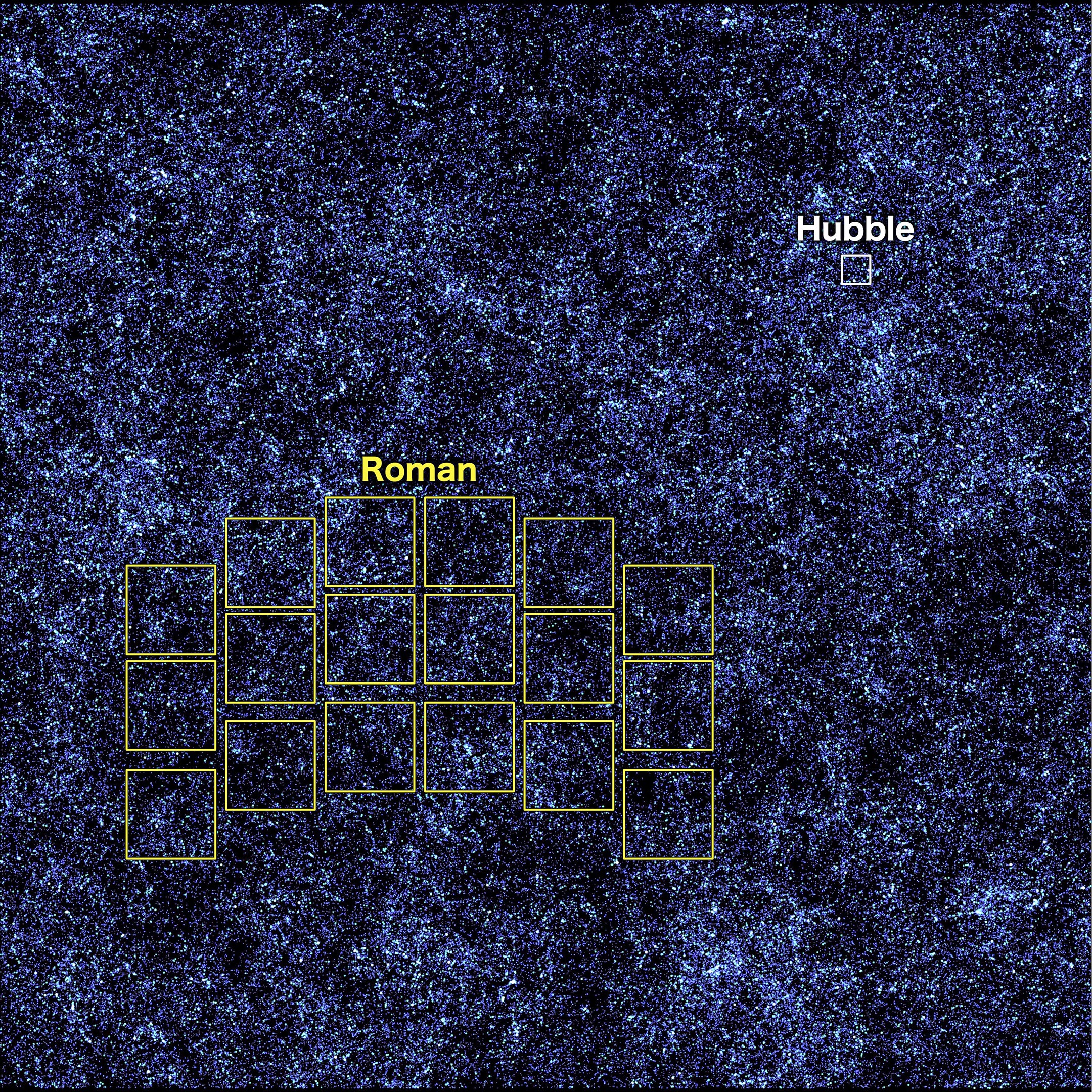
In this simulated view of the deep cosmos, each dot represents a galaxy. The three small squares show Hubble’s field of view, and each reveals a different region of the synthetic universe. Roman will be able to quickly survey an area as large as the whole zoomed-out image, which will give us a glimpse of the universe’s largest structures. Credit: NASA’s Goddard Space Flight Center and A. Yung
The simulation covers a two-square-degree patch of the sky, which is equivalent to about 10 times the apparent size of a full moon, containing over 5 million galaxies. It’s based on a well-tested galaxy formation model that represents our current understanding of how the universe works. Using an extremely efficient technique, the team can simulate tens of millions of galaxies in less than a day – something that could take years using conventional methods. When Roman launches and begins delivering real data, scientists can compare it to a range of such simulations, putting their models to the ultimate test. That will help unravel galaxy formation physics, dark matter – a mysterious substance observed only through its gravitational effects – and much more.
A paper describing the results was published in The Monthly Notices of the Royal Astronomical Society in December 2022.
Unraveling the Cosmic Web
Galaxies and galaxy clusters glow in clumps along invisible threads of dark matter in a tapestry the size of the observable universe. With a broad enough view of that tapestry, we can see that the large-scale structure of the universe is web-like, with strands that extend hundreds of millions of light-years. Galaxies are primarily found at intersections of the filaments, with vast “cosmic voids” between all the shining strands.
That’s how the cosmos looks now. But if we could rewind the universe, we would see something very different.
Instead of giant, blazing stars sparsely scattered throughout galaxies that are each separated by even more immense distances, we would find ourselves submerged in a sea of plasma (charged particles). This primordial soup was almost completely uniform, but thankfully for us, there were tiny knots. Since those clumps were slightly denser than their surroundings, they had slightly larger gravitational pull.
Over hundreds of millions of years, the clumps drew in more and more material. They grew large enough to form stars, which were gravitationally drawn toward the dark matter that forms the invisible backbone of the universe. Galaxies were born and continued to evolve, and eventually, planetary systems like our own emerged.
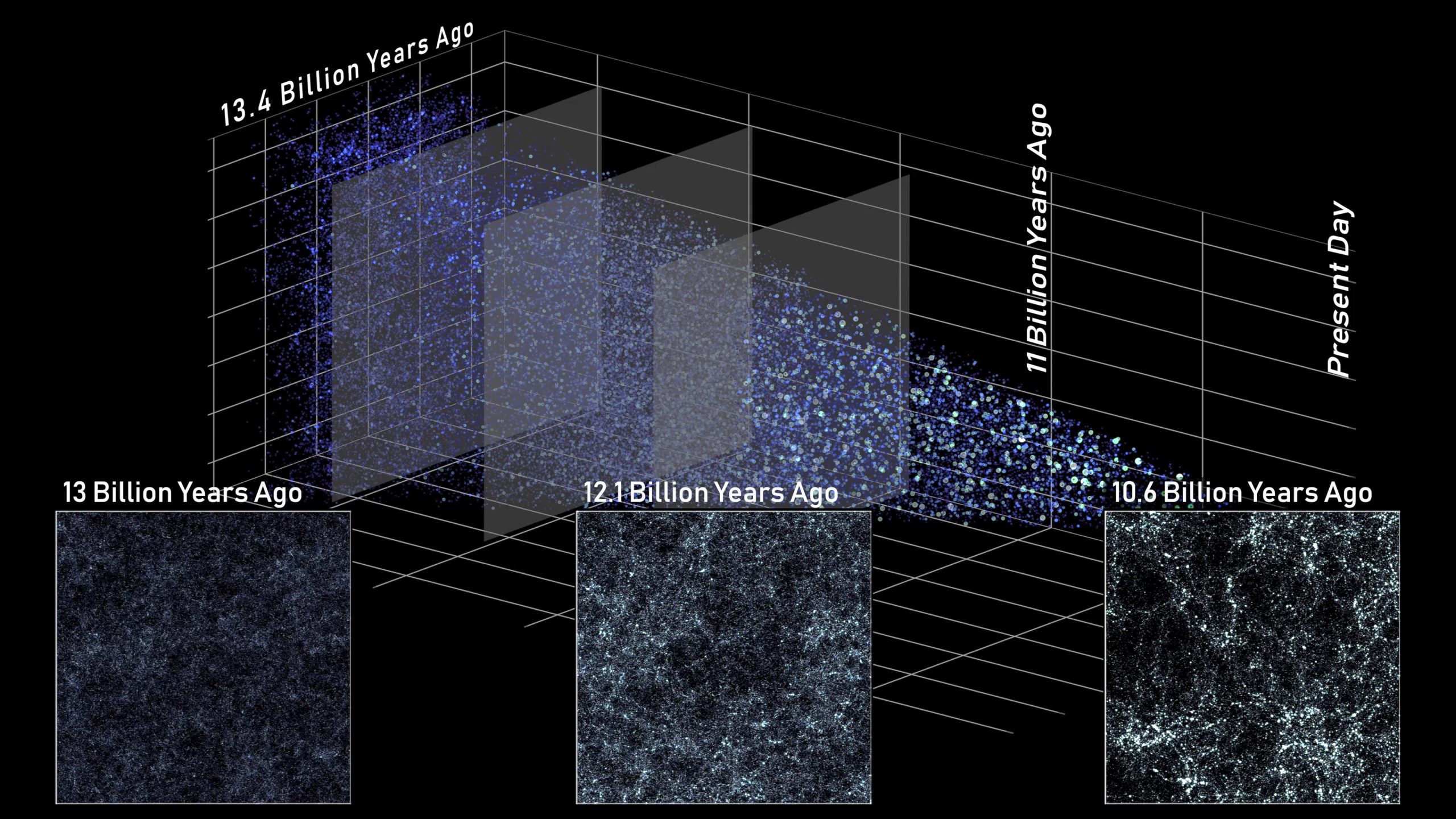
In this side view of the simulated universe, each dot represents a galaxy whose size and brightness corresponds to its mass. Slices from different epochs illustrate how Roman will be able to view the universe across cosmic history. Astronomers will use such observations to piece together how cosmic evolution led to the web-like structure we see today. Credit: NASA’s Goddard Space Flight Center and A. Yung
Roman’s panoramic view will help us see what the universe was like at different stages and fill in many gaps in our understanding. For example, while astronomers have discovered “halos” of dark matter enveloping galaxies, they’re not sure how they formed. By seeing how gravitational lensing caused by dark matter warps the appearance of farther objects, Roman will help us see how the halos developed over cosmic time.
“Simulations like these will be crucial in connecting unprecedented large galaxy surveys from Roman to the unseen scaffolding of dark matter that determines the distribution of those galaxies,” said Sangeeta Malhotra, an astrophysicist at Goddard and a co-author of the paper.
Seeing the Bigger Picture
Studying such vast cosmic structures with other space telescopes isn’t practical because it would take hundreds of years of observations to stitch together enough images to see them.
“Roman will have the unique ability to match the depth of the Hubble Ultra Deep Field, yet cover several times more sky area than wide surveys such as the CANDELS survey,” Yung said. “Such a full view of the early universe will help us understand how representative Hubble and Webb’s snapshots are of what it was like then.”
Roman’s broad view will also serve as a road map Hubble and Webb can use to zoom in on interesting areas.
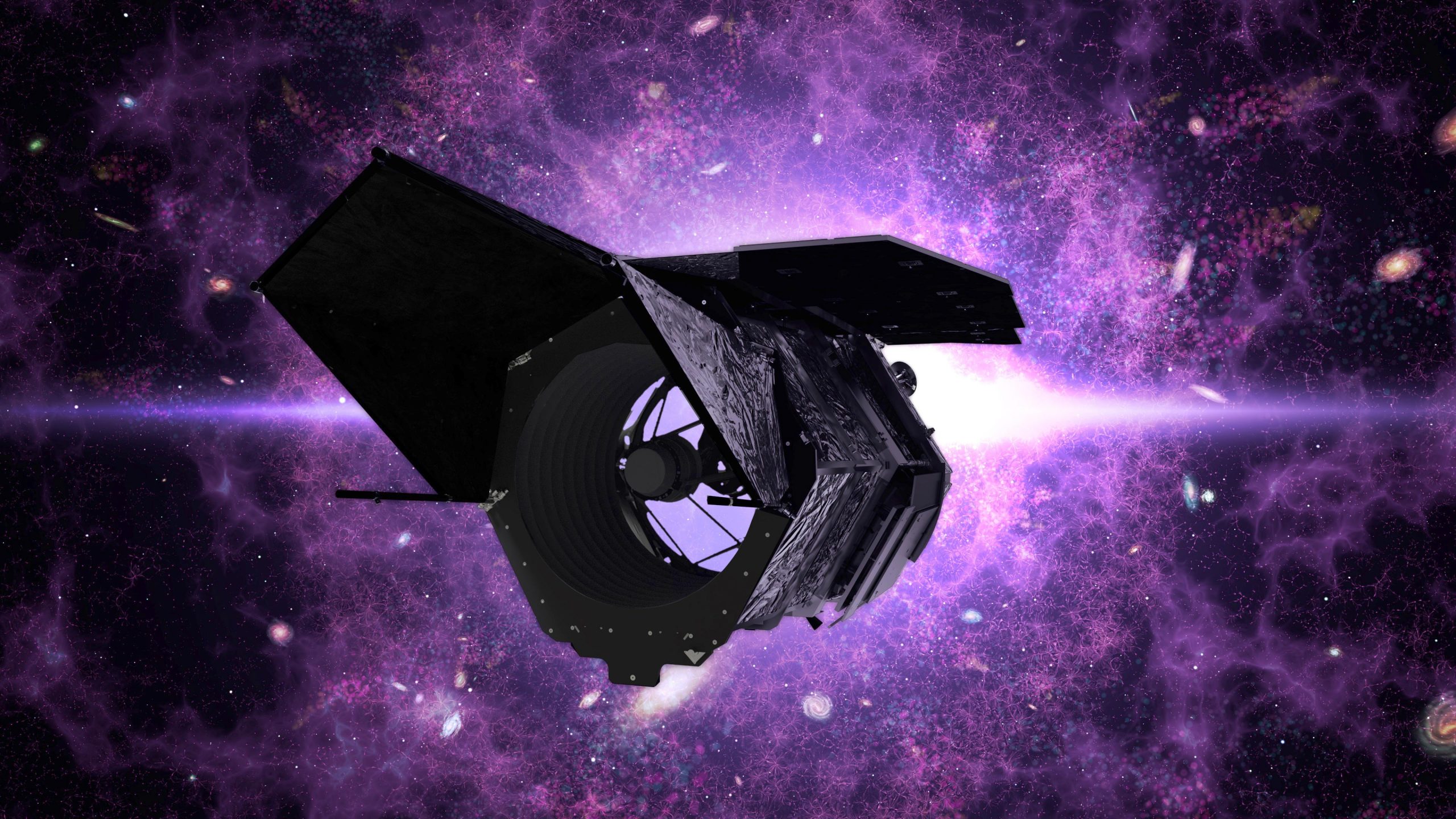
Roman’s sweeping celestial surveys will be able to map the universe up to a thousand times faster than Hubble. That will be possible because of the observatory’s rigid structure, fast slewing speed, and the telescope’s large field of view. Roman will move rapidly from one cosmic target to the next. Once a new target is acquired, vibrations will settle down quickly because potentially wobbly structures like the solar arrays are fixed in place.
“Roman will take around 100,000 pictures every year,” said Jeffrey Kruk, a research astrophysicist at Goddard. “Given Roman’s larger field of view, it would take longer than our lifetimes even for powerful telescopes like Hubble or Webb to cover as much sky.”
By providing a gigantic, crisp view of cosmic ecosystems and teaming up with observatories like Hubble and Webb, Roman will help us solve some of the most profound mysteries in astrophysics.
Reference: “Semi-analytic forecasts for Roman – the beginning of a new era of deep-wide galaxy surveys” by L Y Aaron Yung, Rachel S Somerville, Steven L Finkelstein, Peter Behroozi, Romeel Davé, Henry C Ferguson, Jonathan P Gardner, Gergö Popping, Sangeeta Malhotra, Casey Papovich, James E Rhoads, Micaela B Bagley, Michaela Hirschmann and Anton M Koekemoer, 8 December 202, The Monthly Notices of the Royal Astronomical Society.
DOI: 10.1093/mnras/stac3595
At NASA’s Goddard Space Flight Center, the Nancy Grace Roman Space Telescope is overseen with collaboration from NASA’s Jet Propulsion Laboratory and Caltech/IPAC in Southern California, as well as the Space Telescope Science Institute in Baltimore. A diverse team of scientists from various research institutions form the core of the project’s scientific team. The project is supported by key industrial partners, including Ball Aerospace and Technologies Corporation based in Boulder, Colorado, L3Harris Technologies in Melbourne, Florida, and Teledyne Scientific & Imaging located in Thousand Oaks, California.
Never miss a breakthrough: Join the SciTechDaily newsletter.
Follow us on Google and Google News.
2 Comments
Can you explain. Seems to be a center point in the thirteen billion yr capture. Second picture seems to have a spiral starting. Spewing baby Galaxys out from it’s four points. Thank you.
Don’t u think the lens and photo rays from these telescopes and lens your using changes the contrast of colors as well. Comparing the Hubble to the Webb to the Roman now.