
What Is Gravitational Lensing?
Gravitational lensing occurs when a massive celestial body — such as a galaxy cluster — causes a sufficient curvature of spacetime for the path of light around it to be visibly bent, as if by a lens. The body causing the light to curve is accordingly called a gravitational lens.
According to Einstein’s general theory of relativity, time and space are fused together in a quantity known as spacetime. Within this theory, massive objects cause spacetime to curve, and gravity is simply the curvature of spacetime. As light travels through spacetime, the theory predicts that the path taken by the light will also be curved by an object’s mass. Gravitational lensing is a dramatic and observable example of Einstein’s theory in action. Extremely massive celestial bodies such as galaxy clusters cause spacetime to be significantly curved. In other words, they act as gravitational lenses. When light from a more distant light source passes by a gravitational lens, the path of the light is curved, and a distorted image of the distant object — maybe a ring or halo of light around the gravitational lens — can be observed.
Gravitational lensing occurs when a massive celestial body — such as a galaxy cluster — causes a sufficient curvature of spacetime for the path of light around it to be visibly bent, as if by a lens. The body causing the light to curve is accordingly called a gravitational lens. Credit: ESA/Hubble (M. Kornmesser & L. L. Christensen)
An important consequence of this lensing distortion is magnification, allowing us to observe objects that would otherwise be too far away and too faint to be seen. Hubble makes use of this magnification effect to study objects that would otherwise be beyond the sensitivity of its 2.4-meter-diameter (7.9-foot-diameter) primary mirror, showing us thereby the most distant galaxies humanity has ever encountered.
This Space Sparks Episode explores the concept of gravitational lensing. This effect is only visible in rare cases and only the best telescopes — including the NASA/ESA Hubble Space Telescope — can observe the results of gravitational lensing. The strong gravity of a massive object, such as a cluster of galaxies, warps the surrounding space, and light from distant objects traveling through that warped space is curved away from its straight-line path. This video highlights how Hubble’s sensitivity and high resolution allow it to see details in these faint, distorted images of distant galaxies.
Hubble’s sensitivity and high resolution allow it to see faint and distant gravitational lenses that cannot be detected with ground-based telescopes whose images are blurred by the Earth’s atmosphere. The gravitational lensing results in multiple images of the original galaxy each with a characteristically distorted arc-like shape or even into rings. Hubble was the first telescope to resolve details within these multiple arc-shaped features. Its sharp vision can reveal the shape and internal structure of the lensed background galaxies directly.

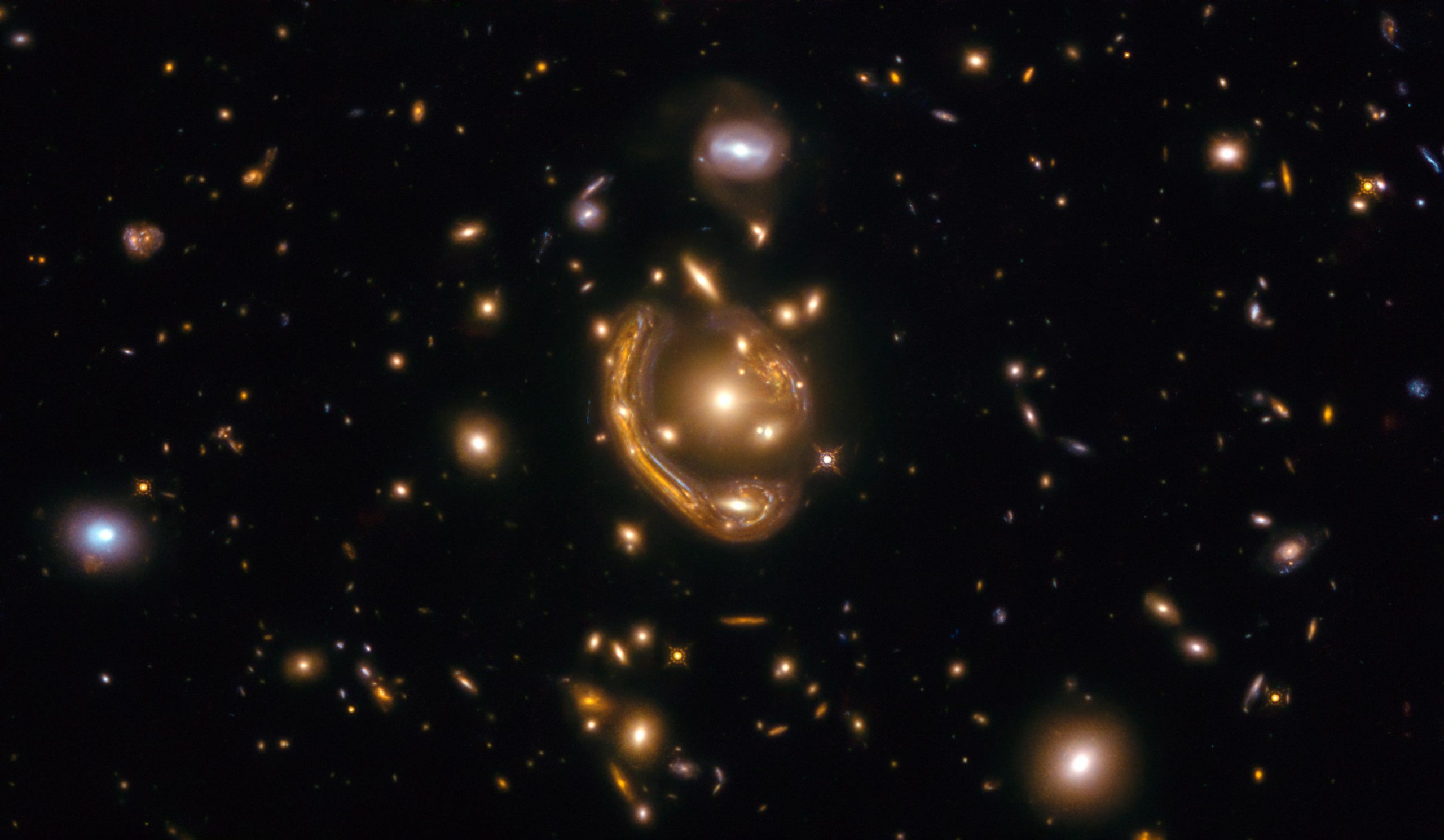
An image released in 2020 as part of the ESA/Hubble Picture of the Week series of the object known as GAL-CLUS-022058s revealed the largest ring-shaped lensed image of a galaxy (known as an Einstein ring) ever discovered, also one of the most complete. The near exact alignment of the background galaxy with the central elliptical galaxy of the cluster warped and magnified the image of the background galaxy into an almost perfect ring.
Learn more about Hubble’s observations of gravitational lensing here.
Never miss a breakthrough: Join the SciTechDaily newsletter.
Follow us on Google and Google News.
1 Comment
It has a name….we have to discover/realize/articulate it