

Scientists investigate the possible chemical pathways by which pentoses could have formed on early Earth.
Pentoses are essential carbohydrates in the metabolism of modern lifeforms, but their availability during early Earth is unclear since these molecules are unstable. A new study led by the Earth-Life Science Institute (ELSI) at Tokyo Institute of Technology, Japan, reveals a chemical pathway compatible with early Earth conditions and by which C6 aldonates could have acted as a source of pentoses without the need for enzymes. Their findings provide clues about primitive biochemistry and bring us closer to understanding the Origins of Life.

Early Earth’s Biochemical Challenges
The emergence of life on Earth from simple chemicals is one of the most exciting yet challenging topics in biochemistry and perhaps all of science. Modern lifeforms can transform nutrients into all sorts of compounds through complex chemical networks; what’s more, they can catalyze very specific transformations using enzymes, achieving a very fine control over what molecules are produced. However, enzymes did not exist before life emerged and became more sophisticated. Thus, it is likely that various nonenzymatic chemical networks existed at an earlier point in Earth’s history, which could convert environmental nutrients into compounds that supported primitive cell-like functions.
Pentoses: Building Blocks of Early Life
The synthesis of pentoses is a prominent example of the above scenario. These simple sugars, containing only five carbon atoms, are the fundamental building blocks of RNA and other molecules that are essential to life as we know it. Scientists have proposed and studied various ways pentoses could have been generated prior to the origin of life, but current theories beg the question: how could pentoses ever accumulate in quantities enough to partake in pre-life reactions if these compounds are extremely short-lived?
To tackle this question, a research team led by Research Scientist Ruiqin Yi from ELSI recently conducted a study to find an alternative explanation for the origin and sustained supply of pentoses on early Earth. They explored an enzyme-free chemical network in which C6 aldonates, which are stable six-carbon carbohydrates, accumulate from various prebiotic sugar sources and then convert back to pentoses.
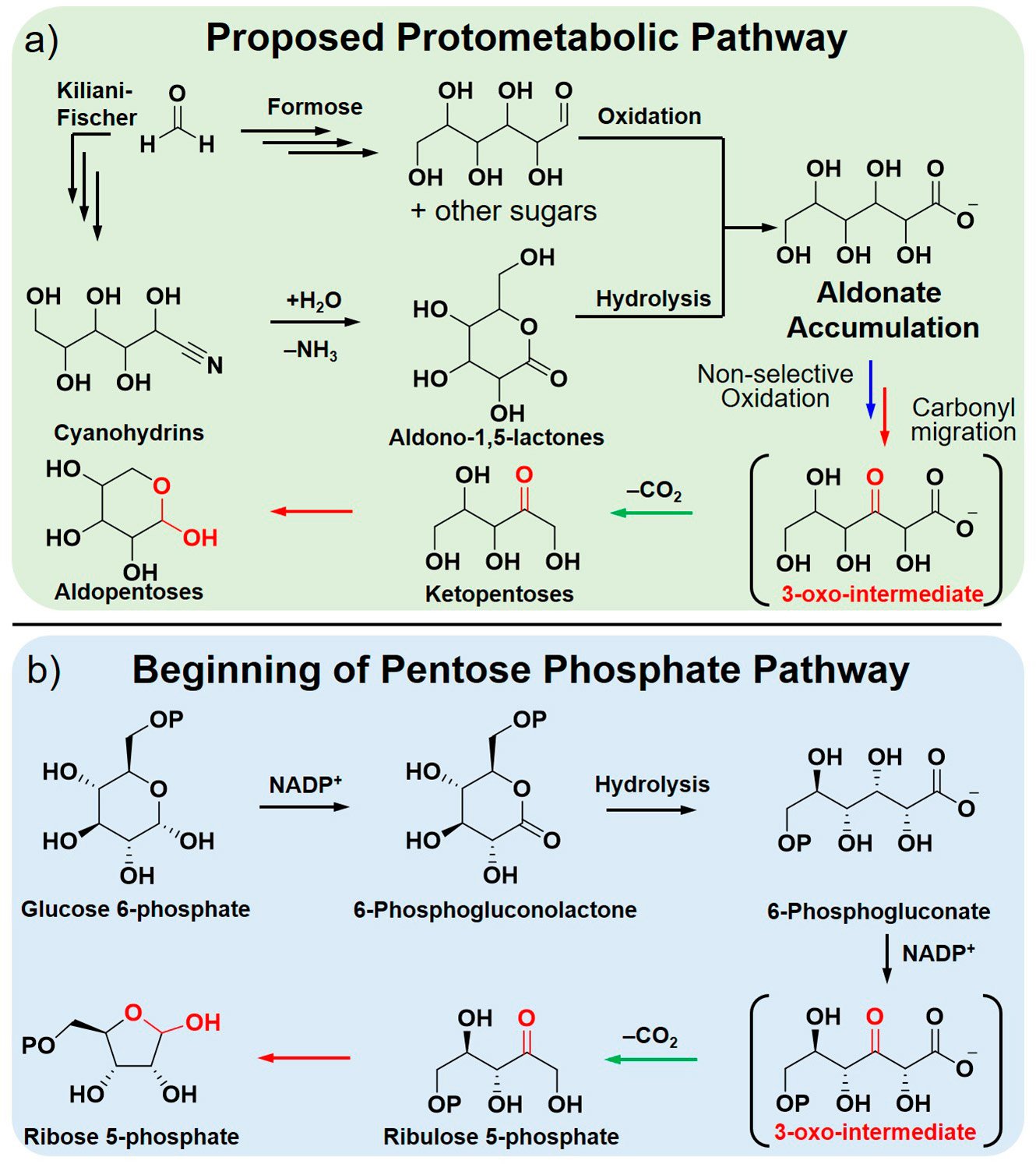
A Novel Pathway for Pentose Synthesis
The proposed chemical pathway begins with gluconate, a stable C6 aldonate that may have been readily available on early Earth through known prebiotic transformations of basic sugars. The next step is the nonselective oxidation of C6 aldonate into uronate; here, the term ‘nonselective’ means that the oxidation process does not discriminate between the various carbon atoms in the aldonate structure, leaving five possible oxidation outcomes.
Through experiments and theoretical analyses, the researchers delved deep into the various oxidation products to figure out the details of the reaction network. Interestingly, they found that no matter where the oxidation takes place, the resulting uronate compounds can always undergo an intramolecular transformation known as ‘carbonyl migration’ until the specific compound 3-oxo-uronate is formed. Once this state is reached, 3-oxo-uronate gets easily transformed into pentose through β-decarboxylation in the presence of H2O2 and a ferrous catalyst, both of which are compatible with the conditions of early Earth.
Linking Prebiotic and Modern Biochemistry
After establishing and testing the entirety of this complex reaction network, the researchers noticed an important resemblance with a modern biochemical pathway. “We demonstrated a nonenzymatic synthetic pathway for five-carbon sugars that relies on chemical transformations reminiscent of the first steps of the pentose phosphate pathway, a core pathway of metabolism,” highlights the lead author Ruiqin Yi. “These results prove that prebiotic sugar synthesis may have overlaps with extant biochemical pathways.” Given that sugars are ubiquitous in modern metabolism, the proposed reaction network could have been important for the emergence of the first life-like systems.
Astrobiological Implications and Future Research
The findings of this study are important in the context of astrochemistry and astrobiology. Aldonates were found abundantly in the Murchison meteorite, a famous carbonaceous meteorite that fell to Earth in 1969. In contrast, the canonical carbohydrates found in modern biological systems were absent in it. This implies that aldonates can form and accumulate in extraterrestrial conditions, and the present study suggests that they could play an important role in the origin of the building blocks of life. “We hope this work will shape the next wave of astrobiology to focus on aldonate studies,” adds Yi.
In future studies, the research team will focus on whether C6 aldonates could have accumulated enough in early Earth to act as ‘nutrients’ for the emergence of proto-metabolism.
Lead researcher Ruiqin Yi concludes: “We want to understand more how these aldonates can be generated from classic prebiotic sugar reactions, such as the formose reaction and Kiliani–Fischer homologation.” Notably, these classic prebiotic sugar reactions are not found in modern metabolism, and thus, the proposed nonenzymatic pathway could act as a much-needed bridge between early sugars and the carbohydrates theoretically used by the first lifeforms.
Reference: “Carbonyl Migration in Uronates Affords a Potential Prebiotic Pathway for Pentose Production” by Ruiqin Yi, Mike Mojica, Albert C. Fahrenbach, H. James Cleaves, II, Ramanarayanan Krishnamurthy and Charles L. Liotta, 7 September 2023, JACS Au.
DOI: 10.1021/jacsau.3c00299
Never miss a breakthrough: Join the SciTechDaily newsletter.
Follow us on Google and Google News.